


The Taipei Zoo on Wednesday and Thursday performed two artificial inseminations of its female giant panda, which is in its high fertility season, in the hopes of conceiving a new cub for its panda family.
Zookeepers on Feb. 9 started noticing signs of impending estrus and ovulation in the panda, known as Yuan Yuan (圓圓), including vulvar swelling, scent-marking behaviors, playing in the water and restlessness, the zoo said in a news release on Friday.
As the chance of ovulation would be highest when Yuan Yuan’s hormone levels peaked on Thursday, the zoo performed artificial inseminations on Wednesday and Thursday with semen collected from Tuan Tuan (團團), its male giant panda, the zoo said.
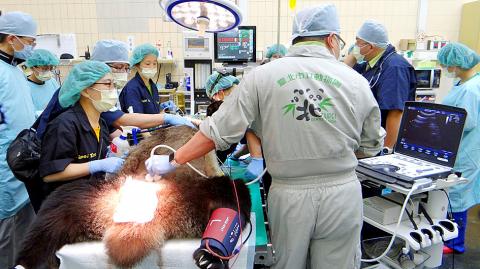
Photo provided by Taipei Zoo
During previous panda mating seasons, Chinese experts from the China Conservation and Research Center for the Giant Panda visited the zoo, but they could not travel to Taiwan this year due to an outbreak of COVID-19 in China, it said.
A team set up a videoconference with the center and researcher Wang Chengdong (王承東) providing advice on breeding, it added.
On Wednesday afternoon, the team inseminated Yuan Yuan with part of the semen collected hours earlier from Tuan Tuan, the zoo said, adding that a sample had a sperm count of approximately 400 million, with 96 percent sperm motility.
On Thursday morning, the team inserted the remaining semen, which had a sperm count of about 450 million and sperm motility of 93 percent, it said.
In the afternoon, the zoo placed the pandas together, hoping to increase the odds of fertilization through natural mating, but with no results, as they either lost interest in mating or simply did not know how, it added.
Besides the tasks related to artificial insemination, the two pandas also received annual dental and abdominal check-ups, the zoo said.
Tuan Tuan and Yuan Yuan were gifted by China to Taiwan in 2008. Their only cub, Yuan Zai (圓仔), was born in 2013 at the zoo following artificial insemination.

NATIONAL SECURITY: Authorities are working to confirm the identities of the military personnel involved and investigating possible illegal conduct and regulatory violations Authorities are probing possible national security implications after Kinmen police and immigration officers on Sunday found a Chinese woman allegedly posing as a tourist while engaging in prostitution involving more than 10 military personnel. The woman, surnamed Chen (陳), has since been deported, authorities said, adding that investigators are still working to confirm the identities of those implicated, as the records only listed code names and aliases. The case stemmed from a report received by the Kinmen District Prosecutors’ Office on Friday last week from the Jinhu Precinct of the Kinmen County Police Bureau. On Sunday, police, along with the National Immigration

GLOBALGIVING: ‘ Caving to external pressure is not acceptable for an organization that has cultivated justice reform and human rights for 30 years,’ one NGO said A slew of non-government organizations (NGOs) have withdrawn from the GlobalGiving fundraising platform after it announced it would use “Chinese Taipei” instead of “Taiwan” from next month. The Taiwan Good Rice Association wrote on Facebook on Friday that it was informed on April 28 via a teleconference call of the change, which was made because the platform wanted to operate in China. Taiwan Good Rice is to terminate all cooperative relationships with GlobalGiving in response to the platform’s “unilateral and non-negotiable” decision to remove references to Taiwan, the NGO said. “Taiwan is in the official name of Taiwan Good Rice Association and the

HEAVY WEATHER: Typhoon Jangmi is due to crash straight into the Ryukyus as airlines look to shift flights to larger aircraft or cancel flights to Okinawa entirely Taiwan’s international air carriers announced flight adjustments over the weekend as Typhoon Jangmi is forecast to hit the Ryukyu Islands today and tomorrow. The Central Weather Administration (CWA) upgraded Jangmi from a tropical storm to a typhoon at 8am yesterday, with the eye located 580km south of Naha city. It was moving north at 19kph. Today, China Airlines’ CI-120, CI-121, CI-122 and CI-123 flights between Taoyuan and Naha, Okinawa, have been canceled as well as CI-132 and CI-133 between Kaohsiung and Naha. EVA Air’s BR-112, BR-113, BR-186 and BR-185 flights between Taoyuan and Naha are also canceled. Low-cost carrier Tigerair Taiwan canceled IT-230,
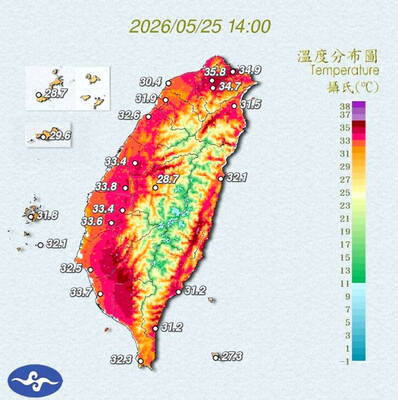
STAY COOL: The HPA recommended that people stay hydrated, use air-conditioning or fans while indoors, wear loose-fitting clothes and walk in the shade while outdoors Employers must implement measures such as installing cooling equipment, and providing drinking water and rest breaks for outdoor workers starting from Monday next week, the Taipei Department of Labor said on Sunday. Employers who fail to comply could face fines of NT$30,000 to NT$300,000 under the Occupational Safety and Health Act (職業安全衛生法), the department said. Businesses in Taipei employing fewer than 100 workers, as well as registered self-employed workers with labor insurance coverage, could receive on-site assessments and guidance from occupational safety consultants to help them apply for central government subsidies to implement or improve heat-protection measures, it said. Under the Ministry of


 RSS
RSS