


Proposed amendments to the Spatial Planning Act (國土計畫法) might cause more environmental injustice under the pretext of “major construction projects,” environmentalists and lawmakers said yesterday, urging the Cabinet to withdraw the “retrogressive” bill.
The act, passed by the legislature in 2015, was hailed as a milestone in environmental protection for classifying land rezoning into national reserve areas, marine resource areas, agriculture development areas and urban development areas.
It is expected to take effect in 2022 when central and local government regulations are completed.
However, the Cabinet on Thursday last week proposed amendments that have unnerved many environmentalists.
National spatial plans could be revised if the Cabinet approves major construction projects, one of the amendments says.
While local governments were to be required to announce regional spatial plans within two years of the central government implementing a national spatial plan, another amendment seeks to replace the two-year time frame with “a certain period.”
Under the pretext of so-called major construction projects, the government has pushed through many projects that have proved useless, are not conducive to furthering the public interest and have caused residents much pain, Democratic Progressive Party (DPP) Legislator Lin Shu-fen (林淑芬) told a news conference in Taipei arranged by Citizens of the Earth, Taiwan, citing as an example land expropriation in Dapu Borough (大埔) in Miaoli County’s Jhunan Township (竹南) to accommodate an expansion of the Hsinchu Science Park.
The county government forcibly expropriated private properties for the expansion. Two suicides in the borough in 2010 and 2013 were linked to the expropriations.
A technology park in Hualien County’s Fonglin Township (鳳林) built more than a decade ago has become a “mosquito house,” showing that many so-called major construction projects lack careful evaluation, Lin said.
Many local governments might have difficulty introducing regional spatial plans within two years, but that does not mean they should be given an indefinite period, she said.
The act aimed to promote more sustainable use of land and efforts to promote the legislation could be traced back more than 20 years, former Chinese Nationalist Party (KMT) legislator Chiau Wen-yan (邱文彥) said.
However, the amendments would allow political considerations to override environmental protection concerns, he said.
DPP Legislator Hung Shen-han (洪申翰), New Power Party Legislator Chen Jiau-hua (陳椒華) and Taiwan People’s Party Legislator Tsai Pi-ju (蔡壁如) also urged the Cabinet to review the amendments.
The act is too rigid, imposing a time limit and lacking flexibility, and it would be a disaster if it is not amended, Minister Without Portfolio Chang Ching-sen (張景森) wrote on Facebook on Monday after the proposed amendments sparked criticism.
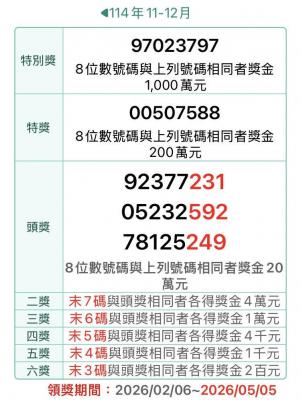
Seven of the 17 NT$10 million (US$311,604) winning receipts from the November-December uniform invoice lottery remain unclaimed as of today, the Ministry of Finance said, urging winners to redeem their prizes by May 5. The reminder comes ahead of the release of the winning numbers for the January-February lottery tomorrow. Among the unclaimed receipts was one for a NT$173 phone bill in Keelung, while others were for a NT$5,913 purchase at Costco in Taipei's Neihu District (內湖), a NT$49 purchase at a FamilyMart in New Taipei City's Tamsui District (淡水), and a NT$500 purchase at a tea shop in New Taipei City's

Taiwanese officials were shown the first of 66 F-16V fighter jets purchased by Taiwan from the United States, the Ministry of National Defense said yesterday, adding the aircraft has completed an initial flight test and is expected to be delivered later this year. A delegation led by Deputy Minister of National Defense Hsu Szu-chien (徐斯儉) visited Lockheed Martin’s F-16 C/D Block 70 (also known as F-16V) assembly line in South Carolina on March 16 to view the aircraft. The jet will undergo a final acceptance flight in the US before being delivered to Taiwan, the
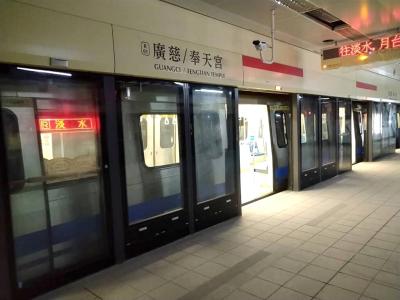
The New Taipei Metro's Sanyin Line and the eastern extension of the Taipei Metro's Tamsui-Xinyi Line (Red Line) are scheduled to begin operations in June, the National Development Council said today. The Red Line, which terminates at Xiangshan Station, would be connected by the 1.4km extension to a new eastern terminal, Guangci/Fengtian Temple Station, while the Sanyin Line would link New Taipei City's Tucheng and Yingge stations via Sanxia District (三峽). The council gave the updates at a council meeting reviewing progress on public construction projects for this year. Taiwan's annual public infrastructure budget would remain at NT$800 billion (US$25.08 billion), with NT$97.3
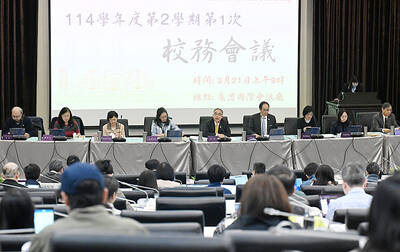
TALENT SCOUTING: The university is investing substantial funds in its future to bring in the kind of researchers that would keep the college internationally competitive National Taiwan University (NTU) plans to invest NT$2 billion (US$62.6 million) to launch two programs aimed at attracting and retaining top research talent, university president Chen Wen-chang (陳文章) said yesterday. The funding would support the “Palm Grove Scholars Project,” which targets academics aged 40 to 55. Up to 20 scholars would be selected, each receiving as much as NT$10 million annually, Chen said. The initiative is designed to attract leading researchers to Taiwan and strengthen NTU’s global competitiveness by fostering a more research-friendly environment and expanding international collaboration, he said. NTU is also introducing a “Hong Hu” chair grant, which would provide Palm


 RSS
RSS