


The post-holiday start date for schools from senior high and below has been pushed back two weeks to Feb. 25 due to the global spread of the 2019 novel coronavirus (2019-nCoV), the Central Epidemic Command Center (CECC) announced yesterday.
While the outbreak of the virus in China is still serious, Taiwan has not seen a local outbreak, but the center is concerned about the risk of cluster infections once students return to school, said the center’s head, Minister of Health and Welfare Chen Shih-chung (陳時中).
“The command center’s specialist meeting suggested pushing back the start of classes to reduce the risk of clustered infections,” he said.
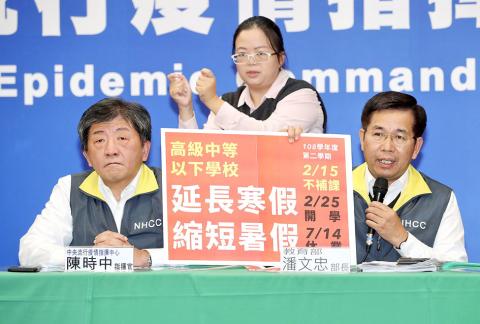
Photo: CNA
Extending the winter break means the first day of the new semester for levels for all schools at the senior high level and below has been pushed back from Feb. 11 to Feb. 25, Minister of Education Pan Wen-chung (潘文忠) said.
Students’ education would not suffer and the number of school days would not be cut, but the summer break would be pushed back from July 1 to July 15, Pan said.
“The dates remain the same for the Comprehensive Assessment Program for Junior High School Students exams, the Entrance Examination for Technological and Vocational Education, and the College Entrance Examination,” Pan said.
However, the examination paper-setting will be adjusted according to the postponed school schedule, so that examinees’ rights would not be affected by the policy, he added.
A new semester schedule for universities is to be discussed today at a meeting with university officials and would be announced after the meeting, Pan said.
Minister of Labor Hsu Ming-chun (許銘春) said that the rights of working parents with young children should not be harmed by the extended winter break.
A parent of a child under 12 years old can ask their employer for “disease prevention childcare leave” during the two weeks, Hsu said.
“As it is a special policy, the employers are required to approve the child-care leave request, and they cannot deem an employee absent from work or make them take personal or other types of leave, nor can they dismiss or punish the employee or deprive them of a perfect attendance record,” she said.
However, a company can decide whether the employee who takes such leave should receive their salary during the leave, she said.
The Ministry of Labor understands that the policy might cause human resource difficulties, but it hopes employers can help as the nation faces this difficult time.
As for the spread of the virus in Taiwan, the CECC said 89 new cases of severe pneumonia with novel pathogens were reported on Saturday, bringing the nationwide total to 1,007 cases, including 10 confirmed cases of 2019-nCoV infection, but 829 people have been ruled out, and the rest are under quarantine.
No new confirmed case of 2019-nCoV was reported on Saturday, and the 10 patients with confirmed cases are in stable condition and still receiving treatment, with just one having a fever and one requiring oxygen.
One of the 2019-nCoV patients being treated has since tested negative for the virus twice, but they would not be discharged from the hospital until their condition has been assessed by specialists and another test comes back negative, the CECC said.
WENZHOU ALERT
At 8pm last night, the CECC announced that Wenzhou, in China’s Zhejiang Province, has been listed as a secondary epidemic area.
As of today, Taiwanese and foreign residents who have visited Wenzhou in the past 14 days would be put under a 14-day home quarantine after returning to Taiwan, while residents of Wenzhou are banned from visiting Taiwan, Centers for Disease Control Director-General Chou Jih-haw (周志浩) said.

UPGRADE: The Kang Ding-class frigate is replacing its Chaparall missiles with Tien Chien II and Hua Yang VLS, which would provide it with long-range, 360° air defense Taiwan plans to produce 1,200 to 1,376 Hai Chien II missiles (海劍二, Sea Sword II) — also known as TC-2N — to serve as the standard air defense system of the navy’s surface combatant fleet, a source said yesterday. Last week, the Hai Chien II, the naval version of the Tien Kung II missile (天劍二, Sky Sword II), completed a live-fire test in waters off the National Chungshan Institute of Science and Technology’s Jiupeng facility (九鵬) in Pingtung County’s Manjhou Township (滿州). The MIM72 Chaparral and other dated air defense missiles that currently arm Taiwanese ships have inadequate range to combat Chinese

REASONS FOR TRAVEL: An assistant professor said that proposed amendments to penalize drivers if they used drugs overseas would not deter people from traveling People who operate a motor vehicle under the influence of marijuana would have their driver’s license revoked, even if they used the substance while overseas, the Ministry of Transportation and Communications said yesterday, citing proposed amendments to the Road Traffic Management and Penalty Act (道路交通管理處罰條例). The amendments would also authorize the government to revoke the licenses of people determined to have used Category 1 or Category 2 narcotics, even if they were not operating a vehicle while under the influence of drugs, as well as ban them from taking the license test for three years, the ministry said. People aged 18 or

HEAVY WEATHER: Typhoon Jangmi is due to crash straight into the Ryukyus as airlines look to shift flights to larger aircraft or cancel flights to Okinawa entirely Taiwan’s international air carriers announced flight adjustments over the weekend as Typhoon Jangmi is forecast to hit the Ryukyu Islands today and tomorrow. The Central Weather Administration (CWA) upgraded Jangmi from a tropical storm to a typhoon at 8am yesterday, with the eye located 580km south of Naha city. It was moving north at 19kph. Today, China Airlines’ CI-120, CI-121, CI-122 and CI-123 flights between Taoyuan and Naha, Okinawa, have been canceled as well as CI-132 and CI-133 between Kaohsiung and Naha. EVA Air’s BR-112, BR-113, BR-186 and BR-185 flights between Taoyuan and Naha are also canceled. Low-cost carrier Tigerair Taiwan canceled IT-230,

Johanne Liou (劉喬安), a Taiwanese woman who shot to unwanted fame during the Sunflower movement protests in 2014, returned to Taiwan last night after being deported from the US. She is to stand trial in Taiwan for charges involving embezzlement, fraud and drug crimes. The Criminal Investigation Bureau (CIB) said it took her into custody at Taiwan Taoyuan International Airport and would first question her before transferring her to the New Taipei District Prosecutors’ Office. She was arrested upon disembarking a flight from San Francisco that landed shortly before 7pm. Liou absconded to the US in 2019 after jumping bail


 RSS
RSS