


Becoming a full professor might signal the start of an easier work life for some academics, but for National Tsing Hua University (NTHU) physicist Lin Hsiu-Hau (林秀豪) it means embarking on a new research trajectory — neuroscience.
After receiving his doctorate in physics at the University of California, Santa Barbara, Lin obtained an academic position at NTHU at 30 and was promoted to full professor at 38 — faster than most academics.
Specializing in statistical physics and spintronics, Lin, now 50, has published nearly 80 research papers, including several that have been cited more than 100 times and one that has been cited more than 350 times.
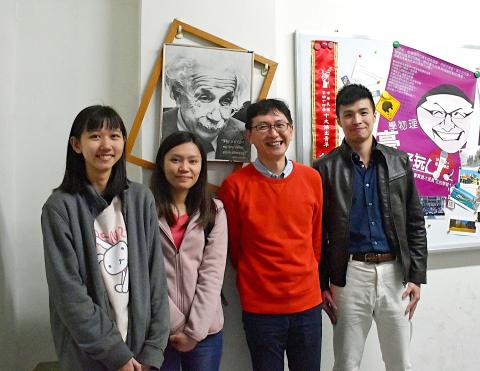
Photo: Lin Chia-nan, Taipei Times
Well-known for his unconventional way of teaching general physics, he years ago decided that instead of using colossal textbooks for first-year students, he would focus on 10 classic questions each semester and use handwritten materials to teach the course.
Despite initial objections from other lecturers, Lin’s energetic teaching won him the admiration of his students, some of whom even made him a book — a collection of his random yet acute remarks that push students to reflect on learning and life.
His two courses, thermal and statistical physics and general physics, in 2013 and 2014 received the Outstanding Course Award for OpenCourseware Excellence from the US-based Open Education Consortium, which selects only five courses from around the world each year.
Some companies have also invited him to design digital learning courses for their employees.
His drive to trigger meaningful change has manifested in his research, as he began to review his career around 2009, after he was promoted to full professor in 2007, Lin said, speaking to the Taipei Times at NTHU earlier this month.
“I found studying physics was no longer the thing I wanted to do the most,” he said, adding that he could find no more interesting physics questions to explore.
Before that critical juncture, he had never doubted his passion for physics, as he had aspired to be a physicist since he was a second-year junior-high school student, he said.
“That can be called a midlife crisis; when your life has achieved certain balance and you expect no more surprising changes before retirement at 65,” he said.
After thorough reasoning, Lin turned to neuroscience, as he was curious to learn about how humans tell lies, he said.
He spent two months making the change in career, but it took him nearly six years to publish papers in the field, he said.
During that period, he worked with material scientists to publish papers and “cover up” his publication gap, he said, adding that being an unproductive professor can invite attacks from other academics.
Some academics might dream about switching to other disciplines, but only a few really do, and even fewer succeed in publishing something significant, Lin said.
“I like adventures, but I am not an idiot,” he added.
Lin said he managed to use quantum theory while studying biochemical receptors in human bodies, and might be the first person to propose a complete theory related to that, although the idea was first broached by late UK physicist Marshall Stoneham.
Lin joined academic conferences and introduced his novel concepts on posters, facing harsh challenges from other established experts as if he were a student, he said.
“An Israeli professor even asked me why I want to ruin my professional reputation this way,” he said.
Trained as a theoretical physicist who values problem-solving, Lin is straightforward with his students.
When his former graduate student Huang Ching-I (黃瀞儀) said she hoped to pursue a doctorate in physics, Lin told her that given her limited grasp of physics, her goal would be extremely challenging for her and her advisor.
Nonetheless, he asked Huang if she would be interested in studying evolutionary biology with him, and they used field theory to study infectious diseases, he said.
In 2015, Lin and Huang published a paper proposing an algorithm for spatial evolutionary game theory at the IEEE Congress on Evolutionary Computation.
After completing her postdoctoral research at Columbia University in New York, Huang is now working on epidemic prevention at a UK-based foundation funded by Microsoft cofounder Bill Gates, he said.
Lin spent most of his time speaking to the Taipei Times explaining the projects he was working on with the students in his research group, and the word he used most often was “exciting.”
Last month, his team found a new network for artificial intelligence that they call the “U(1) neuronal network,” a subject mainly worked on by master’s student Lin Chia-Ying (林佳瑩) and senior student Chen Ping-Han (陳品翰), he said.
The information processing of existing artificial neural networks is black and white, with input and output variables confined to 0 and 1, while the team’s new algorithm makes the networks “colorful” in the sense that the input/output variables can extend into a color palette of hues, which might shed new light on machine learning and human brain working, he said.
Senior student Sam Mei Ian (岑美茵) is applying quantum theory to study how drugs are received by biochemical receptors and become effective, even though undergraduates in Taiwan are not required to produce a thesis, he said.
His research assistant Lin Yu-Hsuan (林宇軒), a bachelor in physics, last year used theoretical analysis to advance a magnetic random access memory (MRAM) finding that he and other material scientists had published in the journal Nature Materials earlier in the year, Lin Hsiu-Hau said, describing what his student has achieved as a world-first breakthrough.
To make the MRAM breakthrough known to peer researchers without having to wait for a time-consuming journal publication, they immediately published their findings on arXiv.org, an online preprint platform managed by Cornell University, he said.
An interdisciplinary approach brings exciting breakthroughs, but one has to secure a footing in one area before crossing over to others, Lin Hsiu-Hau said.
Next year, Lin Hsiu-Hau said he plans to take a year off from teaching for the first time, as all professors who have worked for seven years are allowed to, he said.
“I want to speed up to make more research breakthroughs,” he said.
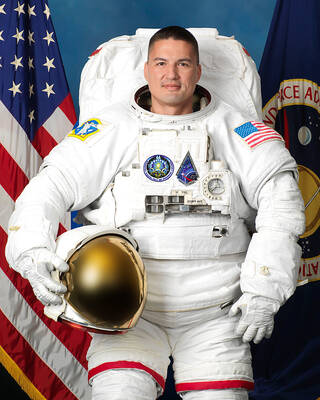
SPACE VETERAN: Kjell N. Lindgren, who helps lead NASA’s human spaceflight missions, has been on two expeditions on the ISS and has spent 311 days in space Taiwan-born US astronaut Kjell N. Lindgren is to visit Taiwan to promote technological partnerships through one of the programs organized by the US for its 250th national anniversary. Lindgren would be in Taiwan from Tuesday to Saturday next week as part of the US Bureau of Educational and Cultural Affairs’ US Speaker Program, organized to celebrate the 250th anniversary of the signing of the Declaration of Independence, the American Institute in Taiwan (AIT) said in a statement yesterday. Lindgren plans to engage with key leaders across the nation “to advance cutting-edge technological partnerships and inspire the next generation of scientists and engineers,”

The Chinese Nationalist Party (KMT) caucus yesterday said it opposes the introduction of migrant workers from India until a mechanism is in place to prevent workers from absconding. Minister of Labor Hung Sun-han (洪申翰) on Thursday told the Legislative Yuan that the first group of migrant workers from India could be introduced as early as this year, as part of a government program. The caucus’ opposition to the policy is based on the assessment that “the risk is too high,” KMT caucus secretary-general Lin Pei-hsiang (林沛祥) said. Taiwan has a serious and long-standing problem of migrant workers absconding from their contracts, indicating that

UNREASONABLE SURVEILLANCE: A camera targeted on an road by a neighbor captured a man’s habitual unsignaled turn into home, netting him dozens of tickets The Taichung High Administrative Court has canceled all 45 tickets given to a man for failing to use a turn signal while driving, as it considered long-term surveillance of his privacy more problematic than the traffic violations. The man, surnamed Tseng (曾), lives in Changhua County and was reported 45 times within a month for failing to signal while driving when he turned into the alley where his residence is. The reports were filed by his neighbor, who set up security cameras that constantly monitored not only the alley but also the door and yard of Tseng’s house. The surveillance occurred from July

TRADE-OFF: Beijing seeks to trade a bowl of tempura for a Chinese delicacy, an official said, while another said its promises were attempts to interfere in the polls The government must carefully consider the national security implications of building a bridge connecting Kinmen County and Xiamen, China, the Public Construction Commission (PCC) said yesterday. PCC Commissioner Derek Chen (陳金德), who is also a minister without portfolio, made the remarks in a meeting of the legislature’s Transportation Committee, after Democratic Progressive Party Legislator Hsu Fu-kuei (徐富癸) asked about China’s proposal of new infrastructure projects to further connect Kinmen and Lienchiang (Matsu) counties with Xiamen. China unveiled the bridge plan, along with nine other policies for Taiwan, on Sunday, the last day of Chinese Nationalist Party (KMT) Chairwoman Cheng Li-wun’s (鄭麗文) visit


 RSS
RSS