


The Forestry Bureau’s new “Forest of Wood” calendar is following the success of 2018’s “Forest of Food” edition that featured edible plants, with more than 20,000 copies of this year’s calendar sold.
January’s page in this year’s calendar features Taiwanese wooden folk toys, because the bureau wants to raise awareness of ecological conservation among young people in urban areas with the calendars, Director-General Lin Hwa-ching (林華慶) said.
“A calendar is a good way to open a dialogue with the public. Before we can convince people how important it is to conserve forested areas and win their support, we must let them know that the bureau exists,” he said.
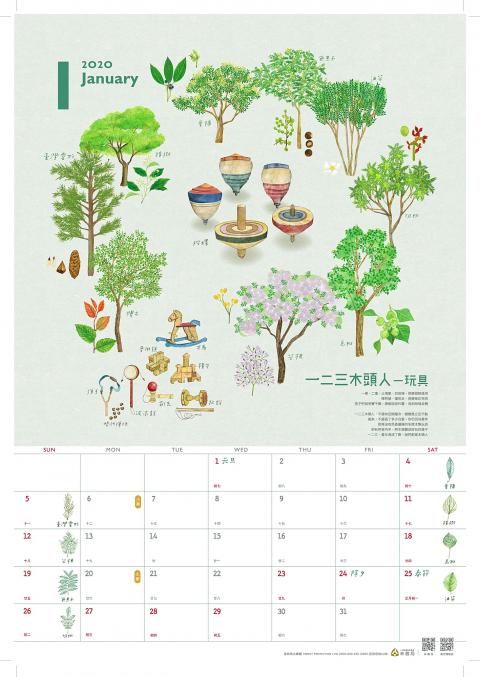
Photo courtesy of the Forestry Bureau
Most people know very little about the bureau, but it is the central government body that promotes ecological conservation, managing nearly half of the total land in the nation, including 1.62 million hectares of government-owned forests and protected forests, he said.
The bureau issued many publications and hosted speeches and seminars, but never managed to reach a wider audience than those who were already interested in forestry, so he decided to use a different approach when he took office in 2016, Lin said.
Drawing on his experience at the Ministry of Culture, he replaced photographs in the annual calendar with hand-drawn illustrations, because he thought young people would like the more lively style, he said.
That is how the “Forest of Food” was created, and it won rave reviews after its launch, with many people sharing pictures of the calendar on social media, he said.
Using the momentum generated by the success of the calendar, the bureau in 2018 collaborated with the Taiwan Railways Administration on the “Satoyama Animal Train” to highlight coexistence between humans and “satoyama animals,” Lin said.
“Satoyama” is the Japanese term for the region between mountains and flatlands inhabited by cicadas, moths, dragonflies, mitten crabs, frogs and snails as well as humans, he said.
Artists’ impression of satoyama animals painted on the train cars became very popular on the Internet, and helped promote ecological conservation, Lin said.
Satoyama areas are highly developed, highlighting the importance of ecological conservation, but traditional promotion approaches such as lectures just bored people, he said.
Just as trains come and go, wild animals and other creatures should be able to move about freely and live comfortably, just as humans do, he said.
The bureau’s calendar last year featured satoyama animals, and two printings quickly sold out.
“We are determined not to lecture the public, but to use aesthetic designs to arouse people’s interest from within,” Lin said.

SHIPS, TRAINS AND AUTOMOBILES: The ministry has announced changes to varied transportation industries taking effect soon, with a number of effects for passengers Beginning next month, the post office is canceling signature upon delivery and written inquiry services for international registered small packets in accordance with the new policy of the Universal Postal Union, the Ministry of Transportation and Communications said yesterday. The new policy does not apply to packets that are to be delivered to China, the ministry said. Senders of international registered small packets would receive a NT$10 rebate on postage if the packets are sent from Jan. 1 to March 31, it added. The ministry said that three other policies are also scheduled to take effect next month. International cruise ship operators

NUMBERS IMBALANCE: More than 4 million Taiwanese have visited China this year, while only about half a million Chinese have visited here Beijing has yet to respond to Taiwan’s requests for negotiation over matters related to the recovery of cross-strait tourism, the Tourism Administration said yesterday. Taiwan’s tourism authority issued the statement after Chinese-language daily the China Times reported yesterday that the government’s policy of banning group tours to China does not stop Taiwanese from visiting the country. As of October, more than 4.2 million had traveled to China this year, exceeding last year. Beijing estimated the number of Taiwanese tourists in China could reach 4.5 million this year. By contrast, only 500,000 Chinese tourists are expected in Taiwan, the report said. The report

HORROR STORIES: One victim recounted not realizing they had been stabbed and seeing people bleeding, while another recalled breaking down in tears after fleeing A man on Friday died after he tried to fight the knife-wielding suspect who went on a stabbing spree near two of Taipei’s busiest metro stations, Taipei Mayor Chiang Wan-an (蔣萬安) said. The 57-year-old man, identified by his family name, Yu (余), encountered the suspect at Exit M7 of Taipei Main Station and immediately tried to stop him, but was fatally wounded and later died, Chiang said, calling the incident “heartbreaking.” Yu’s family would receive at least NT$5 million (US$158,584) in compensation through the Taipei Rapid Transit Corp’s (TRTC) insurance coverage, he said after convening an emergency security response meeting yesterday morning. National
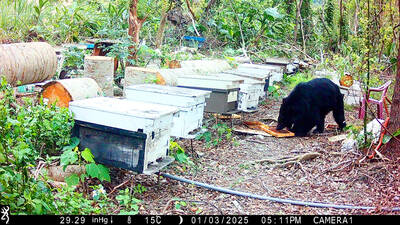
The Forestry and Nature Conservation Agency yesterday launched a gift box to market honey “certified by a Formosan black bear” in appreciation of a beekeeper’s amicable interaction with a honey-thieving bear. Beekeeper Chih Ming-chen (池明鎮) in January inspected his bee farm in Hualien County’s Jhuosi Township (卓溪) and found that more than 20 beehives had been destroyed and many hives were eaten, with bear droppings and paw prints near the destroyed hives, the agency said. Chih returned to the farm to move the remaining beehives away that evening when he encountered a Formosan black bear only 20m away, the agency said. The bear


 RSS
RSS