


Far Eastern Air Transport (FAT) employees yesterday petitioned the Ministry of Transportation and Communications to give the airline a second opportunity and assist it in resuming flight services.
Led by FAT deputy manager Lu Chi-rong (盧紀融), about a dozen employees turned in a written petition with 580 staff signatures to the ministry and the Executive Yuan.
“The company has found a quality investor. Employees would get their salaries so long as the government assists the airline in resuming flight services,” Lu said. “We are asking the government to give the airline a chance, and give employees a way to work and survive.”
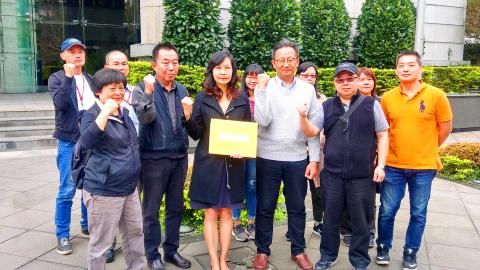
Photo: Cheng Wei-chi, Taipei Times
Deputy Minister of Transportation and Communications Wang Kwo-tsai (王國材) said the airline has suspended its flight services for more than 40 days, and the Civil Aviation Act (民用航空法) requires that it must first pass a five-stage review from the Civil Aeronautics Administration before it can resume operations.
This procedure is the only way that the airline could restart flight services, regardless of whether the ministry decides to revoke its air operator certificate, he said.
“The investor should be more interested in knowing if FAT’s employees and aircraft are sound enough to ensure flight safety,” Wang added.
FAT chairman Chang Kang-wei (張綱維) on Dec. 13 told a news conference that it was the airline’s management who misunderstood the situation and made the decision to suspend flight services, adding that it was applying to resume services.
On Wednesday, he said that the company could only secure new funding if the ministry allows the airline to resume flight services.
However, the ministry said that Chang has failed five times to keep his promise of securing new funding for the company.
The airline’s employees have yet to receive their salaries for last month, Lu said, adding that most of them are hoping that the government would help them.
More than half of the employees have signed the petition, she added.
In the petition, employees said that they still go to work every day, even though flight services has been suspended since Dec. 13, because they need their job to support their families.
“Some of us are senior employees who have dedicated their whole life to the company,” the statement said. “We understand that the company is having financial difficulties at the moment, but all of us, including our families, would lose our financial support if the ministry continues to prohibit the airline from resuming flight services,” the statement read.

NATIONAL SECURITY: Authorities are working to confirm the identities of the military personnel involved and investigating possible illegal conduct and regulatory violations Authorities are probing possible national security implications after Kinmen police and immigration officers on Sunday found a Chinese woman allegedly posing as a tourist while engaging in prostitution involving more than 10 military personnel. The woman, surnamed Chen (陳), has since been deported, authorities said, adding that investigators are still working to confirm the identities of those implicated, as the records only listed code names and aliases. The case stemmed from a report received by the Kinmen District Prosecutors’ Office on Friday last week from the Jinhu Precinct of the Kinmen County Police Bureau. On Sunday, police, along with the National Immigration

GLOBALGIVING: ‘ Caving to external pressure is not acceptable for an organization that has cultivated justice reform and human rights for 30 years,’ one NGO said A slew of non-government organizations (NGOs) have withdrawn from the GlobalGiving fundraising platform after it announced it would use “Chinese Taipei” instead of “Taiwan” from next month. The Taiwan Good Rice Association wrote on Facebook on Friday that it was informed on April 28 via a teleconference call of the change, which was made because the platform wanted to operate in China. Taiwan Good Rice is to terminate all cooperative relationships with GlobalGiving in response to the platform’s “unilateral and non-negotiable” decision to remove references to Taiwan, the NGO said. “Taiwan is in the official name of Taiwan Good Rice Association and the

HEAVY WEATHER: Typhoon Jangmi is due to crash straight into the Ryukyus as airlines look to shift flights to larger aircraft or cancel flights to Okinawa entirely Taiwan’s international air carriers announced flight adjustments over the weekend as Typhoon Jangmi is forecast to hit the Ryukyu Islands today and tomorrow. The Central Weather Administration (CWA) upgraded Jangmi from a tropical storm to a typhoon at 8am yesterday, with the eye located 580km south of Naha city. It was moving north at 19kph. Today, China Airlines’ CI-120, CI-121, CI-122 and CI-123 flights between Taoyuan and Naha, Okinawa, have been canceled as well as CI-132 and CI-133 between Kaohsiung and Naha. EVA Air’s BR-112, BR-113, BR-186 and BR-185 flights between Taoyuan and Naha are also canceled. Low-cost carrier Tigerair Taiwan canceled IT-230,

Chinese Nationalist Party (KMT) Chairwoman Cheng Li-wun (鄭麗文) yesterday briefed her party’s Central Standing Committee regarding her scheduled visit to the US between Monday next week and June 16, saying that her purpose would be to persuade the US that the Republic of China (ROC) Constitution was a “one China” constitution that would foster stable and peaceful cross-strait relations. The ROC Constitution is the most important defense for all Taiwanese citizens, as it upholds our democracy and has contributed to our robust economy, which aligns with international and US interests, she said. “We would not be troublemakers and drag the US under,”


 RSS
RSS