

The High Court yesterday upheld a life sentence for a man convicted of killing a three-year-old girl, known as “Little Light Bulb” (小燈泡), in a gruesome knife attack in Taipei in 2016.
In the retrial, doctors for the prosecution said that Wang Ching-yu (王景玉), although diagnosed with schizophrenia, was cognitively normal during the attack and capable of controling himself, High Court spokeswoman Wang Ping-hsia (王屏夏) said.
The High Court saw no reason to reduce the life sentence imposed by the lower court, the spokeswoman said, citing Article 19 of the Criminal Code, which lists mental illness as possible grounds for a commuted sentence.
The court decided against imposing the death penalty, as it concluded that Wang Ching-yu’s schizophrenia could improve with proper treatment, reducing the likelihood of recidivism, she added.
Wang Ching-yu is believed to have committed the crime while having hallucinations induced by his schizophrenia, she said, citing doctors’ testimony.
Wang Ching-yu’s family was not aware of his condition and he had not received psychiatric treatment, the spokeswoman added.
The case can still be appealed.
The killing occurred on March 28, 2016, when Little Light Bulb and her mother, Claire Wang (王婉諭), were walking to an MRT station in Taipei’s Neihu District (內湖).
Wang Ching-yu grabbed the child from behind and beheaded her with a cleaver.
The Taipei District Prosecutors’ Office had sought the death penalty for Wang Ching-yu, but the Taipei District Court gave him a life sentence in May 2017 and the High Court upheld the ruling in July 2018.
Prosecutors appealed the case, taking it to the Supreme Court, which sent it back to the High Court in December 2018 for retrial, saying that no medical testimony had been presented in the lower court.
Claire Wang, who became a social advocate after the death of her daughter, was nominated for legislator-at-large on a New Power Party ticket in the Jan. 11 legislative elections and is to begin serving in the Legislative Yuan next month.
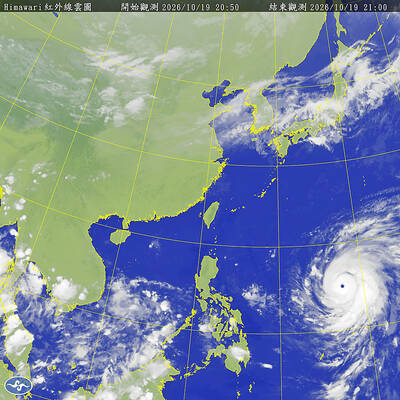
Typhoon Champi is forecast to turn northward earlier than previously expected, sparing Taiwan a direct hit but still bringing heavy rain to the north of the country on Friday and Saturday, the Central Weather Administration (CWA) said yesterday. Typhoon Champi had strengthened and increased in size over the past 12 hours, and as of yesterday afternoon, was packing sustained winds of 198kph near its center, CWA forecaster Cheng Chieh-jen (鄭傑仁) said. However, due to the weakening of a Pacific high-pressure system the storm is now expected to turn northward earlier than initially forecast, likely around Japan’s Ishigaki Island, Cheng said. As Champi brushes
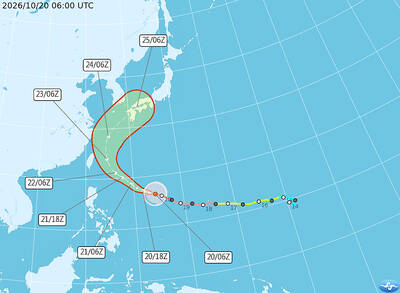
A sea warning for Typhoon Champi might be issued tonight, while the storm’s trajectory would determine whether a land warning is to be issued tomorrow night, the Central Weather Administration (CWA) said yesterday. As of 2pm yesterday, Champi was about 1,536km east-southeast of Taiwan proper’s southernmost point, Oluanpi (鵝鑾鼻), packing maximum sustained winds of 198kph, CWA forecaster Tseng Chao-cheng (曾昭誠) said. The storm was moving west-northwest at 23kph and was expected to strengthen over the next 24 hours before weakening slightly as it approaches cooler waters east of Taiwan, Tseng said. Champi is expected to turn north tomorrow, with the angle of the
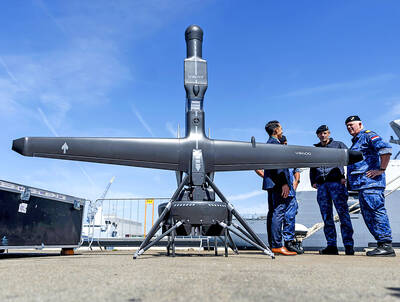
DEFENSE PROCUREMENT: Taiwan could become the largest operator of V-BAT drones outside the US if the contract is finalized, the Ministry of National Defense said The navy and the coast guard reportedly plan to acquire 292 units of MQ-35A V-BAT vertical takeoff and landing (VTOL) surveillance drones. If the contract is awarded and finalized, it would make Taiwan one of the largest buyers of the uncrewed aerial vehicle (UAV) developed by the US-based defense technology company Shield AI. The Coast Guard Administration budgeted NT$1.2 billion (US$37.1 million) to buy 12 drones, which have been delivered, Shield AI said in a report on Oct 13. The navy is planning to spend NT$36 billion under a four-year program code-named Project Yuan Hsiao (遠鴞) to acquire 280 V-BAT drones,
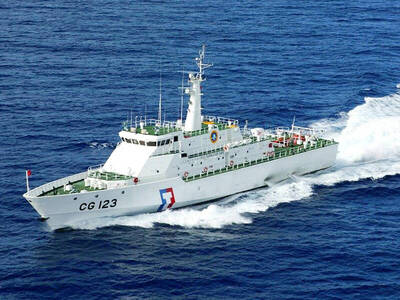
A patrol vessel donated by the Coast Guard Administration (CGA) to the Philippines would not be used in waters near Taiwan or areas where Taiwanese fishing vessels operate, Premier Cho Jung-tai (卓榮泰) said yesterday. The vessel, formerly the CGA's 500-tonne-class Kinmen (金門), was commissioned into the Philippine Coast Guard on Oct. 2. Speaking at the Legislative Yuan, Cho said the Philippines had pledged during the donation process that the vessel would be used only for designated missions and would not operate in waters related to Taiwan. The vessel could even provide assistance to Taiwan if needed, he added. Responding to questions from Chinese


 RSS
RSS