


Thai authorities on Monday confirmed that a visitor from Wuhan, China, has been infected with a new coronavirus, the Centers for Disease Control (CDC) said yesterday, adding that the possibility of human-to-human transmission cannot yet be ruled out.
Chinese health officials in the middle of last month reported a pneumonia outbreak linked to Huanan Seafood City market in Wuhan. The WHO on Monday named the virus novel coronavirus 2019 (2019-nCoV).
The visitor is a 61-year-old woman, who was found to have a fever upon her arrival in Thailand on Wednesday last week and quarantined, CDC Deputy Director-General Chuang Jen-hsiang (莊人祥) said, adding that test results on Sunday showed that she was infected with 2019-nCoV.

Photo: Lin Hui-chin, Taipei Times
Her respiratory symptoms and fever have since improved, and she is likely to be discharged from hospital in a few days, he said.
Sixteen airline passengers who had come into direct contact with the woman showed negative results when screened for 2019-nCoV, he added.
The woman had not visited the seafood market, which Wuhan officials closed on Jan. 1, but she had been to other markets, so the possibility of human-to-human transmission cannot be ruled out, Chuang said, adding that she also might have been infected by animals.
As of Sunday, Wuhan authorities had reported 41 confirmed cases of 2019-nCoV infection, six of whom were in a critical condition, and one death, he said, adding that there is no clear evidence of human-to-human transmission.
CDC Deputy Director-General Philip Lo (羅一鈞) on Monday said that the WHO did not name the virus after Wuhan or China, as previous practices of naming diseases after places, such as the Middle East respiratory syndrome coronavirus, were protested by the affected countries.
Seasonal flu, pneumonia and respiratory disease cases usually peak in the winter, the CDC said, urging people who plan to visit Wuhan or nearby areas to wash their hands frequently with soap, wear a surgical mask when visiting livestock markets or crowded public spaces, and avoid direct contact with wild animals.

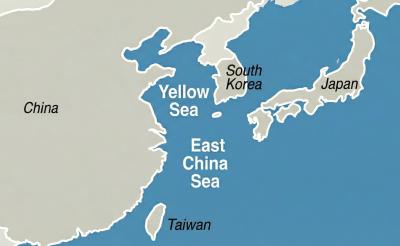
China has reserved offshore airspace in the Yellow Sea and East China Sea from March 27 to May 6, issuing alerts usually used to warn of military exercises, although no such exercises have been announced, the Wall Street Journal (WSJ) reported yesterday. Reserving such a large area for 40 days without explanation is an “unusual step,” as military exercises normally only last a few days, the paper said. These alerts, known as Notice to Air Missions (Notams), “are intended to inform pilots and aviation authorities of temporary airspace hazards or restrictions,” the article said. The airspace reserved in the alert is

NAMING SPAT: The foreign ministry called on Denmark to propose an acceptable solution to the erroneous nationality used for Taiwanese on residence permits Taiwan has revoked some privileges for Danish diplomatic staff over a Danish permit that lists “Taiwan” as “China,” Eric Huang (黃鈞耀), head of the Ministry of Foreign Affairs’ Department of European Affairs, told a news conference in Taipei yesterday. Reporters asked Huang whether the Danish government had responded to the ministry’s request that it correct the nationality on Danish residence permits of Taiwanese, which has been listed as “China” since 2024. Taiwan’s representative office in Denmark continues to communicate with the Danish government, and the ministry has revoked some privileges previously granted to Danish representatives in Taiwan and would continue to review
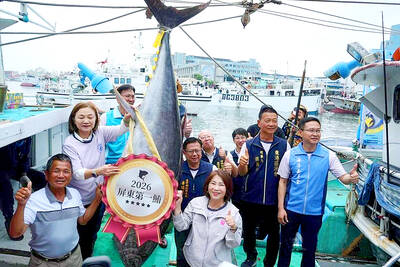
The first bluefin tuna of the season, brought to shore in Pingtung County and weighing 190kg, was yesterday auctioned for NT$10,600 (US$333.5) per kilogram, setting a record high for the local market. The auction was held at the fish market in Donggang Fishing Harbor, where the Siaoliouciou Island-registered fishing vessel Fu Yu Ching No. 2 delivered the “Pingtung First Tuna” it had caught for bidding. Bidding was intense, and the tuna was ultimately jointly purchased by a local restaurant and a local company for NT$10,600 per kilogram — NT$300 ,more than last year — for a total of NT$2.014 million. The 67-year-old skipper

China has reserved offshore airspace over the Yellow Sea and East China Sea from March 27 to May 6, issuing alerts that are usually used to warn of military exercises, although no such exercises have been announced, the Wall Street Journal (WSJ) reported on Sunday. Reserving such a large area for 40 days without explanation is an “unusual step,” as military exercises normally only last a few days, the paper said. The alerts, known as notice to air missions (NOTAMs), “are intended to inform pilots and aviation authorities of temporary airspace hazards or restrictions,” the article said. The airspace reserved in the alert


 RSS
RSS