


The Chinese Nationalist Party (KMT) yesterday accused President Tsai Ing-wen’s (蔡英文) administration of restricting freedom of speech through crackdowns on perceived disinformation.
Since Jan. 31 last year, the government has been collecting evidence of perceived disinformation from social media posts and group chats on messaging apps, said Chou Hsi-wei (周錫瑋), deputy director-general of KMT presidential candidate Han Kuo-yu’s (韓國瑜) campaign headquarters, at a news conference, citing documents from an unnamed local police department.
Since no definition of disinformation has been given to police to guide their investigations, people could be summoned for questioning whenever investigators suspect they had helped spread false information, Chou said.
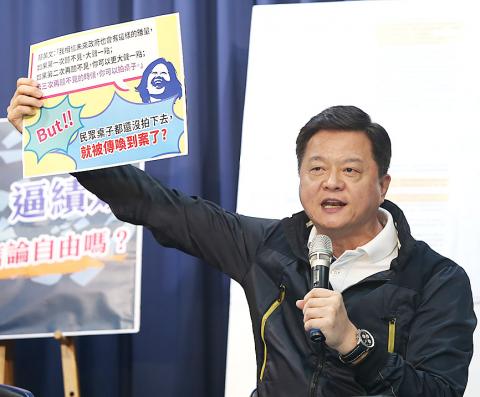
Photo: CNA
“This is a serious encroachment on human rights,” he said. “We think there are probably thousands of people who have been approached by police [for disinformation allegations].”
At least one police officer provided information to the KMT because they were concerned about infringing on people’s freedom of speech, he said, urging authorities to release the statistics on the numbers of people who have summoned for questioning.
The police crackdown on disinformation is all part of a nationwide program to curb vote-buying and the spread of false information launched by the National Police Agency (NPA) on May 17 last year, KMT Taipei City Councilor Yu Shu-hui (游淑慧) said.
Under the program, police officers who crack a disinformation case are rewarded the same as those who crack a vote-buying case, she said.
“The approach is creating problems for members of the public and the police,” she said.
Since disinformation cases are easier to crack, the program inadvertently encourages police to probe disinformation over other more difficult and important cases, she said.
From January to Dec. 2 last year, the National Police Agency handled about 400 cases of disinformation, with the majority — 173 of them — involving a political figure, she said.
“Do authorities only target critics of the Democratic Progressive Party and those who spreads false information about Tsai, while ignoring all mudslinging campaigns against Han?” she asked, urging the agency to publish the statistics on the 173 cases.
Separately, Criminal Investigation Bureau Commissioner Huang Ming-chao (黃明昭) rejected allegations that the judiciary is targeting supporters of Han and the KMT.
Additional reporting by Jason Pan

Considering that most countries issue more than five denominations of banknotes, the central bank has decided to redesign all five denominations, the bank said as it prepares for the first major overhaul of the banknotes in more than 24 years. Central bank Governor Yang Chin-lung (楊金龍) is expected to report to the Legislative Yuan today on the bank’s operations and the redesign’s progress. The bank in a report sent to the legislature ahead of today’s meeting said it had commissioned a survey on the public’s preferences. Survey results showed that NT$100 and NT$1,000 banknotes are the most commonly used, while NT$200 and NT$2,000

The Centers for Disease Control (CDC) yesterday reported the first case of a new COVID-19 subvariant — BA.3.2 — in a 10-year-old Singaporean girl who had a fever upon arrival in Taiwan and tested positive for the disease. The girl left Taiwan on March 20 and the case did not have a direct impact on the local community, it said. The WHO added the BA.3.2 strain to its list of Variants Under Monitoring in December last year, but this was the first imported case of the COVID-19 variant in Taiwan, CDC Deputy Director-General Lin Ming-cheng (林明誠) said. The girl arrived in Taiwan on

South Korea is planning to revise its controversial electronic arrival card, a step Taiwanese officials said prompted them to hold off on planned retaliatory measures, a South Korean media report said yesterday. A Yonhap News Agency report said that the South Korean Ministry of Foreign Affairs is planning to remove the “previous departure place” and “next destination” fields from its e-arrival card system. The plan, reached after interagency consultations, is under review and aims to simplify entry procedures and align the electronic form with the paper version, a South Korean ministry official said. The fields — which appeared only on the electronic form

The Ministry of Foreign Affairs (MOFA) is suspending retaliation measures against South Korea that were set to take effect tomorrow, after Seoul said it is updating its e-arrival system, MOFA said today. The measures were to be a new round of retaliation after Taiwan on March 1 changed South Korea's designation on government-issued alien resident certificates held by South Korean nationals to "South Korea” from the "Republic of Korea," the country’s official name. The move came after months of protests to Seoul over its listing of Taiwan as "China (Taiwan)" in dropdown menus on its new online immigration entry system. MOFA last week


 RSS
RSS