


A coalition of labor rights groups yesterday marched in Taipei, demanding that the three presidential candidates respond to their appeals, which include increasing the minimum wage and retirement pay, and abolishing the broker system for migrant workers.
They gathered at noon in front of the Chinese Nationalist Party’s (KMT) headquarters, then marched to the People First Party’s (PFP) headquarters, the re-election campaign headquarters of President Tsai Ing-wen (蔡英文) of the Democratic Progressive Party (DPP), and finally to the Legislative Yuan.
Labor policies were not listed as priorities of the three presidential candidates during their last policy program presentation, while legislator-at-large candidates advocating labor rights also rank low on parties’ lists, said coalition spokesman Hung Ching-fu (洪清福), who is also the chairman of the New Taipei City Confederation of Trade Unions.
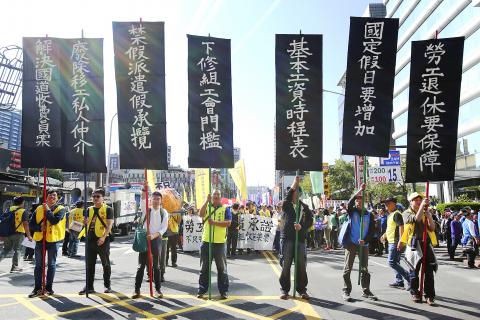
Photo: Chiang Ying-ying, AP
The coalition last month sent letters to the three presidential candidates, asking them to respond to their appeals.
They announced their responses yesterday.
They asked whether the candidates, if elected, would ask businesses to pay more tax to establish a basic workers’ pension system, and whether they would increase the ratio of firms’ contributions to employees’ pensions from 6 percent to 9 percent of salaries.
The candidates were also asked whether they would increase official days off from 116 days to 123 days a year; whether they would propose a timetable for increasing the minimum wage from NT$23,800 to NT$30,000; whether they would lower the threshold required to form a workers’ union from 30 to 10 members, or half of a firm’s total employees; whether they would promote legislation that bans government agencies or private firms from hiring temporary workers for long-term jobs; and whether they would abolish the private broker system for migrant workers and introduce migrant workers through government-to-government agreements.
They also required the next government to reach an agreement with former highway toll collectors on severance pay, as some lost their jobs after the highway toll system became electronic in 2013.
Tsai and Kaohsiung Mayor Han Kuo-yu (韓國瑜), the KMT’s presidential candidate, replied, but did not address the appeals directly, while PFP presidential candidate James Soong (宋楚瑜) did not reply, the coalition said.
Speaking in front of Tsai’s re-election campaign headquarters, Former Freeway Toll Collectors ‘Self-Help Organization president Sun Hsiu-luan (孫秀鑾) vowed to protest against Tsai wherever the president goes, as she failed to realize an agreement reached with the group in 2016.

FUKUOKA SITUATION: Japanese media reported that the pathogen is expected to be identified by the summer, while the CDC downplayed the idea that it was hMPV A “mysterious cold-like illness” reported in Japan’s Fukuoka Prefecture does not seem to be a new disease, but Japanese authorities have been asked about the situation, the Centers for Disease Control (CDC) said yesterday. The Fukuoka Prefectural Medical Association on Wednesday told a news conference that a “mystery cold” that has become a hot topic on social media is “highly likely to be caused by some kind of viral infection,” Japan’s KBC News reported. “Many people are experiencing symptoms starting with a sore throat, followed by a runny nose, phlegm and a severe cough,” KBC News reported, citing association officials. Health authorities are

Nvidia Corp CEO Jensen Huang (黃仁勳) arrived in Taiwan yesterday ahead of upcoming AI and technology events, saying he plans to meet with clients and Taiwan Semiconductor Manufacturing Co Chairman C.C. Wei (魏哲家) during his visit. After landing at Taipei Songshan Airport, Huang posed for photos with fans and handed out Yakult drinks to reporters and supporters waiting at the scene, saying he has “a lot to do” during the trip. Asked about reports that Nvidia’s planned headquarters site in Taipei’s Beitou Shilin Technology Park could break ground on May 27, Huang said that if the company holds an event, he would

Carrefour Taiwan is to begin using a new name from the start of July, but it cannot divulge the name until then, the chairman of the supermarket chain's parent company said today. President Chain Store Co chairman Lo Chih-hsien (羅智先) was asked by reporters after a shareholders' meeting to confirm whether the company has settled on a new name for the supermarket brand. In March, the government-registered name of two Carrefour Taiwan branches was quietly changed to "Le Chia Kang" (樂家康) in Chinese, raising speculation that has been selected as the name. Lo said that because of local regulations and contractual obligations, the
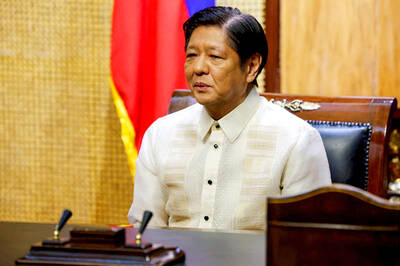
The Philippines would likely be involved in any conflict over Taiwan due to its proximity to the democracy claimed by China, President Ferdinand Marcos Jr said, reiterating a stance that risks angering Beijing. “In the Philippines, we do not have a choice because Taiwan is so close to the Philippines and we have almost 200,000 Filipino nationals living and working in Taiwan,” Marcos said in an interview with Japanese media in Manila on Monday. The Philippine leader’s comments come ahead of a state visit to Japan next week, where he is to meet with Japanese Prime Minister Sanae Takaichi to discuss security


 RSS
RSS