


Changhua County police yesterday displayed materials and evidence seized in raids over the past few weeks related to 37 cases of illegal gambling pools, five of which were focused on wagers on the outcome of the presidential and legislative elections next Saturday.
Nine people were detained in relation to the five cases and have been listed as suspects after questioning, Criminal Police Section Deputy Chief Lin Shih-ming (林世明) said, adding that they faced charges for contravening provisions of the Civil Servants Election and Recall Act (公職人員選舉罷免法), under which it is illegal to wager on election outcomes.
Gamblers placed wagers on the presidential election through the use of the code words “fish” (魚), a homophone in Chinese of the third character in the name of Kaohsiung Mayor Han Kuo-yu (韓國瑜), the Chinese Nationalist Party’s (KMT) presidential candidate, and “vegetable” (菜), a homophone of President Tsai Ing-wen’s (蔡英文) surname, Lin said.
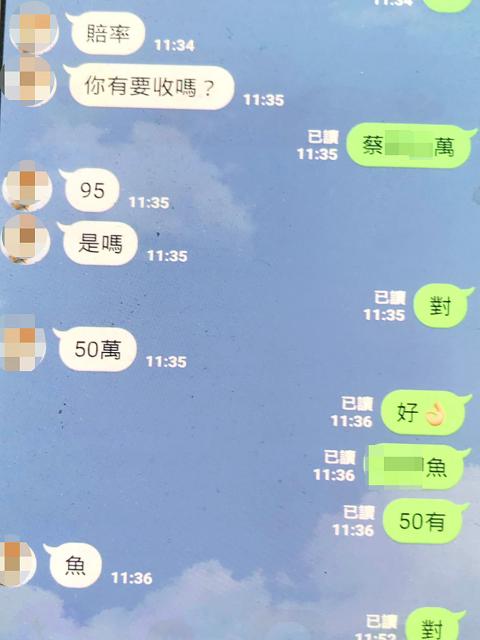
Photo copied by Tang Shih-ming, Taipei Times
One seized mobile phone showed that its owner wrote: “Can we eat ‘fish’ today?” on Line, asking a gambling pool operator if they were taking bets on Han that day. After receiving an affirmative reply, the man wrote back to place a NT$500,000 (US$16,609) wager on Han.
A total of 46 suspects were detained in the raids across the county related to the 37 cases, which involved NT$132 million in wagers, Lin said.
“Proprietors of underground gambling pools had flourished in past elections, but law enforcement agencies and local police have intensified their sweeps to crack down on these and other illegal activities related to the elections,” Lin said.
“Over the past several years, we have seen less vote-buying, but more illegal gambling on election outcomes through these operations,” he said.
“Through our investigations and the seized evidence, we can see that the proprietors skewed the odds to entice people to bet on a particular candidate. Those who placed large wagers would do their best to win by persuading friends and relatives to cast votes for those candidates, increasing their chances of a big payout,” he added.
The Criminal Investigation Bureau earlier this week said in a year-end report that enhanced efforts last month to crack down on illegal gambling that could affect the elections had seen some success, with 89 suspects detained for questioning over 56 cases of illegal gambling pools focused on the election outcomes.
Last month’s 56 increased the total number of cases related to illegal wagers on the election outcomes to 113 for the whole of last year, Bureau Deputy Commissioner Chu Tsung-tai (朱宗泰) said.
An examination of the evidence is under way to confirm the total amount wagered and investigate the money flow in the 56 cases, he added.
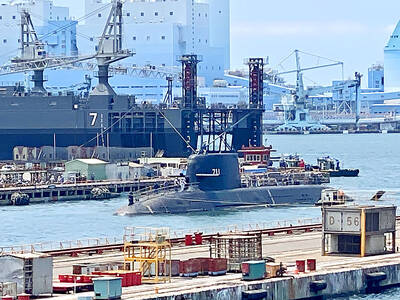
AGING: While Japan has 22 submarines, Taiwan only operates four, two of which were commissioned by the US in 1945 and 1946, and transferred to Taiwan in 1973 Taiwan would need at least 12 submarines to reach modern fleet capabilities, CSBC Corp, Taiwan chairman Chen Cheng-hung (陳政宏) said in an interview broadcast on Friday, citing a US assessment. CSBC is testing the nation’s first indigenous defense submarine, the Hai Kun (海鯤, Narwhal), which is scheduled to be delivered to the navy next month or in July. The Hai Kun has completed torpedo-firing tests and is scheduled to undergo overnight sea trials, Chen said on an SET TV military affairs program. Taiwan would require at least 12 submarines to establish a modern submarine force after assessing the nation’s operational environment and defense
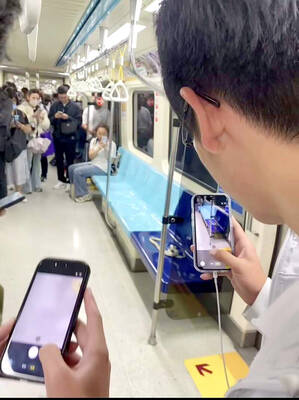
A white king snake that frightened passengers and caused a stir on a Taipei MRT train on Friday evening has been claimed by its owner, who would be fined, Taipei Rapid Transit Corp (TRTC) said yesterday. A person on Threads posted that he thought he was lucky to find an empty row of seats on Friday after boarding a train on the Bannan (Blue) Line, only to spot a white snake with black stripes after sitting down. Startled, he jumped up, he wrote, describing the encounter as “terrifying.” “Taipei’s rat control plan: Release snakes on the metro,” one person wrote in reply, referring
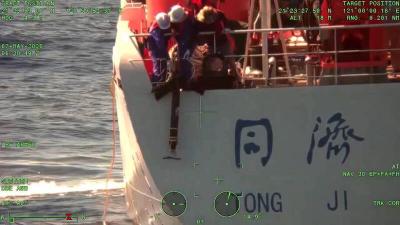
The coast guard today said that it had disrupted "illegal" operations by a Chinese research ship in waters close to the nation and driven it away, part of what Taipei sees a provocative pattern of China's stepped up maritime activities. The coast guard said that it on Thursday last week detected the Chinese ship Tongji (同濟號), which was commissioned only last year, 29 nautical miles (54km) southeast of the southern tip of Taiwan, although just outside restricted waters. The ship was observed lowering ropes into the water, suspected to be the deployment of scientific instruments for "illegal" survey operations, and the coast

Taiwan’s two cases of hantavirus so far this year are on par with previous years’ case numbers, and the government is coordinating rat extermination work, so there should not be any outbreaks, Centers for Disease Control (CDC) Director-General Philip Lo (羅一鈞) said today in an interview with the Liberty Times (the Taipei Times’ sister newspaper). An increase in rat sightings in Taipei and New Taipei City has raised concerns about the spread of hantavirus, as rats can carry the disease. In January, a man in his 70s who lived in Taipei’s Daan District (大安) tested positive posthumously for hantavirus, Taiwan’s


 RSS
RSS