


A presidential debate for the Jan. 11 elections is to be held on Dec. 29 and broadcast by Public Television Service (PTS), several news organizations announced yesterday.
The candidates would field questions by journalists from the Central News Agency and the Chinese-language Apple Daily, Liberty Times, United Daily News and China Times newspapers, PTS News Network producer and debate host Chen Hsin-tsung (陳信聰) told a news conference.
The news outlets were joined at the conference by SET-TV, Formosa TV, TVBS and CtiTV News — which are to jointly broadcast the debate along with PTS — as well as representatives from the campaign offices of the three presidential candidates.
The debate would be divided into four segments and run from 2pm to 4:30pm, Chen said.
Kaohsiung Mayor Han Kuo-yu (韓國瑜), the Chinese Nationalist Party’s (KMT) candidate, was represented at the meeting by KMT Taipei City Councilor Lo Chih-chiang (羅智強) and KMT legislator-at-large nominee Chen Yi-hsin (陳以信).
People First Party (PFP) Chairman James Soong (宋楚瑜) was represented by his secretary, Wei Chih-chung (魏志中), and Shih Pei-pei (時蓓蓓), who is office director for PFP Legislator Lee Hung-chun (李鴻鈞).
President Tsai Ing-wen (蔡英文), who is seeking re-election, was represented by Democratic Progressive Party legislators Lee Chun-yi (李俊俋) and Wang Ting-yu (王定宇), as well as her campaign office spokesman Liao Tai-hsiang (廖泰翔).
The debate would be produced and broadcast by PTS, while the other TV companies would share it on their channels and online streaming services, Chen said, adding that sign language service would be provided during the debate.
The order in which the candidates are to speak was determined by drawing lots, Chen said, adding that Han would speak first, followed by Soong and Tsai.
The speeches, which are to last eight minutes each, would be the first segment, he added.
That would be followed by a question-and-answer session, with the journalists asking five jointly determined questions, one at a time, Chen said.
The candidates would each have two-and-a-half minutes to answer each question, he said.
In the third segment, the candidates would each be given one minute to ask questions of each other, and two minutes each to answer the questions, Chen said.
The candidates would deliver their closing remarks in the final segment, he added.
The candidates would later decide whether to hold a second debate, Lee said, adding that Tsai and Soong hope for a second round.
Han’s campaign office would prefer having just one debate, citing concerns over the political stance of senior executives at SET-TV, Lo said.


UPGRADE: The Kang Ding-class frigate is replacing its Chaparall missiles with Tien Chien II and Hua Yang VLS, which would provide it with long-range, 360° air defense Taiwan plans to produce 1,200 to 1,376 Hai Chien II missiles (海劍二, Sea Sword II) — also known as TC-2N — to serve as the standard air defense system of the navy’s surface combatant fleet, a source said yesterday. Last week, the Hai Chien II, the naval version of the Tien Kung II missile (天劍二, Sky Sword II), completed a live-fire test in waters off the National Chungshan Institute of Science and Technology’s Jiupeng facility (九鵬) in Pingtung County’s Manjhou Township (滿州). The MIM72 Chaparral and other dated air defense missiles that currently arm Taiwanese ships have inadequate range to combat Chinese

REASONS FOR TRAVEL: An assistant professor said that proposed amendments to penalize drivers if they used drugs overseas would not deter people from traveling People who operate a motor vehicle under the influence of marijuana would have their driver’s license revoked, even if they used the substance while overseas, the Ministry of Transportation and Communications said yesterday, citing proposed amendments to the Road Traffic Management and Penalty Act (道路交通管理處罰條例). The amendments would also authorize the government to revoke the licenses of people determined to have used Category 1 or Category 2 narcotics, even if they were not operating a vehicle while under the influence of drugs, as well as ban them from taking the license test for three years, the ministry said. People aged 18 or
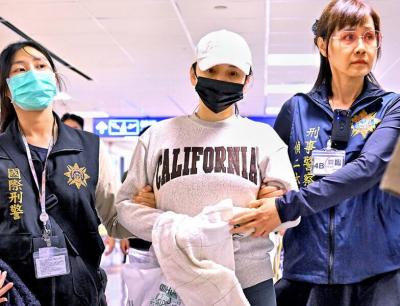
Johanne Liou (劉喬安), a Taiwanese woman who shot to unwanted fame during the Sunflower movement protests in 2014, returned to Taiwan last night after being deported from the US. She is to stand trial in Taiwan for charges involving embezzlement, fraud and drug crimes. The Criminal Investigation Bureau (CIB) said it took her into custody at Taiwan Taoyuan International Airport and would first question her before transferring her to the New Taipei District Prosecutors’ Office. She was arrested upon disembarking a flight from San Francisco that landed shortly before 7pm. Liou absconded to the US in 2019 after jumping bail
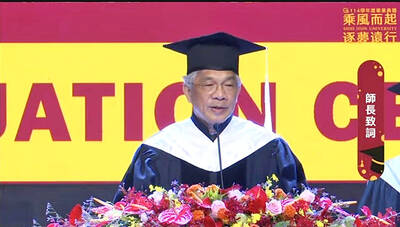
Shih Hsin University President Chen Ching-he (陳清河) yesterday issued a public apology for comments made in his commencement speech last week, stating that he has asked the school to suspend his duties and halt his wages for two months as a show of contrition. At the commencement ceremony on May 30, Chen said, “If you don’t manage your time well, or your own emotions, or your health, then I am telling every one of you — put a quick end to ‘you,’ because the world has no need for ‘you.’” The comments have sparked significant controversy online, and Chen through an open


 RSS
RSS