


The Centers for Disease Control (CDC) yesterday reported the first case of malaria relapse in three years and added that a subtype of the avian influenza has been detected in two children in China.
In the malaria case, a woman in her 50s from southern Taiwan had been working in Ethiopia from early August to late October, CDC physician Lin Yung-ching (林詠青) said.
The woman sought treatment in Ethiopia after developing a fever in the middle of October and was hospitalized for four days for suspected malaria, but she did not continue to take medication after she was discharged, Lin said.
She was not displaying any symptoms when she arrived in Taiwan, but nevertheless reported her experience to the CDC quarantine station at the airport and visited a doctor for a checkup the next day, but a blood test did not detect malaria parasites, he said.
However, when she sought treatment on Friday for a fever and upper respiratory infection, a blood test found suspected malaria parasites, and she was diagnosed with tertian malaria on Monday, he said.
The centers determined it to be a case of malaria relapse resulting from incomplete treatment, Lin said.
The woman is to remain hospitalized until the symptoms abate and blood tests find no malaria parasites, he said, adding that she would be asked to undergo follow-up test once a month for a year.
The previous case of malaria relapse was in a person who visited India in 2015 and experienced a relapse of tertian malaria in 2016, CDC Deputy Director-General Philip Lo (羅一鈞) said.
Lin said people who plan to visit places where malaria is prevalent should visit a travel medicine doctor at least one month in advance, and take malaria prophylaxis drugs before, during and after the trip as prescribed.
In related news, the WHO has announced two cases of avian influenza A (H9N2) virus infection in humans in China, CDC Epidemic Intelligence Center Deputy Director Guo Hung-wei (郭宏偉) said.
The cases involve a four-year-old girl from China’s Fujian Province reported in late October and a five-year-old girl from China’s Anhui Province reported last month, Lo said.
Both had been exposed to poultry or a poultry slaughterhouse, Guo said.
Thirty-nine H9N2 cases have been confirmed globally since 2013, of which 32 were in China, including the death of a 57-year-old woman in Sichuan Province, Lo said.
Although H9N2 infections in humans generally cause mild symptoms, a nine-year-old boy who was infected in March developed serious pneumonia, he said.
People visiting China should eat poultry or eggs only after they have been thoroughly cooked, avoid exposure to birds and poultry, wash their hands thoroughly with soap after exposure and wear a surgical mask, Lo said, urging people to immediately seek medical attention if they experience flu symptoms.
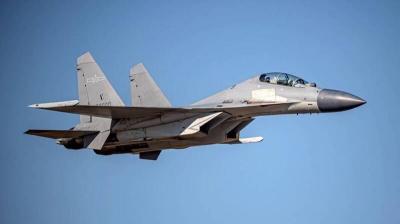
Eight Chinese naval vessels and 24 military aircraft were detected crossing the median line of the Taiwan Strait between 6am yesterday and 6am today, the Ministry of National Defense said this morning. The aircraft entered Taiwan’s northern, central, southwestern and eastern air defense identification zones, the ministry said. The armed forces responded with mission aircraft, naval vessels and shore-based missile systems to closely monitor the situation, it added. Eight naval vessels, one official ship and 36 aircraft sorties were spotted in total, the ministry said.
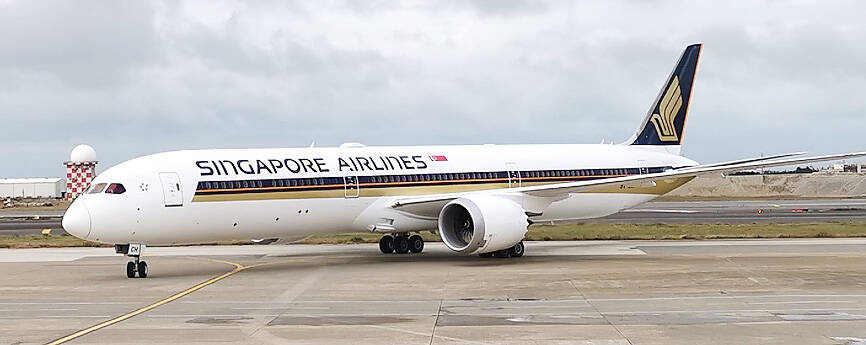
INCREASED CAPACITY: The flights on Mondays, Wednesdays, Fridays and Sundays would leave Singapore in the morning and Taipei in the afternoon Singapore Airlines is adding four supplementary flights to Taipei per week until May to meet increased tourist and business travel demand, the carrier said on Friday. The addition would raise the number of weekly flights it operates to Taipei to 18, Singapore Airlines Taiwan general manager Timothy Ouyang (歐陽漢源) said. The airline has recorded a steady rise in tourist and business travel to and from Taipei, and aims to provide more flexible travel arrangements for passengers, said Ouyang, who assumed the post in July last year. From now until Saturday next week, four additional flights would depart from Singapore on Monday, Wednesday, Friday
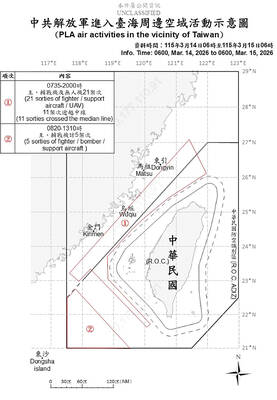
The Ministry of National Defense yesterday reported the return of large-scale Chinese air force activities after their unexplained absence for more than two weeks, which had prompted speculation regarding Beijing’s motives. China usually sends fighter jets, drones and other military aircraft around the nation on a daily basis. Interruptions to such routine are generally caused by bad weather. The Ministry of National Defense said it had detected 26 Chinese military aircraft in the Taiwan Strait over the previous 24 hours. It last reported that many aircraft on Feb. 25, when it spotted 30 aircraft, saying Beijing was carrying out another “joint combat
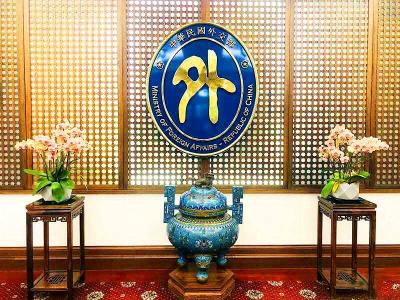
The Ministry of Foreign Affairs (MOFA) today said that if South Korea does not reply appropriately to its request to correct Taiwan’s name on its e-Arrival card system before March 31, it would take corresponding measures to alter how South Korea is labeled on the online Taiwan Arrival Card system. South Korea’s e-Arrival card system lists Taiwan as “China (Taiwan)” in the “point of departure” and “next destination” fields. The ministry said that it changed the nationality for South Koreans on Taiwan’s Alien Resident Certificates from “Korea” to “South Korea” on March 1, in a gesture of goodwill and based on the


 RSS
RSS