


The Ministry of the Interior does not run an “Internet army” or provide funding for such activities, Minister of the Interior Hsu Kuo-yung (徐國勇) said yesterday in response to reporters’ questions about the scandal surrounding Yang Hui-ju (楊蕙如).
Yang has been accused of paying members of an “Internet army” NT$10,000 a month to post on popular social media platforms in an attempt to influence public opinion.
Yang and a man surnmed Tsai (蔡), who used the same Internet Protocol address as Yang, have also been accused of insulting a public official.
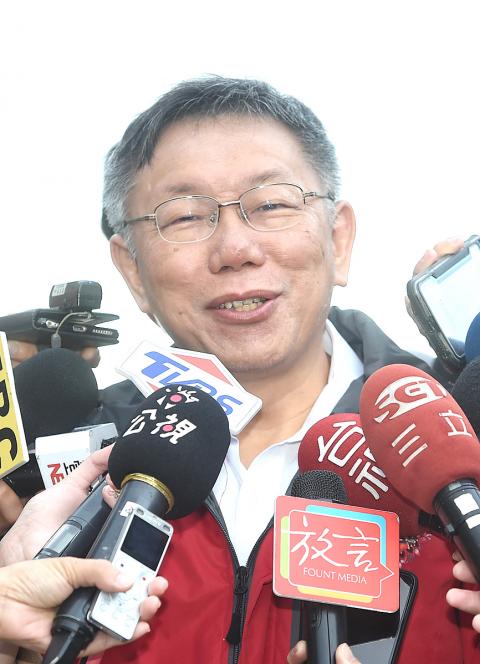
Photo: Liu Hsin-de, Taipei Times
Asked about his relationship with Yang after a photograph surfaced showing the two together, Hsu said that he and Yang had worked in the media and knew each other, but that he had not talked to her since becoming minister.
Working in the media, he often met members of both the pan-blue and pan-green camps, including Chinese Nationalist Party (KMT) officials, he said.
“It’s meaningless to try to concoct some speculation based on one photograph,” Hsu said.
In response to accusations by the KMT that Hsu has close links with Yang, the Democratic Progressive Party’s (DPP) headquarters said in a statement that Yang had no connection to the DPP and condemned the KMT for deliberately trying to link the two.
“The DPP fully supports the judicial investigation into this case and if the defendant is found to have broken the law, then she must bear the legal responsibility,” the statement said.
DPP Deputy Secretary-General Lin Fei-fan (林飛帆) said the accusation that Yang is running a DPP Internet army was baseless, adding that many DPP officials had been among her victims.
“People in DPP’s central office, including Chairman Cho Jung-tai (卓榮泰), Secretary-General Luo Wen-jia (羅文嘉) and myself have been victims of Yang’s online bullying,” Lin said.
Taipei Mayor Ko Wen-je (柯文哲) claimed that Yang could not have paid the alleged “Internet army” members by herself and “there must be someone paying from above.”
The Taipei District Prosecutors’ Office on Monday accused Yang, who was a Web manager for the 2008 presidential campaign of then-DPP candidate Frank Hsieh (謝長廷), of posting an article on Sept. 6 last year defending Representative to Japan Hsieh and blaming the Taipei Economic and Cultural Office in Japan’s Osaka branch for not helping Taiwanese stranded at Kansai International Airport after it was shut down due to Typhoon Jebi on Sept. 4 last year.
Then-Osaka branch director-general Su Chii-cherng (蘇啟誠) committed suicide eight days after the article was posted, leading to speculation that his death might have been linked to the criticism.
Ko yesterday said that he believes Hsieh could have been telling the truth when he said he was not responsible for the posting, because he knows that Hsieh has hardly dealt with domestic issues since leaving for Japan.
“So I have to take responsibility for Yang Hui-ju’s case?” Hsieh wrote on Facebook on Tuesday.
When asked about Yang’s case possibly being linked with the DPP, Ko said that when he asked the DPP who was responsible for political pundit Wu Hsiang-hui (吳祥輝) inviting US author Ethan Gutmann to visit Taiwan last year and accuse Ko of being involved in organ harvesting in China, the party said that “it had nothing to do with them.”
“Whenever something like this occurs, everyone is good at distancing themselves from it,” Ko said.
Meanwhile, the Taiwan Statebuilding Party accused Ko of paying Chiu Yu-kai (邱昱凱) NT$80,000 a month to run online propaganda campaigns in an attempt to shape public opinion on social media platforms.
Ko is a master at operating his own “Internet army,” the party said, adding that after Ko hired Chiu in August last year, there had been an unusual spike in fabricated stories and heated online discussions in favor of then-KMT Kaohsiung mayoral candidate Han Kuo-yu (韓國瑜), now the KMT’s presidential candidate.

SECURITY: Starlink owner Elon Musk has taken pro-Beijing positions, and allowing pro-China companies to control Taiwan’s critical infrastructure is risky, a legislator said Starlink was reluctant to offer services in Taiwan because of the nation’s extremely high penetration rates in 4G and 5G services, the Ministry of Digital Affairs said yesterday. The ministry made the comments at a meeting of the legislature’s Transportation Committee, which reviewed amendments to Article 36 of the Telecommunications Management Act (電信管理法). Article 36 bans foreigners from holding more than 49 percent of shares in public telecommunications networks, while shares foreigners directly and indirectly hold are also capped at 60 percent of the total, unless specified otherwise by law. The amendments, sponsored by Chinese Nationalist Party (KMT) Legislator Ko

The military has spotted two Chinese warships operating in waters near Penghu County in the Taiwan Strait and sent its own naval and air forces to monitor the vessels, the Ministry of National Defense (MND) said. Beijing sends warships and warplanes into the waters and skies around Taiwan on an almost daily basis, drawing condemnation from Taipei. While the ministry offers daily updates on the locations of Chinese military aircraft, it only rarely gives details of where Chinese warships are operating, generally only when it detects aircraft carriers, as happened last week. A Chinese destroyer and a frigate entered waters to the southwest

The eastern extension of the Taipei MRT Red Line could begin operations as early as late June, the Taipei Department of Rapid Transit Systems said yesterday. Taipei Rapid Transit Corp said it is considering offering one month of free rides on the new section to mark its opening. Construction progress on the 1.4km extension, which is to run from the current terminal Xiangshan Station to a new eastern terminal, Guangci/Fengtian Temple Station, was 90.6 percent complete by the end of last month, the department said in a report to the Taipei City Council's Transportation Committee. While construction began in October 2016 with an

NON-RED SUPPLY: Boosting the nation’s drone industry is becoming increasingly urgent as China’s UAV dominance could become an issue in a crisis, an analyst said Taiwan’s drone exports to Europe grew 41.7-fold from 2024 to last year, with demand from Ukraine’s fight against Russian aggression the most likely driver of growth, a study showed. The Institute for Democracy, Society and Emerging Technology (DSET) in a statement on Wednesday said it found that many of Taiwan’s uncrewed aerial vehicle (UAV) sales were from Poland and the Czech Republic. These countries likely transferred the drones to Ukraine to aid it in its fight against the Russian invasion that started in 2022, it said. Despite the gains, Taiwan is not the dominant drone exporter to these markets, ranking second and fourth


 RSS
RSS