


The Russian Empire in 1875 sent a naval vessel to Taiwan proper to investigate after Japan attacked the island the year before, Russian historical records showed.
In 1871, a Ryukyuan boat that was returning to Miyako Island after paying annual tribute to the seat of the Ryukyu Kingdom in Naha was shipwrecked off the southern coast of Taiwan after it was caught in a typhoon.
The 66 people aboard the vessel traveled inland, entering Paiwan territory, but were attacked due to a misunderstanding caused by the language barrier, and 54 were killed.
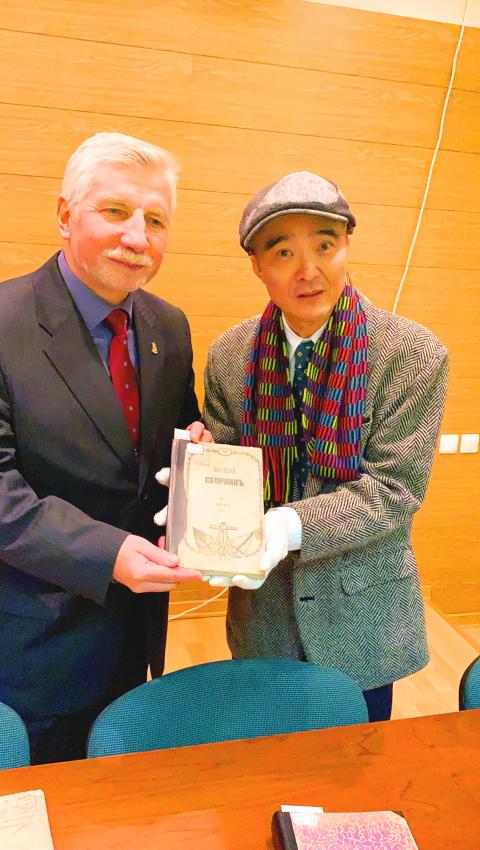
Photo courtesy of Yang Meng-che
The attack later became known as the Mudan Incident.
The Japanese government sought compensation from the Qing court over the killings, but was told that the incident was out of the court’s hands as it involved “savages.”
Japan used the incident to challenge Qing sovereignty over Taiwan and in May 1874 sent a naval force to attack the Paiwan in retaliation.
The incident received worldwide attention at the time, including in the Russian Empire, which dispatched its navy to investigate, the documents showed.
National Taipei University of Education professor Yang Meng-che (楊孟哲) on Nov. 12 visited the Russian Academy of Science’s Taiwan Research Center to examine the documents and talk to researchers.
Yang met with the archive’s director at the Russian State Naval Archive in Saint Petersburg, and examined the original records by naval officer and Asia researcher Pavel Ivanovich Ibis, who had visited Kaohsiung (then Takao) in 1875 aboard the Russian cruiser Askold.
After landing in Kaohsiung in January, Ibis spent the next two months traveling north to learn more about the Aborigines, the records showed.
Ibis was interested in finding out whether Taiwan’s Aborigines were related to those in other Asia-Pacific islands, Yang said, adding that he visited 13 Aboriginal communities in Taiwan, becoming the first European to do so.
Through a translator, Ibis gathered information for Russian authorities about the communities’ lifestyles and their military capabilities, Yang said.
Ibis’ report was published by the Russian military the following year, Yang said, adding that Taiwan researchers in Russia consider the report an impartial account of the Aboriginal communities.
The report was important for foreigners researching the incident and Taiwan’s strategic importance, Yang said.
“Taiwan has had few exchanges with Russia aside from Chiang Kai-shek’s (蔣介石) treatise on the Soviet-China relationship, or the aid provided by Russia following the Jiji Earthquake,” Yang said, adding that the documents are invaluable in the face of the limited exchanges.
There are plans to bring the documents to Taiwan next year for an exhibition and have them translated to Mandarin, Yang said.
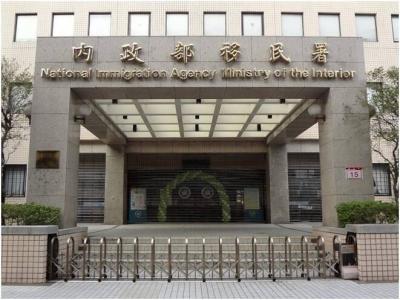
A small number of Taiwanese this year lost their citizenship rights after traveling in China and obtaining a one-time Chinese passport to cross the border into Russia, a source said today. The people signed up through Chinese travel agencies for tours of neighboring Russia with companies claiming they could obtain Russian visas and fast-track border clearance, the source said on condition of anonymity. The travelers were actually issued one-time-use Chinese passports, they said. Taiwanese are prohibited from holding a Chinese passport or household registration. If found to have a Chinese ID, they may lose their resident status under Article 9-1

Taiwanese were praised for their composure after a video filmed by Taiwanese tourists capturing the moment a magnitude 7.5 earthquake struck Japan’s Aomori Prefecture went viral on social media. The video shows a hotel room shaking violently amid Monday’s quake, with objects falling to the ground. Two Taiwanese began filming with their mobile phones, while two others held the sides of a TV to prevent it from falling. When the shaking stopped, the pair calmly took down the TV and laid it flat on a tatami mat, the video shows. The video also captured the group talking about the safety of their companions bathing

PROBLEMATIC APP: Citing more than 1,000 fraud cases, the government is taking the app down for a year, but opposition voices are calling it censorship Chinese Nationalist Party (KMT) Chairwoman Cheng Li-wun (鄭麗文) yesterday decried a government plan to suspend access to Chinese social media platform Xiaohongshu (小紅書) for one year as censorship, while the Presidential Office backed the plan. The Ministry of the Interior on Thursday cited security risks and accusations that the Instagram-like app, known as Rednote in English, had figured in more than 1,700 fraud cases since last year. The company, which has about 3 million users in Taiwan, has not yet responded to requests for comment. “Many people online are already asking ‘How to climb over the firewall to access Xiaohongshu,’” Cheng posted on

A classified Pentagon-produced, multiyear assessment — the Overmatch brief — highlighted unreported Chinese capabilities to destroy US military assets and identified US supply chain choke points, painting a disturbing picture of waning US military might, a New York Times editorial published on Monday said. US Secretary of Defense Pete Hegseth’s comments in November last year that “we lose every time” in Pentagon-conducted war games pitting the US against China further highlighted the uncertainty about the US’ capability to intervene in the event of a Chinese invasion of Taiwan. “It shows the Pentagon’s overreliance on expensive, vulnerable weapons as adversaries field cheap, technologically


 RSS
RSS