


More than 900 transportation experts and specialists have signed a petition launched on Sunday calling for a more transparent and systematic approach to reviewing major transportation projects around the nation.
The petition was launched by Tamkang University Department of Transportation Management professor Chang Sheng-hsiung (張勝雄), one of two experts who resigned from the ministry’s review committee for the Taoyuan Railway Grade Separation Project immediately after the committee approved the project on Nov. 15.
Chang accused the ministry of failing to follow due process in reviewing the project.
He also referred to the project as a “money pit,” saying not only has its budget surged from NT$30 billion (US$983.2 million) to NT$120 billion, but it would also cause the Taiwan Railways Administration’s (TRA) maintenance costs to rise 10 times.
Minister of Transportation and Communications Lin Chia-lung (林佳龍) on Friday said that Chang should not impose his opinions on others, adding that the ministry would continue with the project and that Chang’s opinions would be listed for reference.
Lin also said that transportation experts should help local government officials make their proposed projects more feasible, and that the government “should not allow only a small group of people to have the final say on the national transportation policy.”
“We want experts to help the government implement good policies and move Taiwan forward. Due to opposition from a few review committee members, the ministry was not able to implement any railway grade separation projects in the past five to six years,” he said.
Chang launched the petition after Lin said he was only one of a few experts who opposed railway grade separation projects.
Chang called for a transparent and systematic approach to reviews of transportation projects, as well as a re-evaluation of the policy to implement railway grade separation projects across the nation.
The petition collected 931 signatures within 36 hours, Chang said on Facebook.
Its supporters include 53 college professors from transportation, urban planning and landscaping departments; 245 specialists from construction firms and private transportation business operators; and 182 officials from the ministry, local transportation departments and the TRA.
Of the supporters, 98.9 percent agreed that the ministry should have a more open and transparent mechanism to review transportation projects, while 98.7 percent said it should publicize information about important projects and the procedures it has followed when reviewing them.
About 96 percent said that the government should evaluate the policy to promote railway grade separation projects and transform the TRA into a system like the Taipei Mass Rapid Transit System.
However, 56.2 percent said they opposed the ministry’s plan to remove the self-liquidation ratio from a list of criteria used to approve transportation projects.
“The results show that many transportation experts share my thoughts on this matter. I am not alone and definitely not from a small group of experts. They also show that many government officials cannot dare speak out against their supervisors. If this is the atmosphere that dominates the organization, then leaders cannot hear the voice of experts, which could hurt the nation,” Chang said.
Lin was asked about the petition yesterday after a groundbreaking ceremony for the Railway Technical Research and Certification Center in Kaohsiung.
He reiterated that the ministry followed due process when reviewing and approving important transportation projects, but agreed that the review process should be more open and transparent.
“We are willing to re-examine the opinions of experts and adopt some of the good ones,” he said, adding that all voices should be heard in a democratic nation.
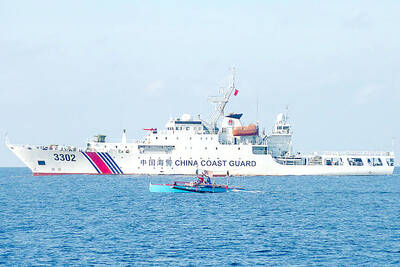
EXPANSIONIST: China deploys an average of 40 to 50 warships and coast guard vessels daily in the South China Sea, despite pledges not to militarize the region, an official said China is attempting to expand its influence across the First Island Chain and increase pressure on Japan by sending coast guard vessels into waters off of Taiwan under the pretext of maritime negotiations with Japan and the Philippines, a national security official said yesterday. China’s recent actions in the waters east of Taiwan and Japan and the Philippines’ exclusive economic zones (EEZ) are attempts to establish dominance in First Island Chain waters, said the official who declined to be named, adding that this is “expansion disguised as law enforcement.” Framing China’s actions solely as a cross-strait issue is a serious misjudgment that
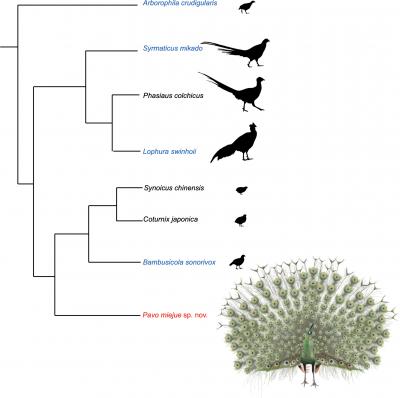
Through analyzing fossil evidence, a research team at National Taiwan University (NTU) discovered the largest endemic bird to have lived in Taiwan, naming it Pavo miejue, or extinct peafowl (滅絕孔雀). The Mikado pheasant, which is printed on the back of the NT$1,000 bank note, was previously believed to be the biggest endemic bird to Taiwan. The research team’s findings suggest that Pavo miejue lived during the Pleistocene epoch tens of thousands of years ago. It is the first endemic extinct bird species discovered and formally named in Taiwan. The study was coauthored by NTU Institute of Ecology and Evolutionary Biology professor Tsai Cheng-hsiu (蔡政修),
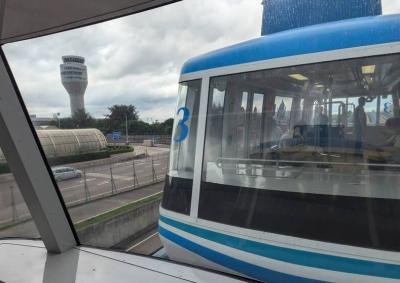
Taiwan Taoyuan International Airport is to suspend its automated Skytrain service connecting Terminal 1 and Terminal 2 starting on July 1 to facilitate connection works for the upcoming Terminal 3, the airport operator said today. Passengers and staff who need to travel between the two terminals after the suspension can instead use the Taoyuan MRT or the airport's 24-hour shuttle bus service, Taoyuan International Airport Corp said. The Taoyuan MRT Airport Line directly links the two terminals, while the shuttle buses are to operate around the clock, the company added. The Skytrain provides free transportation between the airport’s two terminals for travelers and
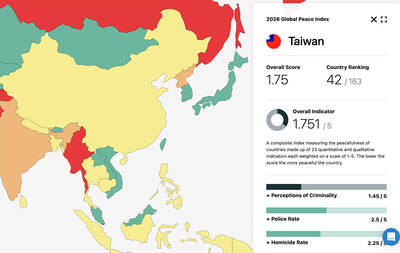
Taiwan ranked 42nd in terms of peacefulness among 163 countries, down five places from last year, according to this year’s Global Peace Index. With an overall score of 1.751, Taiwan dropped from 37th last year, the report published by the global Institute for Economics and Peace showed. The overall score measures a country’s level of peacefulness using 23 quantitative and qualitative indicators across three domains — ongoing domestic and international conflict, societal safety and security, and militarization. While Taiwan ranked 42nd worldwide, it was listed in ninth place among the 19 Asian-Pacific countries in the report, after New Zealand, Singapore, Japan, Malaysia,


 RSS
RSS