


Taiwan is facing a formidable crisis as Beijing’s “united front” tactics penetrate society, Chinese-born American historian Yu Ying-shih (余英時) said yesterday in a recorded speech, urging people to resist Chinese infiltration by improving “humanistic learning.”
An Academia Sinica academician, the US-based historian and Sinologist’s speech, titled “From scientific democracy to humanistic democracy,” was for a Sinology forum named after Chinese historian Luo Jialun (羅家倫) at National Chengchi University in Taipei.
Noting the protests against Hong Kong’s extradition bill, which has been withdrawn, Yu said that high-school students and undergraduates are the group voicing the strongest objection to oppression by the Chinese Communist Party (CCP).
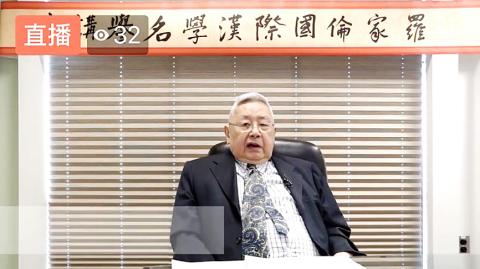
Screen grab from National Chengchi University’s Facebook account
Although Taiwanese society generally supports the protesters in their pursuit for democracy, other opinions are still heard, the 89-year-old said.
While diversity is good, people need a solid understanding of humanism to make correct judgements, he said.
Taiwanese society was subjected to the yoke of ideas imparted by the Chinese Nationalist Party (KMT), which affects conceptions of freedom and democracy, he said.
Hong Kongers know the importance of freedom, as they enjoyed it under the British government, which governed the territory until 1997, he said, adding that he had lived in Hong Kong for years.
Taiwan has fulfilled the ideal of developing democracy and science, which people of the May Fourth Movement in China in 1919 sought, Yu said.
Taiwanese can elect their own leaders and their scientific research has met global standards, Yu said.
However, despite its formal establishment, Taiwan’s democracy has not yet matured, he said.
Taiwanese should gain more understanding about the CCP through the study of politics, philosophy and history, Yu said.
Many media firms in Taiwan have become parrots of the Chinese-language Renmin Ribao (人民日報), a mouthpiece of the Chinese government, showing the lack of humanistic cultivation of Taiwanese, he said.
Without humanistic learning, it is hard to see through and resist China’s ever-present infiltration, Yu said.
Beijing has employed economic leverage to menace many nations, including in the West, which silence themselves in certain domains to protect their business with China, he said.
Democracy should be bolstered by humanistic values, otherwise it would spoil other parts of society, Yu said.
A lesson worth learning is that the Soviet Union, once looking to establish a democracy, returned to dictatorship after its dissolution, he said.
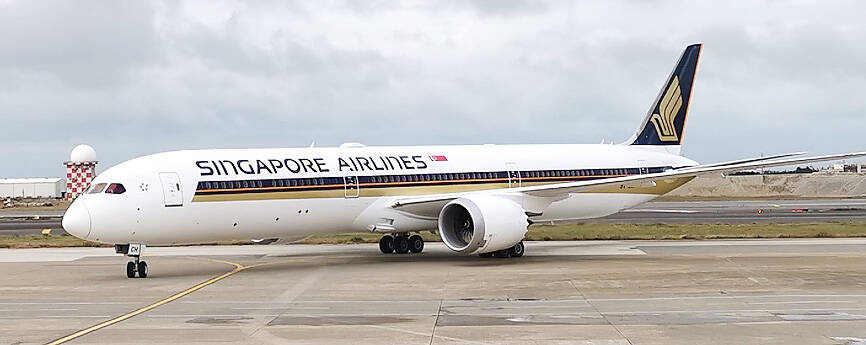
INCREASED CAPACITY: The flights on Mondays, Wednesdays, Fridays and Sundays would leave Singapore in the morning and Taipei in the afternoon Singapore Airlines is adding four supplementary flights to Taipei per week until May to meet increased tourist and business travel demand, the carrier said on Friday. The addition would raise the number of weekly flights it operates to Taipei to 18, Singapore Airlines Taiwan general manager Timothy Ouyang (歐陽漢源) said. The airline has recorded a steady rise in tourist and business travel to and from Taipei, and aims to provide more flexible travel arrangements for passengers, said Ouyang, who assumed the post in July last year. From now until Saturday next week, four additional flights would depart from Singapore on Monday, Wednesday, Friday
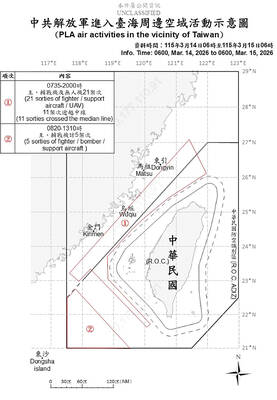
The Ministry of National Defense yesterday reported the return of large-scale Chinese air force activities after their unexplained absence for more than two weeks, which had prompted speculation regarding Beijing’s motives. China usually sends fighter jets, drones and other military aircraft around the nation on a daily basis. Interruptions to such routine are generally caused by bad weather. The Ministry of National Defense said it had detected 26 Chinese military aircraft in the Taiwan Strait over the previous 24 hours. It last reported that many aircraft on Feb. 25, when it spotted 30 aircraft, saying Beijing was carrying out another “joint combat

Taiwan successfully defended its women’s 540 kilogram title and won its first-ever men’s 640 kg title at the 2026 World Indoor Tug of War Championships in Taipei yesterday. In the women’s event, Taiwan’s eight-person squad reached the final following a round-robin preliminary round and semifinals featuring teams from Ukraine, Japan, Thailand, Vietnam, the Basque Country and South Korea. In the finals, they swept the Basque team 2-0, giving the team composed mainly of National Taiwan Normal University students and graduates its second championship in a row, and its fourth in five years. Team captain
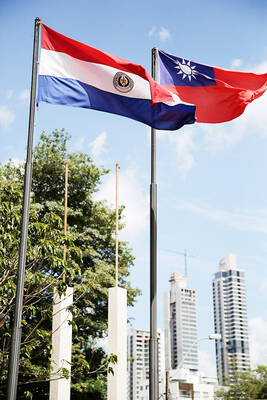
When Paraguayan opposition lawmaker Leidy Galeano returned from an all-expenses-paid tour of six Chinese cities late last year, she was convinced Paraguay risked missing out on major economic gains by sticking with longtime ally Taipei over Beijing — a message that participants on the trip heard repeatedly from Chinese officials. “Everything I saw there, I wanted for my country,” said Galeano, a member of the newly-formed Yo Creo party whose senior figures have spoken favorably about China. This trip and others like it — which people familiar with the visits said were at the invitation of the Chinese consulate in Sao Paulo


 RSS
RSS