


Kaohsiung Mayor Han Kuo-yu (韓國瑜) yesterday completed his registration at the Central Election Commission office in Taipei to run in next year’s presidential election.
The commission is accepting registrations from party-nominated candidates for the Jan. 11 presidential and legislative elections from yesterday to Friday.
Han, the Chinese Nationalist Party’s (KMT) candidate, was accompanied by his running mate, former premier Simon Chang (張善政), and his Taipei campaign office deputy chief executive, Hsu Shu-hua (許淑華).
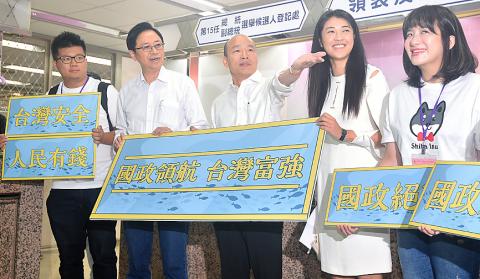
Photo: Liao Chen-huei, Taipei Times
Speaking to reporters at the commission, Han said he would very much like a “clean, civilized and healthy” presidential election that could make future generations proud.
“My running mate, Simon Chang, and I will work hard to create clean elections, a sunny vibe, a beautiful Taiwan and a bright future,” he said.
He and Chang will clearly explain their concerns and plans for the nation’s future so that people can decide whom to vote for, he added.
Compared with most democratic elections, next year’s presidential and legislative elections have a special significance, he said.
“While elections are usually about changing government, next year’s elections will determine the life or death of the Republic of China,” he said, urging Taiwanese around the world to return home to vote to protect the nation.
A survey conducted by the Chinese-language United Daily News published yesterday showed President Tsai Ing-wen (蔡英文) of the Democratic Progressive Party (DPP) leading in a three-way race, with a support rating of 45 percent, followed by Han with 29 percent and People First Party Chairman James Soong (宋楚瑜) with 8 percent.
Asked how he would close the 16-point gap with Tsai, Han said: “Can’t you see that I’m still smiling?”
The DPP is “silly” to assume that good poll numbers would ensure victory, he said.
“I think in a completely different way. I believe you can only win [the election] if you win people’s hearts,” he said.
If people look closely, they would notice that, while people attending his rally were there for him, those at Tsai’s were just there for “a lunchbox,” he said.
In other developments, Kaohsiung Tourism Bureau Secretary-General Kao Mei-lan (高美蘭) yesterday applied for a month’s leave, which means she would again miss the Kaohsiung City Council’s interpellation.
Kao has been on leave since Monday last week and had missed a question-and-answer session at the city council last week.
The Chinese-language Next Magazine earlier this month reported that Han and Kao in 2011 each purchased a pre-sale luxury apartment in Taipei’s Nangang District (南港) valued at more than NT$70 million (US$2.3 million).
A week after the report, DPP Legislator Lin Chun-hsien (林俊憲) said that Han and five other buyers allegedly pressured the construction company into offering them a combined loan of NT$1.3 billion to be returned over 20 years, conditions that were against the company’s policy.
Kao said in a written statement that by taking time off, she hoped to avoid any concerns about the government’s neutrality and to give her colleagues more space to work undisturbed.
All her housing investments were done legally and before she became a public servant, she said.
Additional reporting by CNA
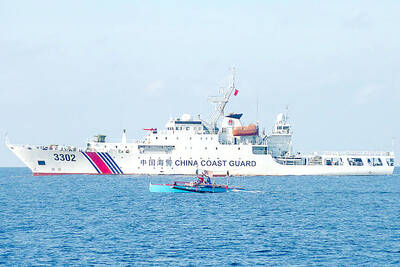
EXPANSIONIST: China deploys an average of 40 to 50 warships and coast guard vessels daily in the South China Sea, despite pledges not to militarize the region, an official said China is attempting to expand its influence across the First Island Chain and increase pressure on Japan by sending coast guard vessels into waters off of Taiwan under the pretext of maritime negotiations with Japan and the Philippines, a national security official said yesterday. China’s recent actions in the waters east of Taiwan and Japan and the Philippines’ exclusive economic zones (EEZ) are attempts to establish dominance in First Island Chain waters, said the official who declined to be named, adding that this is “expansion disguised as law enforcement.” Framing China’s actions solely as a cross-strait issue is a serious misjudgment that
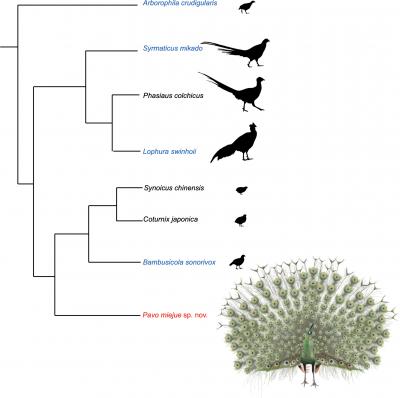
Through analyzing fossil evidence, a research team at National Taiwan University (NTU) discovered the largest endemic bird to have lived in Taiwan, naming it Pavo miejue, or extinct peafowl (滅絕孔雀). The Mikado pheasant, which is printed on the back of the NT$1,000 bank note, was previously believed to be the biggest endemic bird to Taiwan. The research team’s findings suggest that Pavo miejue lived during the Pleistocene epoch tens of thousands of years ago. It is the first endemic extinct bird species discovered and formally named in Taiwan. The study was coauthored by NTU Institute of Ecology and Evolutionary Biology professor Tsai Cheng-hsiu (蔡政修),
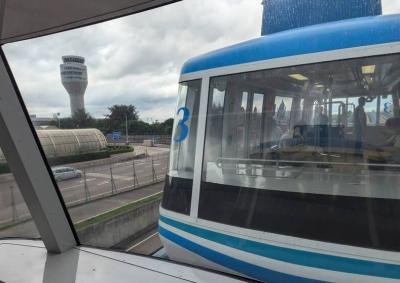
Taiwan Taoyuan International Airport is to suspend its automated Skytrain service connecting Terminal 1 and Terminal 2 starting on July 1 to facilitate connection works for the upcoming Terminal 3, the airport operator said today. Passengers and staff who need to travel between the two terminals after the suspension can instead use the Taoyuan MRT or the airport's 24-hour shuttle bus service, Taoyuan International Airport Corp said. The Taoyuan MRT Airport Line directly links the two terminals, while the shuttle buses are to operate around the clock, the company added. The Skytrain provides free transportation between the airport’s two terminals for travelers and
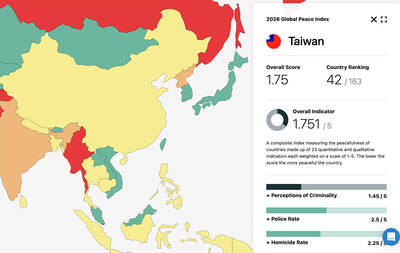
Taiwan ranked 42nd in terms of peacefulness among 163 countries, down five places from last year, according to this year’s Global Peace Index. With an overall score of 1.751, Taiwan dropped from 37th last year, the report published by the global Institute for Economics and Peace showed. The overall score measures a country’s level of peacefulness using 23 quantitative and qualitative indicators across three domains — ongoing domestic and international conflict, societal safety and security, and militarization. While Taiwan ranked 42nd worldwide, it was listed in ninth place among the 19 Asian-Pacific countries in the report, after New Zealand, Singapore, Japan, Malaysia,


 RSS
RSS