


Lack of knowledge about hikikomori — a Japanese term describing an individual who withdraws from society — is impeding treatment, a child psychologist said on Sunday.
Ko Chih-hung (柯志鴻), head of the psychiatry department at Kaohsiung Medical University Chung-Ho Memorial Hospital, made the remarks at a discussion titled “Smartphone/Internet Addiction and Hikikomori” that was cohosted by the Formosan Medical Association and the Taiwanese Society of Psychiatry as a part of an annual conference called Taiwan Medical Week.
Playing video games are often seen as the “simplest and fastest way to achieve happiness,” Ko said, adding that not only are the games challenging, but they also contain clear and fair rules.
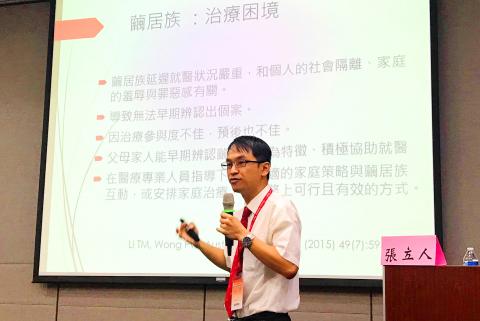
Photo: CNA
As long as players put in a little effort, they can derive a sense of accomplishment and happiness from playing games, he said, but added that when an individual spends an excessive amount of time gaming, they might lose interest in or the ability to complete their studies or hold a job.
Games could be used to compensate for setbacks they encounter in reality, they risk becoming conditioned by games over time and then falling into a vicious cycle, Ko said.
If they lack guidance during this time, they might exhibit behavioral problems at school and become a hikikomori, he added.
Hikikomori are a group of people showing prolonged social withdrawal, said Chang Li-ren (張立人), a pediatric psychologist at National Taiwan University Children’s Hospital.
Hikikomori, which mainly refers to adolescents or young adults, share five main traits: spending most of their time at home; showing a lack of interest in school or work; prolonged social withdrawal lasting more than six months; lack of social interactions; and the absence of schizophrenia, mood disorders or other mental disorders, he said.
According to studies in Japan, Hong Kong, South Korea and other Asian regions, the prevalence of Internet addiction is about 4 percent, with about 1 to 2 percent of those with Internet addiction becoming hikikomori, Chang said.
Most hikikomori are men, he said, adding that they spend on average one to four years withdrawn from society.
The risk factors for hikikomori are fairly diverse, he said.
Factors such as urbanization, globalization, a preference for virtual interactions, lack of social cohesion, childhood trauma, bullying, exclusion by peers, parent rejection or overprotection, poor academic performance and overly high expectations for oneself are all possible causes, Chang said.
Hikikomori also manifests itself differently based on culture, sources said.
In the US, hikikomori are mainly associated with a fear of failure, in the UK with avoidant personalities and in Japan with children relying on their parents for financial support, they said.
Most hikikomori followed rules and did not rebel as children, Chang said.
Although they appear lazy on the outside, on the inside, hikikomori are actually suffering, fearful of others and feeling lonely, bored or empty, he said.
Often hikikomori react strongly when their parents show concern or reprimand them, leading many parents to misinterpret their children’s abnormal behavior as problems in the parent-child relationship, he said.
However, these behaviors might be early signs of hikikomori, Chang said.
People rarely seek help for these behaviors, he said, adding that this is the biggest challenge in the treatment of the condition.
As hikikomori typically refuse to accept counseling or treatment, parents could first speak to medical professionals and change their own behavior at home to “slowly open their child’s heart,” Chang said.
Giving examples of what parents of hikikomori could do, Chang said parents should greet their children everyday, whether or not they receive a response, to create opportunities for their child to speak.
They could write notes to their children, speak to them from outside their bedroom door and ask them for their opinions, he said, adding that they should avoid discussing their children’s future plans or comparing them to their peers.
Before children are introduced to the Internet, it would be best to help them find other activities that lead to happiness and fulfillment, such as participating in sports teams or in the arts, such as music, painting or dance, Ko said.
By establishing different sources of happiness, even without the Internet, children would have other ways of making themselves happy and be less likely to rely solely on the Internet or on online games, he said.

The Centers for Disease Control (CDC) yesterday reported the first case of a new COVID-19 subvariant — BA.3.2 — in a 10-year-old Singaporean girl who had a fever upon arrival in Taiwan and tested positive for the disease. The girl left Taiwan on March 20 and the case did not have a direct impact on the local community, it said. The WHO added the BA.3.2 strain to its list of Variants Under Monitoring in December last year, but this was the first imported case of the COVID-19 variant in Taiwan, CDC Deputy Director-General Lin Ming-cheng (林明誠) said. The girl arrived in Taiwan on

South Korea is planning to revise its controversial electronic arrival card, a step Taiwanese officials said prompted them to hold off on planned retaliatory measures, a South Korean media report said yesterday. A Yonhap News Agency report said that the South Korean Ministry of Foreign Affairs is planning to remove the “previous departure place” and “next destination” fields from its e-arrival card system. The plan, reached after interagency consultations, is under review and aims to simplify entry procedures and align the electronic form with the paper version, a South Korean ministry official said. The fields — which appeared only on the electronic form

The Ministry of Foreign Affairs (MOFA) is suspending retaliation measures against South Korea that were set to take effect tomorrow, after Seoul said it is updating its e-arrival system, MOFA said today. The measures were to be a new round of retaliation after Taiwan on March 1 changed South Korea's designation on government-issued alien resident certificates held by South Korean nationals to "South Korea” from the "Republic of Korea," the country’s official name. The move came after months of protests to Seoul over its listing of Taiwan as "China (Taiwan)" in dropdown menus on its new online immigration entry system. MOFA last week

A bipartisan group of US senators has introduced a bill to enhance cooperation with Taiwan on drone development and to reduce reliance on supply chains linked to China. The proposed Blue Skies for Taiwan Act of 2026 was introduced by Republican US senators Ted Cruz and John Curtis, and Democratic US senators Jeff Merkley and Andy Kim. The legislation seeks to ease constraints on Taiwan-US cooperation in uncrewed aerial systems (UAS), including dependence on China-sourced components, limited access to capital and regulatory barriers under US export controls, a news release issued by Cruz on Wednesday said. The bill would establish a "Blue UAS


 RSS
RSS