


Minister of Transportation and Communications Lin Chia-lung (林佳龍) yesterday forecast that international tourists coming to Taiwan would grow by 7 percent this year.
Lin made the remarks at the four-day Taipei International Travel Fair, which began yesterday.
Lin said his ministry expected the total number of tourists visiting Taiwan to grow to 11.8 million by the end of next month, 7 percent more compared to last year.

Photo: Fang Pin-chao, Taipei Times
The Tourism Bureau is to be upgraded to the Tourism Administration and plans to convene a nationwide tourism symposium at the end of the year.
The bureau would soon release its 2030 Tourism White Paper, he added.
President Tsai Ing-wen (蔡英文), who also took part in the opening ceremony, said Taiwanese tourism quality is on the rise despite challenges this year.
“We have succeeded in pushing into more a more diverse market for international tourism and have made our tourism system all the more sustainable,” she said. “While the focus this year has been on township tourism, we are looking forward to next year where the focus will be on mountain-climbing and tourism,” she added.
Taiwan Visitors Association Director Yeh Chu-lan (葉菊蘭) said the fair would highlight Taiwan as a desirable location to visit, adding that her association would continue promoting Taiwanese tourism globally.
“We hope to let others behold how attractive Taiwanese scenery is and encourage them to come and visit,” Yeh said.
According to the event organizer, there are about 1,700 booths from 60 countries at the fair, which ends on Monday at the Taipei Nangang Exhibition Center.
The fair, the largest of its kind in Taiwan, features South Korean and Japanese tourism operators as well, because of growing local interest in travel to those countries.
Meanwhile, at the fair yesterday, Taiwan’s Tourism Bureau promoted mountain tourism.
The bureau is focusing on five north-south mountain ranges — the Central Mountain Range, Yushan (玉山), Hsuehshan (雪山), Alishan (阿里山) and the Coastal Mountain range — in its pavilion at the fair, bureau Deputy Director-General Chang Shi-chung (張錫聰) said.
There would be various exhibitions and forums on the mountains of Taiwan, as well as information about unique cultural features such as historic trails and Aboriginal communities, Chang said.
Taiwan is preparing to market next year as the “Year of Mountain Tourism” after it positioned the nation as an important international mountaineering destination in July, when the government allowed public access to national parks.
Previously, people who visited restricted ecological protected areas in Taiwan’s national parks had to apply for permits from both the National Police Agency and the Construction and Planning Agency.
However, the Construction and Planning Agency has launched a new mountain permit application portal that requires mountain visitors to apply for only one permit and provides fast-track processing, the bureau said.
Much of Taiwan is covered by mountains, and it has 268 mountains higher than 3,000m, the Bureau Web site showed.
The number of permits issued to Taiwanese and foreign nationals for access to trails in Yushan, Taroko and Shei Pa national parks has risen from 153,736 in 2016 to 187,053 in 2017 and 201,526 last year, according to Construction and Planning Agency figures, adding that last year, foreign nationals accounted for about 7.24 percent of the permits issued.

The Ministry of Finance this afternoon announced the winning numbers for the March-April uniform invoice lottery. The winning number for the NT$10 million (US$318,060) special prize is 19531471, and the winning number for the NT$2 million grand prize is 85941329. Three numbers were drawn for the NT$200,000 first prize: 07225810, 20231230 and 83518781. Those with receipts matching the last seven digits of any of the first-prize numbers will win the NT$40,000 second prize, while those matching the last six digits will win the NT$10,000 third prize. Those whose receipts match the last five digits of the first-prize numbers can claim the NT$4,000 fourth prize,

SIX SUBSIDIES: The monthly allowance for older farmers is to increase to NT$10,000, and NT$5,000 is to be given to homemakers under the national pension system, Lai said The government is to implement major welfare policies for disadvantaged groups, including raising the monthly allowance for older farmers to NT$10,000 and providing homemakers with NT$5,000 per month, President William Lai (賴清德) said yesterday. Lai made the remarks during a visit to Wangling Temple in Chiayi County, saying that the planned increases were being introduced amid economic growth and an increase in tax revenue. Touting a policy, in which the government plans to provide a monthly allowance of NT$5,000 for every child under the age of 18 in a bid to address Taiwan’s low birthrate, Lai said that if received for the
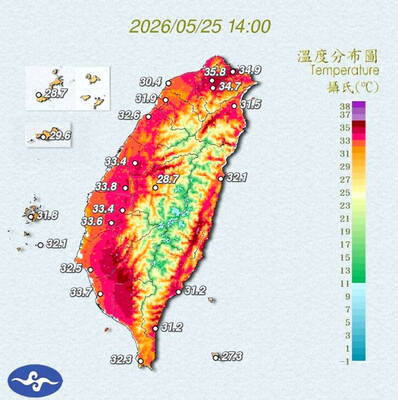
STAY COOL: The HPA recommended that people stay hydrated, use air-conditioning or fans while indoors, wear loose-fitting clothes and walk in the shade while outdoors Employers must implement measures such as installing cooling equipment, and providing drinking water and rest breaks for outdoor workers starting from Monday next week, the Taipei Department of Labor said on Sunday. Employers who fail to comply could face fines of NT$30,000 to NT$300,000 under the Occupational Safety and Health Act (職業安全衛生法), the department said. Businesses in Taipei employing fewer than 100 workers, as well as registered self-employed workers with labor insurance coverage, could receive on-site assessments and guidance from occupational safety consultants to help them apply for central government subsidies to implement or improve heat-protection measures, it said. Under the Ministry of
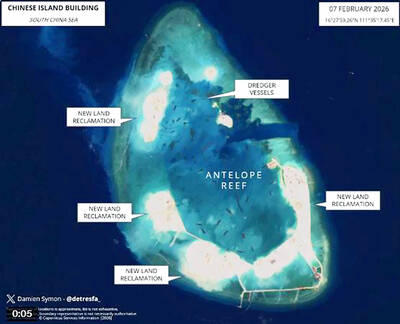
ISOLATION: The outposts would serve as support and backup bases, forcing US forces to either face China head-on or reroute, increasing travel time and operational costs China’s outposts in the South China Sea could be used to delay and constrain foreign forces during a conflict in the Taiwan Strait, giving Beijing a critical window to carry out amphibious landing and blockade operations, a report said. The Chinese Communist Party’s (CCP) forward operating bases on islands and reclaimed features in the South China Sea could delay foreign forces long enough for the Chinese People’s Liberation Army (PLA) to secure a key 48-to-72-hour window in the Taiwan Strait, a report commissioned by the Mainland Affairs Council found. The report, conducted by the Institute for National Defense and Security Research, examined


 RSS
RSS