


The majority of food-delivery personnel are hired as employees, rather than contractors, the Ministry of Labor (MOL) said yesterday.
The ministry said that the findings of a labor inspection conducted by the Occupational Safety and Health Administration, contradicted claims by food-delivery platform operators that their workers are contractors and not employees, so they are not obligated to follow the rules in the Labor Standards Act (勞動基準法) and Labor Inspection Act (勞動檢查法).
The inspection focused on people working for Foodpanda, Lalamove, Cutaway, Quickpick, Deliveroo, Uber Eats, YoWoo Food Delivery, Foodomo and JKO Delivery, administration Director Tsou Tzu-lien (鄒子廉) said, adding that Honestbee and Foodtoall have ceased operations.
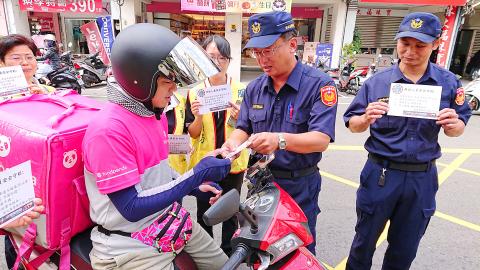
Photo: Tang Shih-ming, Taipei Times
Inspections were carried out by randomly selecting five or more delivery workers from each of the nine existing platform operators and asking them about their work relationship with their platform.
Five of the nine platforms hire their workers as employees, including Uber Eats, Lalamove, Cutaway, Quickpick and Foodpanda, the administration found.
JKO Delivery, Yo-Woo and Foodomo do not recruit workers, instead outsourcing the job to courier companies, while Deliveroo hires its workers as contractors, it found.
The inspection also found that the nation has 45,129 delivery workers, only 1,363 of which are contractors.
While five platforms hire their workers as employees, they do not follow labor regulations, such as maintaining worker record cards and workers’ attendance records, or subscribing to national labor insurance, the inspection found.
“We will hand over the collected evidence to local labor officials, who will determine the fines that platform operators should pay in view of their labor regulation infringements,” Tsou said.
Chu Chin-lung (朱金龍), an administration official who was in charge of this labor inspection, said that inspectors examined also examined records to determine the relationship between delivery workers and platform operators, including the contracts between operators and workers, delivery workers’ work schedules, how the delivery orders were given, and how workers are punished or rewarded.
They also interviewed the workers to verify the information they found, Chu said.
The business models used by food delivery platforms vary, Chu said.
Some platforms give assignments to workers directly, while others have food delivered by courier companies or other means, he said, adding that some platforms formed partnerships with cargo transport firms, but maintain a high degree of control over the delivery workers.
Using Uber Eats as an example, Chu said that it monitors workers’ whereabouts through its mobile phone application, adding that the company requires them to report to the system when a delivery is completed or interrupted.
The system also determines how many food orders a worker should deliver and how much they should be paid.
There is no room to negotiate salaries, he said.
Before attending a meeting at the Legislative Yuan yesterday morning, Minister of Labor Hsu Ming-chun (許銘春) said that the ministry would help delivery workers form a union, through which they could join a labor insurance plan.
The Sharing Economy Association Taiwan said that the ministry should respect workers’ decisions and avoid using outdated laws to regulate new services.
It should not look at isolated cases and use them to destroy job opportunities for 80,000 delivery workers, the association said.
“We hope that the Executive Yuan will quickly convene an inter-departmental meeting to discuss this issue,” it said.

NATIONAL SECURITY: Authorities are working to confirm the identities of the military personnel involved and investigating possible illegal conduct and regulatory violations Authorities are probing possible national security implications after Kinmen police and immigration officers on Sunday found a Chinese woman allegedly posing as a tourist while engaging in prostitution involving more than 10 military personnel. The woman, surnamed Chen (陳), has since been deported, authorities said, adding that investigators are still working to confirm the identities of those implicated, as the records only listed code names and aliases. The case stemmed from a report received by the Kinmen District Prosecutors’ Office on Friday last week from the Jinhu Precinct of the Kinmen County Police Bureau. On Sunday, police, along with the National Immigration

GLOBALGIVING: ‘ Caving to external pressure is not acceptable for an organization that has cultivated justice reform and human rights for 30 years,’ one NGO said A slew of non-government organizations (NGOs) have withdrawn from the GlobalGiving fundraising platform after it announced it would use “Chinese Taipei” instead of “Taiwan” from next month. The Taiwan Good Rice Association wrote on Facebook on Friday that it was informed on April 28 via a teleconference call of the change, which was made because the platform wanted to operate in China. Taiwan Good Rice is to terminate all cooperative relationships with GlobalGiving in response to the platform’s “unilateral and non-negotiable” decision to remove references to Taiwan, the NGO said. “Taiwan is in the official name of Taiwan Good Rice Association and the

HEAVY WEATHER: Typhoon Jangmi is due to crash straight into the Ryukyus as airlines look to shift flights to larger aircraft or cancel flights to Okinawa entirely Taiwan’s international air carriers announced flight adjustments over the weekend as Typhoon Jangmi is forecast to hit the Ryukyu Islands today and tomorrow. The Central Weather Administration (CWA) upgraded Jangmi from a tropical storm to a typhoon at 8am yesterday, with the eye located 580km south of Naha city. It was moving north at 19kph. Today, China Airlines’ CI-120, CI-121, CI-122 and CI-123 flights between Taoyuan and Naha, Okinawa, have been canceled as well as CI-132 and CI-133 between Kaohsiung and Naha. EVA Air’s BR-112, BR-113, BR-186 and BR-185 flights between Taoyuan and Naha are also canceled. Low-cost carrier Tigerair Taiwan canceled IT-230,

Chinese Nationalist Party (KMT) Chairwoman Cheng Li-wun (鄭麗文) yesterday briefed her party’s Central Standing Committee regarding her scheduled visit to the US between Monday next week and June 16, saying that her purpose would be to persuade the US that the Republic of China (ROC) Constitution was a “one China” constitution that would foster stable and peaceful cross-strait relations. The ROC Constitution is the most important defense for all Taiwanese citizens, as it upholds our democracy and has contributed to our robust economy, which aligns with international and US interests, she said. “We would not be troublemakers and drag the US under,”


 RSS
RSS