


The Ministry of Health and Welfare’s planned relaxation of standards for hiring foreign caretakers for respite care is too stiff in implementation, lacks sufficient funding and has a shortage of caretakers, according to the Taiwan Association of Family Caregivers.
The ministry had announced that it would relax regulations and allow an additional 180,000 people to be employed as respite care workers.
Of the nation’s 800,000 people who are disabled or diagnosed with dementia, 130,000 use long-term house care or daycare services, 100,000 are using such services provided by agencies, 240,000 hire foreign caretakers, while the remaining 330,000 are cared for by family members, association secretary-general Chen Ching-ning (陳景寧) said on Tuesday.
Aside from those who are cared for by long-term healthcare organizations or elderly individuals living alone, 650,000 individuals are in potential need of respite care, she said, adding that the 50,000 people now working in respite care is inadequate to handle the demand.
The association is advocating for a “one-day mutual respite care” program that would ultimately see groups of two, three or four families with respite care patients help each other one or two days a week.
The 2017 ministry funding — NT$300 million (US$9.8 million) — for respite care would, at NT$30,000 per person, only support 10,000 individuals, association standing executive director Chen Cheng-fen (陳正芬) said.
She also highlighted the shortage of personnel and how most respite caregivers work on a volunteer and short-term basis, stating that such a system of respite care lacked financial incentives for investment.
She urged an introduction of the “respite voucher,” which she said would return respite care choice to families caring for their own members.
“It would allow families to understand the importance of respite care,” Chen said, adding that the circulation of these vouchers would allow the market to gauge how much and what kind of services are needed.
A change of strategy was required for respite care to improve, association director Kuo Tsu-an (郭慈安) said.
Respite care organizations could target select parts of the service, such as caretaking, Kuo said, adding that it is also possible to discuss dividing personnel based on different skill sets, which would introduce different pay grades.
Companies specializing in caretaking, or dispatch services, are more proficient at short-term services, making it possible to consider relaxing regulations for such companies and encouraging more temporary caretakers, he said.
Long-term respite care must be innovative and flexible, National Chengchi University Professor Wang Tseng-yung (王增勇) said, adding that funding and choice should be given to respite care agencies.

Chinese spouse and influencer Guan Guan’s (關關) residency permit has been revoked for repeatedly posting pro-China videos that threaten national security, the National Immigration Agency confirmed today. Guan Guan has said many controversial statements in her videos posted to Douyin (抖音), including “the red flag will soon be painted all over Taiwan” and “Taiwan is an inseparable part of China,” and expressing hope for expedited reunification. The agency last year received multiple reports alleging that Guan Guan had advocated for armed reunification. After verifying the reports, the agency last month issued a notice requiring her to appear and explain her actions. Guan

GIVE AND TAKE: Blood demand continues to rise each year, while fewer young donors are available due to the nation’s falling birthrate, a doctor said Blood donors can redeem points earned from donations to obtain limited edition Formosan black bear travel mugs, the Kaohsiung Blood Center said yesterday, as it announced a goal of stocking 20,000 units of blood prior to the Lunar New Year. The last month of the lunar year is National Blood Donation Month, when local centers seek to stockpile blood for use during the Lunar New Year holiday. The blood demand in southern Taiwan — including Tainan and Kaohsiung, as well as Chiayi, Pingtung, Penghu and Taitung counties — is about 2,000 units per day, the center said. The donation campaign aims to boost

The Kaohsiung Tourism Bureau audited six hotels in an effort to prevent price gouging ahead of Korean band BTS’ concert tour in the city scheduled for Nov. 19, 21 and 22 this year. The bureau on Friday said that the audits — conducted in response to allegations of unfair pricing posted on social media — found no wrongdoing. These establishments included the local branches of Chateau de Chine, Hotel Nikko, My Humble House, and Grand Hai Lai, it said, adding that the Consumer Protection Commission would have penalized price gougers had the accusations been substantiated. The bureau said the Tourism Development Act
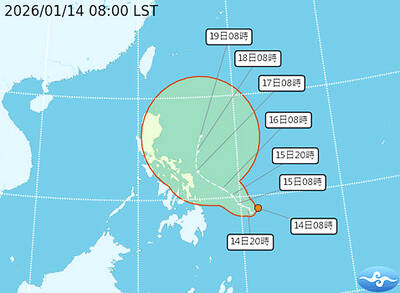
BACK TO WINTER: A strong continental cold air mass would move south on Tuesday next week, bringing colder temperatures to northern and central Taiwan A tropical depression east of the Philippines could soon be upgraded to be the first tropical storm of this year, the Central Weather Administration (CWA) said yesterday, adding that the next cold air mass is forecast to arrive on Monday next week. CWA forecaster Cheng Jie-ren (鄭傑仁) said the first tropical depression of this year is over waters east of the Philippines, about 1,867km southeast of Oluanpi (鵝鑾鼻), and could strengthen into Tropical Storm Nokaen by early today. The system is moving slowly from northwest to north, and is expected to remain east of the Philippines with little chance of affecting Taiwan,


 RSS
RSS