


The US Department of Agriculture yesterday approved the imports of fresh guava from Taiwan after 10 years of negotiations, the Council of Agriculture (COA) said yesterday.
Taiwan is an endemic area of the oriental fruit fly (Bactrocera dorsalis), the melon fruit fly (Bactrocera cucurbitae) and the fruit fly (Bactrocera tau) — pests that might be found on guavas grown in Taiwan.
The two sides have been discussing quarantine requirements on pests to address these concerns, COA Bureau of Animal and Plant Health Inspection and Quarantine Deputy Director-General Chou Hui-chuan (鄒慧娟) said.
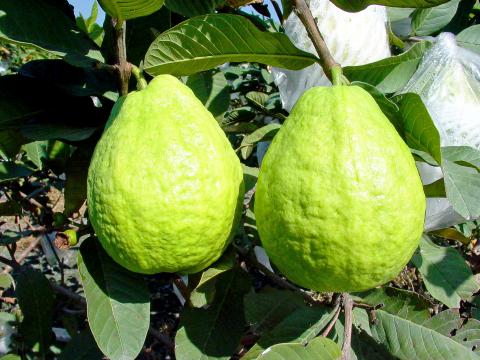
Photo courtesy of the Council of Agriculture
The application was filed to the US 10 years ago, along with documents of production management, pest species and pest control regulations, she said.
The evaluation on the US side took a long time, Chou said, adding that after documents were reviewed on the first round, the US sent delegations to inspect the certification and product management systems in Taiwan.
Fresh guavas are to be stored in an environment below 1?C for 17 consecutive days before arriving in the US, and cover bags will be applied to keep pests away from smaller guavas that have a diameter of less than 4 cm, the council said.
Every location of guava production and packing has to be officially registered and certified, Chou said.
Taiwan is the first country after Mexico that has been authorized to import fresh guavas into the US, she added.
After the announcement comes into effect, both sides will sign more documents and confirm further directions for farmers to follow, Chou said, adding that the first shipment of guavas could be sent to the US as early as the end of this year.

HORROR STORIES: One victim recounted not realizing they had been stabbed and seeing people bleeding, while another recalled breaking down in tears after fleeing A man on Friday died after he tried to fight the knife-wielding suspect who went on a stabbing spree near two of Taipei’s busiest metro stations, Taipei Mayor Chiang Wan-an (蔣萬安) said. The 57-year-old man, identified by his family name, Yu (余), encountered the suspect at Exit M7 of Taipei Main Station and immediately tried to stop him, but was fatally wounded and later died, Chiang said, calling the incident “heartbreaking.” Yu’s family would receive at least NT$5 million (US$158,584) in compensation through the Taipei Rapid Transit Corp’s (TRTC) insurance coverage, he said after convening an emergency security response meeting yesterday morning. National

Taiwan has overtaken South Korea this year in per capita income for the first time in 23 years, IMF data showed. Per capita income is a nation’s GDP divided by the total population, used to compare average wealth levels across countries. Taiwan also beat Japan this year on per capita income, after surpassing it for the first time last year, US magazine Newsweek reported yesterday. Across Asia, Taiwan ranked fourth for per capita income at US$37,827 this year due to sustained economic growth, the report said. In the top three spots were Singapore, Macau and Hong Kong, it said. South

PLANNED: The suspect visited the crime scene before the killings, seeking information on how to access the roof, and had extensively researched a 2014 stabbing incident The suspect in a stabbing attack that killed three people and injured 11 in Taipei on Friday had planned the assault and set fires at other locations earlier in the day, law enforcement officials said yesterday. National Police Agency (NPA) Director-General Chang Jung-hsin (張榮興) said the suspect, a 27-year-old man named Chang Wen (張文), began the attacks at 3:40pm, first setting off smoke bombs on a road, damaging cars and motorbikes. Earlier, Chang Wen set fire to a rental room where he was staying on Gongyuan Road in Zhongzheng District (中正), Chang Jung-hsin said. The suspect later threw smoke grenades near two exits
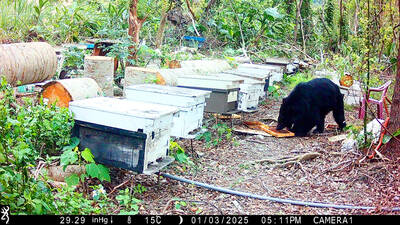
The Forestry and Nature Conservation Agency yesterday launched a gift box to market honey “certified by a Formosan black bear” in appreciation of a beekeeper’s amicable interaction with a honey-thieving bear. Beekeeper Chih Ming-chen (池明鎮) in January inspected his bee farm in Hualien County’s Jhuosi Township (卓溪) and found that more than 20 beehives had been destroyed and many hives were eaten, with bear droppings and paw prints near the destroyed hives, the agency said. Chih returned to the farm to move the remaining beehives away that evening when he encountered a Formosan black bear only 20m away, the agency said. The bear


 RSS
RSS