


Four cases of serious complications from enterovirus infections were confirmed last week, including a two-year-old in northern Taiwan, and a two-year-old, three-year-old and an 11-year-old in central Taiwan, Centers for Disease Control (CDC) physician Lin Yung-ching (林詠青) said yesterday.
Three of the children were infected with enterovirus 71 (EV71) and one with coxsackievirus A4, he said, adding that they had developed either encephalitis (inflammation of the brain) or encephalomyelitis (inflammation of the brain and spinal cord).
The symptoms — fever, vomiting, oral ulcers, leg weakness, involuntary twitching of the muscles and loss of consciousness — occurred between Sept. 12 and Sept. 25, Lin said.
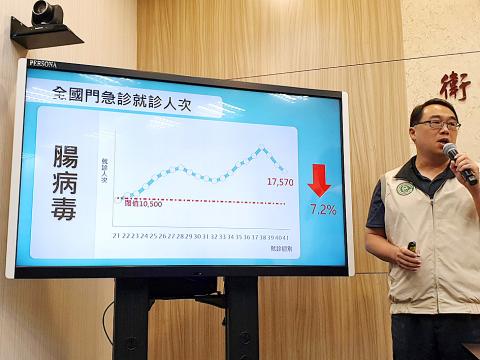
Photo: CNA
All four were hospitalized and treated in time, Lin said.
CDC Deputy Director-General Philip Lo (羅一鈞) said children under five years old are at an increased risk of serious complications, especially as there has not been a large EV71 epidemic in Taiwan for many years, so most children or teenagers have never been infected.
There were 17,570 hospital visits for enterovirus infections last week, a reduction of 7.2 percent compared with the week before, with the main virus types in the past four weeks being coxsackie type A, CDC data showed.
The reduced number of cases last week could be because many clinics and hospitals were not open during the four-day Double Ten National Day holiday, Lo said, adding that enterovirus is still in its epidemic season, so parents and people who work with children should take preventive measures and be on the look out for symptoms.
Meanwhile, a case of Japanese encephalitis in a man in his 30s in Yunlin’s Huwei Township (虎尾) was confirmed last week, the CDC said.
The man, who had not visited another country, suffered a fever on Sept. 21, was hospitalized on Sept. 23 after losing consciousness and remained in an intensive care unit until Oct. 2, Lin said.
“The man’s vital signs are stable, but his speech has not yet fully recovered and he still has weak limbs,” he said.
The fatality rate of Japanese encephalitis can be up to 20 or 30 percent, and 30 to 50 percent of those who do recover suffer permanent neurological or psychiatric aftereffects.
Twenty-one cases have been confirmed this year, including two deaths: Five were in Kaohsiung, four in Taoyuan and three in Taichung, with the others being sporadic cases in other cities and counties, Lin said.
Getting vaccinated is the best way to prevent Japanese encephalitis, Lin said, urging people to take infants older than 15 months to get vaccinated at local health departments, contracted clinics and hospitals.

Considering that most countries issue more than five denominations of banknotes, the central bank has decided to redesign all five denominations, the bank said as it prepares for the first major overhaul of the banknotes in more than 24 years. Central bank Governor Yang Chin-lung (楊金龍) is expected to report to the Legislative Yuan today on the bank’s operations and the redesign’s progress. The bank in a report sent to the legislature ahead of today’s meeting said it had commissioned a survey on the public’s preferences. Survey results showed that NT$100 and NT$1,000 banknotes are the most commonly used, while NT$200 and NT$2,000

The Centers for Disease Control (CDC) yesterday reported the first case of a new COVID-19 subvariant — BA.3.2 — in a 10-year-old Singaporean girl who had a fever upon arrival in Taiwan and tested positive for the disease. The girl left Taiwan on March 20 and the case did not have a direct impact on the local community, it said. The WHO added the BA.3.2 strain to its list of Variants Under Monitoring in December last year, but this was the first imported case of the COVID-19 variant in Taiwan, CDC Deputy Director-General Lin Ming-cheng (林明誠) said. The girl arrived in Taiwan on

South Korea is planning to revise its controversial electronic arrival card, a step Taiwanese officials said prompted them to hold off on planned retaliatory measures, a South Korean media report said yesterday. A Yonhap News Agency report said that the South Korean Ministry of Foreign Affairs is planning to remove the “previous departure place” and “next destination” fields from its e-arrival card system. The plan, reached after interagency consultations, is under review and aims to simplify entry procedures and align the electronic form with the paper version, a South Korean ministry official said. The fields — which appeared only on the electronic form

The Ministry of Foreign Affairs (MOFA) is suspending retaliation measures against South Korea that were set to take effect tomorrow, after Seoul said it is updating its e-arrival system, MOFA said today. The measures were to be a new round of retaliation after Taiwan on March 1 changed South Korea's designation on government-issued alien resident certificates held by South Korean nationals to "South Korea” from the "Republic of Korea," the country’s official name. The move came after months of protests to Seoul over its listing of Taiwan as "China (Taiwan)" in dropdown menus on its new online immigration entry system. MOFA last week


 RSS
RSS