


The Centers for Disease Control (CDC) yesterday reported the first case of measles contracted in New Zealand, as it warned that this is still the peak period for enterovirus infections.
A man in his 20s living in southern Taiwan who visited New Zealand with his family from Aug. 14 to Aug. 24 developed a fever on Sept. 1 and sought medical attention at clinics three times before he developed a rash and sought treatment at a hospital on Sept. 5 and again on Sept. 7.
On his last visit, he was finally confirmed to have measles and hospitalized.
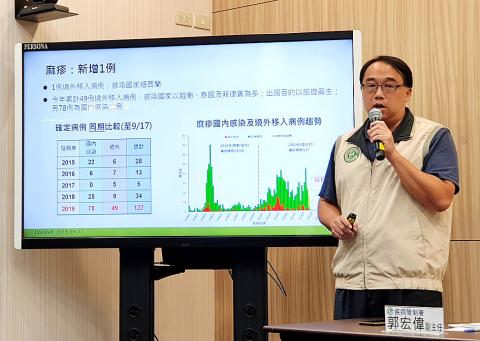
Photo: CNA
CDC physician Huang Wan-ting (黃婉婷) said the man had initially been diagnosed with a cold and a viral infection.
He is now back home, while the 601 people who had direct contact with him during the communicable period for measles will continue to be monitored until Wednesday next week, Huang said.
CDC Deputy Director-General Philip Lo (羅一鈞) said doctors might have erred in their initial diagnoses because most cases of imported measles have come from Southeast Asia, Europe or the US, so the doctors did not suspect measles even when the man told them he had recently visited New Zealand.
New Zealand is facing its worst measles outbreak in more than 22 years, with a total of 1,275 cases confirmed as of Friday, 165 cases in the past week alone, Huang said.
The CDC has issued a level-one travel notice — the “Watch” level — for measles in New Zealand, she added.
On the enterovirus front, CDC Epidemic Intelligence Center Deputy Director Guo Hung-wei (郭宏偉) said 20,585 hospital and clinic visits related to the virus were reported last week, a 6.5 percent increase from the week before, showing the disease is still in its peak period.
A total of 243 classes were suspended last week due to enterovirus infections, 194 at preschools, 26 at elementary schools and 23 at nursery schools.
The enterovirus outbreak is expected to continue until the middle of next month, so parents and people who work with young children should be especially alert for signs of suspected symptoms in children.
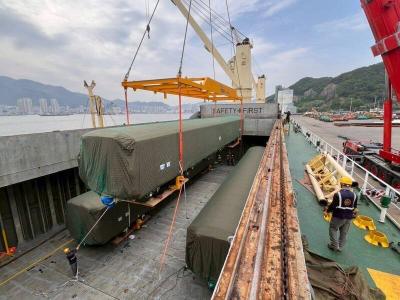
The first of 10 new high-capacity trains purchased from South Korea’s Hyundai Rotem arrived at the Port of Taipei yesterday to meet the demands of an expanding metro network, Taipei Rapid Transit Corp (TRTC) said yesterday. The train completed a three-day, 1,200km voyage from the Port of Masan in South Korea, the company said. Costing NT$590 million (US$18.79 million) each, the new six-carriage trains feature a redesigned interior based on "human-centric" transportation concepts, TRTC said. The design utilizes continuous longitudinal seating to widen the aisles and optimize passenger flow, while also upgrading passenger information displays and driving control systems for a more comfortable
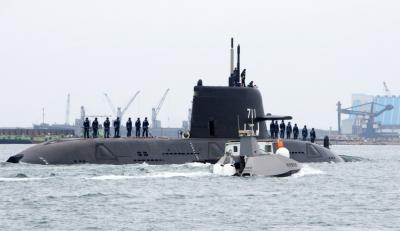
Taiwan's first indigenous defense submarine, the SS-711 Hai Kun (海鯤, or Narwhal), departed for its 13th sea trial at 7am today, marking its seventh submerged test, with delivery to the navy scheduled for July. The outing also marked its first sea deployment since President William Lai (賴清德) boarded the submarine for an inspection on March 19, drawing a crowd of military enthusiasts who gathered to show support. The submarine this morning departed port accompanied by CSBC Corp’s Endeavor Manta (奮進魔鬼魚號) uncrewed surface vessel and a navy M109 assault boat. Amid public interest in key milestones such as torpedo-launching operations and overnight submerged trials,
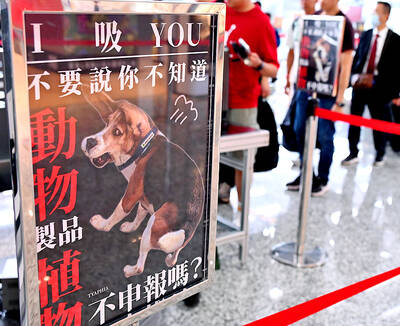
Quarantine awareness posters at Taiwan Taoyuan International Airport have gone viral for their use of wordplay. Issued by the airport branch of the Animal and Plant Health Inspection Agency, the posters feature sniffer dogs making a range of facial expressions, paired with advisory messages built around homophones. “We update the messages for holidays and campaign needs, periodically refreshing materials to attract people’s attention,” quarantine officials said. “The aim is to use the dogs’ appeal to draw focus to quarantine regulations.” A Japanese traveler visiting Taiwan has posted a photo on X of a poster showing a quarantine dog with a

SECURITY RISK: A university student sent a general alarm signal to THSRC’s control center on April 5, causing four operating trains to temporarily halt services The Ministry of Transportation and Communications yesterday pledged to submit a report on ways to harden the communication security of railway systems after a university student hacked into Taiwan High Speed Rail Corp’s (THSRC) radio communications system and disrupted operations of four high-speed rail trains last month. Investigation by the police and prosecutors found that the university student and radio enthusiast, surnamed Lin (林), first used a software-defined radio (SDR) filter to analyze THSRC signals, downloaded the data to a computer, cracked the parameters and then programmed the codes into his radio devices. Lin then sent a general alarm signal to


 RSS
RSS