


The Civil Aeronautics Administration (CAA) yesterday said that it would consider revising regulations on uncrewed aerial vehicles (UAVs) in the Civil Aviation Act (民用航空法) after they take effect on March 31 next year.
An amendment adding the regulations was passed by the Legislative Yuan on April 3 last year and promulgated by President Tsai Ing-wen (蔡英文) on April 25.
The CAA yesterday held its first computerized license test for drone operators, which was taken by 24 people from government-affiliated agencies.
All the applicants passed the written test and are scheduled to conduct drone flight tests in Miaoli County this afternoon, the agency said.
People flying drones weighing at least 2kg or those who need to operate drones at special events should have a valid license to do so, it said.
All drones used in Taiwan must be registered with the it, the CAA said, adding that owners who fail to do so would face up to NT$150,000 in fines, while people operating drones without a license would be fined up to NT$300,000.
The minimum fine for people flying drones in restricted airspace is NT$300,000, it said.
Drones are likely to be used in various services and applications, from the delivery of goods to those equipped with radio frequency identification (RFID) functions, CAA Flight Standards Division Director Clark Lin (林俊良) said.
As the technology continues to mature, the agency is considering amending the regulations after they take effect next year, Lin said.
The government wants to be in sync with other Asia-Pacific nations in terms of the certifications for drones weighing between 25kg and 150kg equipped with RFID functions, Lin said.
The CAA has been attending a regional UAV alliance conferences to gather the latest information on drone applications.
At present, foreign drone operators must have their drones certified locally if they want to use them in Taiwan, Lin said.
If there are identical standards across the Asia-Pacific region, the CAA could then streamline certification procedures for drone operators, Lin said, adding that it has reserved the room for such an amendment in the regulations.
The Chinese-language Commercial Times yesterday reported that the CAA might start to regulate the components used in drones by asking owners to report the suppliers of the components.
The proposal follows a drone attack n Saturdayon two major oil facilities in Saudi Arabia, it said.
Incidents such as terrorist attacks are under the purview of national security agencies, which would determine which facilities need heightened security, Lin said.

FUKUOKA SITUATION: Japanese media reported that the pathogen is expected to be identified by the summer, while the CDC downplayed the idea that it was hMPV A “mysterious cold-like illness” reported in Japan’s Fukuoka Prefecture does not seem to be a new disease, but Japanese authorities have been asked about the situation, the Centers for Disease Control (CDC) said yesterday. The Fukuoka Prefectural Medical Association on Wednesday told a news conference that a “mystery cold” that has become a hot topic on social media is “highly likely to be caused by some kind of viral infection,” Japan’s KBC News reported. “Many people are experiencing symptoms starting with a sore throat, followed by a runny nose, phlegm and a severe cough,” KBC News reported, citing association officials. Health authorities are

Nvidia Corp CEO Jensen Huang (黃仁勳) arrived in Taiwan yesterday ahead of upcoming AI and technology events, saying he plans to meet with clients and Taiwan Semiconductor Manufacturing Co Chairman C.C. Wei (魏哲家) during his visit. After landing at Taipei Songshan Airport, Huang posed for photos with fans and handed out Yakult drinks to reporters and supporters waiting at the scene, saying he has “a lot to do” during the trip. Asked about reports that Nvidia’s planned headquarters site in Taipei’s Beitou Shilin Technology Park could break ground on May 27, Huang said that if the company holds an event, he would

The Ministry of Finance this afternoon announced the winning numbers for the March-April uniform invoice lottery. The winning number for the NT$10 million (US$318,060) special prize is 19531471, and the winning number for the NT$2 million grand prize is 85941329. Three numbers were drawn for the NT$200,000 first prize: 07225810, 20231230 and 83518781. Those with receipts matching the last seven digits of any of the first-prize numbers will win the NT$40,000 second prize, while those matching the last six digits will win the NT$10,000 third prize. Those whose receipts match the last five digits of the first-prize numbers can claim the NT$4,000 fourth prize,
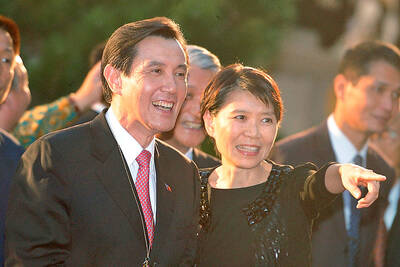
Former president Ma Ying-jeou (馬英九) yesterday expressed “shock and regret” over a statement issued by his wife without his consent, and rejected her assertion that his eldest sister, Ma Yi-nan (馬以南), would manage his medical care or act as his spokesperson amid an ongoing embezzlement probe into his foundation. Ma Ying-jeou in a statement said he was shocked by a statement by his wife, Chou Mei-ching (周美青), regarding his affairs. Ma Yi-nan “must not” be in charge of his healthcare and other personal affairs, nor can she be allowed to represent the Ma family, the former president said. He said he was also


 RSS
RSS