


The US’ Sally Ride, its newest research vessel, berthed at the Port of Keelung on Thursday as it makes its way to international waters near Palau with a research team that includes faculty and students from National Taiwan University’s Institute of Oceanography.
President Tsai Ing-wen (蔡英文) said at an event in outlying Kinmen County yesterday that the port call was an international collaboration involving the university.
The vessel flew a Republic of China (ROC) flag alongside a US flag.
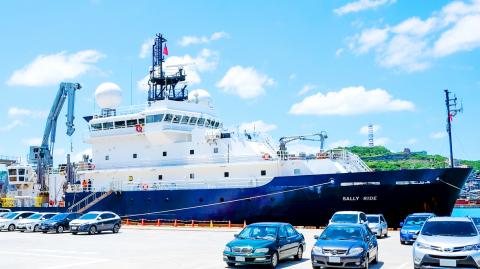
Photo courtesy of Lin Lu-hung
Yang Yiing-jang (楊穎堅), an associate professor at the institute, said separately that it is not unusual for the two flags to be flown together, as foreign ships berthing at Taiwan’s ports fly “a courtesy flag” according to international convention as a token of respect.
In October last year, another US research vessel, the Thomas G. Thompson, stopped at the Port of Kaohsiung, with some media mistakenly reporting that the visit had something to do with US Navy drills a month later.
Launched in August 2014, the Sally Ride is owned by the US Office of Naval Research and operated by the Scripps Institution of Oceanography at the University of California, San Diego.
The vessel is named after US astronaut Sally Ride — the first American woman in space.
It is to remain in Keelung until Sept. 2 while the institute’s staff confirm logistics, Yang said, adding that technicians and students would be on the voyage in a learning capacity.
The ship is a shared-use research vessel under the US’ University-National Oceanographic Laboratory System, meaning that other institutes can use it for research purposes, institute director Jan Sen (詹森) said.
Researchers onboard are working on a project called “Propagation of Intra-Seasonal Tropical Oscillations” that involves Taiwanese, US and Philippine personnel, Jan said.
It aims to improve understanding of multiscale, air-sea and land-atmosphere interactions that regulate boreal summer intra-seasonal oscillations, he said.
The vessel would return to Keelung late next month, he said.
Over the past two decades, institute members have maintained friendly collaborations with US oceanographers, as the latter found Taiwan’s logistics more reliable than other countries in the region, he said.
Given Taiwan’s geostrategic location in the northwestern Pacific, the government should consider making the nation a relay station for oceanographers, which would be a more pragmatic “way out” for Taiwan with its difficult foreign relations situation, Jan said.
With climate change effects drawing increased attention, Taiwan and the US are expanding collaboration on Earth science research, Minister of Science and Technology Chen Liang-gee (陳良基) said separately yesterday.
After he led a delegation to meet with US National Science Foundation members last month, another delegation would visit the foundation next month to explore further collaboration ideas, Chen said.
Proposals include installing US National Oceanic and Atmospheric Administration weather radars in Taiwan to advance forecasting models, he said, adding that the ministry would discuss with the American Institute in Taiwan regarding the arrangements.

Yangmingshan National Park authorities yesterday urged visitors to respect public spaces and obey the law after a couple was caught on a camera livestream having sex at the park’s Qingtiangang (擎天崗) earlier in the day. The Shilin Police Precinct in Taipei said it has identified a suspect and his vehicle registration number, and would summon him for questioning. The case would be handled in accordance with public indecency charges, it added. The couple entered the park at about 11pm on Thursday and began fooling around by 1am yesterday, the police said, adding that the two were unaware of the park’s all-day live

Fast food chain McDonald's is to raise prices by up to NT$5 on some products at its restaurants across Taiwan, starting on Wednesday next week, the company announced today. The prices of all extra value meals and sharing boxes are to increase by NT$5, while breakfast combos and creamy corn soup would go up by NT$3, the company said in a statement. The price of the main items of those meals, if ordered individually, would remain the same. Meanwhile, the price of a medium-sized lemon iced tea and hot cappuccino would rise by NT$3, extra dipping sauces for chicken nuggets would go up

Yangmingshan National Park’s Qingtiangang (擎天崗) nature area has gone viral after a park livestream camera observed a couple in the throes of intimate congress, which was broadcast live on YouTube, drawing large late-night crowds and sparking a backlash over noise, bright lights and disruption to wildlife habitat. The area’s livestream footage appeared to show a couple engaging in sexual activity on a picnic table in the park on Friday last week, with the uncensored footage streamed publicly online. The footage quickly spread across social media, prompting a tide of visitors to travel to the site to “check in” and recreate the

Minister of Digital Affairs Lin Yi-ching (林宜敬) yesterday cited regulatory issues and national security concerns as an expert said that Taiwan is among the few Asian regions without Starlink. Lin made the remarks on Facebook after funP Innovation Group chief executive officer Nathan Chiu (邱繼弘) on Friday said Taiwan and four other countries in Asia — China, North Korea, Afghanistan and Syria — have no access to Starlink. Starlink has become available in 166 countries worldwide, including Ukraine, Malaysia, the Philippines and Vietnam, in the six years since it became commercial, he said. While China and North Korea block Starlink, Syria is not


 RSS
RSS