


The North Pacific Fisheries Commission (NPFC) on Thursday agreed to set quotas for saury fishing next year, the Fisheries Agency said yesterday.
Taiwan, participating under the name Chinese Taipei, would limit its catch to less than 180,000 tonnes, the agency said.
Formally established in 2015, the group’s seven other members are Japan, Russia, China, South Korea, Vanuatu, Canada and the US, according to information on the commission’s Web site.
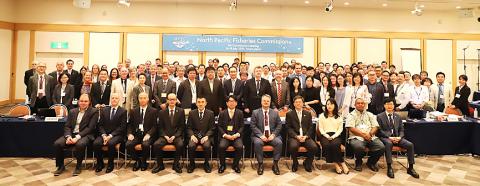
Photo courtesy of the Fisheries Agency
Nearly 90 Taiwanese ships operate in the North Pacific’s high seas from July to November every year, bringing back an average annual catch of 160,000 tonnes and making Taiwan one of the major consumers of the species, the agency said.
While the commission in 2015 launched measures to protect saury fry and limit member states’ fleet expansion, it did not set a cap on fishing volume until this year’s meeting in Tokyo, which was held from Tuesday to Thursday, the agency said.
The saury population has been declining due to overfishing, it said, citing studies by the commission.
The idea of placing a cap was broached by Japan, after its proposal last year failed to garner a consensus, Fisheries Agency Deputy-General Lin Kuo-ping (林國平) said.
China and Vanuatu, which opposed the measure last year, approved it this year, Lin said.
Effective next year, saury fishing in the exclusive economic zones of coastal countries and the North Pacific’s high seas would be limited to 556,250 tonnes, the agency said.
The volume might be re-evaluated in future meetings, Lin said, adding that it would be better to determine each member’s allowable catch to avoid potential conflict over quota division.
Member states are also required to limit their saury catch in the high seas to below last year’s level, which was 180,000 tonnes in Taiwan’s case.
That goal is not difficult to meet and would have a limited impact on Taiwanese fishers, Lin said.
Members are also advised not to work in waters 170 degrees east longitude from June to July every year to protect saury fry, a vital step in protecting the species’ breeding, the agency said.
The commission also passed other critical regulations about the vessel monitoring system, as well as conservation and management measures, it said.
Taiwan would amend its regulations in compliance with the commission’s new rules and keep working with other member states to ensure the sustainable use of saury resources, it added.

SHIPS, TRAINS AND AUTOMOBILES: The ministry has announced changes to varied transportation industries taking effect soon, with a number of effects for passengers Beginning next month, the post office is canceling signature upon delivery and written inquiry services for international registered small packets in accordance with the new policy of the Universal Postal Union, the Ministry of Transportation and Communications said yesterday. The new policy does not apply to packets that are to be delivered to China, the ministry said. Senders of international registered small packets would receive a NT$10 rebate on postage if the packets are sent from Jan. 1 to March 31, it added. The ministry said that three other policies are also scheduled to take effect next month. International cruise ship operators

NUMBERS IMBALANCE: More than 4 million Taiwanese have visited China this year, while only about half a million Chinese have visited here Beijing has yet to respond to Taiwan’s requests for negotiation over matters related to the recovery of cross-strait tourism, the Tourism Administration said yesterday. Taiwan’s tourism authority issued the statement after Chinese-language daily the China Times reported yesterday that the government’s policy of banning group tours to China does not stop Taiwanese from visiting the country. As of October, more than 4.2 million had traveled to China this year, exceeding last year. Beijing estimated the number of Taiwanese tourists in China could reach 4.5 million this year. By contrast, only 500,000 Chinese tourists are expected in Taiwan, the report said. The report
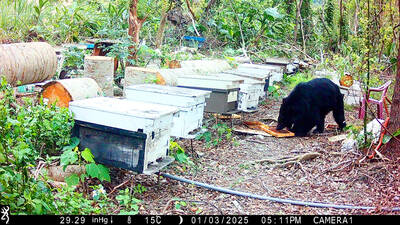
The Forestry and Nature Conservation Agency yesterday launched a gift box to market honey “certified by a Formosan black bear” in appreciation of a beekeeper’s amicable interaction with a honey-thieving bear. Beekeeper Chih Ming-chen (池明鎮) in January inspected his bee farm in Hualien County’s Jhuosi Township (卓溪) and found that more than 20 beehives had been destroyed and many hives were eaten, with bear droppings and paw prints near the destroyed hives, the agency said. Chih returned to the farm to move the remaining beehives away that evening when he encountered a Formosan black bear only 20m away, the agency said. The bear

HORROR STORIES: One victim recounted not realizing they had been stabbed and seeing people bleeding, while another recalled breaking down in tears after fleeing A man on Friday died after he tried to fight the knife-wielding suspect who went on a stabbing spree near two of Taipei’s busiest metro stations, Taipei Mayor Chiang Wan-an (蔣萬安) said. The 57-year-old man, identified by his family name, Yu (余), encountered the suspect at Exit M7 of Taipei Main Station and immediately tried to stop him, but was fatally wounded and later died, Chiang said, calling the incident “heartbreaking.” Yu’s family would receive at least NT$5 million (US$158,584) in compensation through the Taipei Rapid Transit Corp’s (TRTC) insurance coverage, he said after convening an emergency security response meeting yesterday morning. National


 RSS
RSS