


President Tsai Ing-wen (蔡英文) has no right to criticize the Hong Kong government over an extradition bill, as Taiwan is becoming increasingly undemocratic under her rule, former president Ma Ying-jeou (馬英九) said yesterday.
Ma made the remarks at an academic conference on democracy held by the Ma Ying-jeou Foundation and the Fair Winds Foundation in Taipei.
The Republic of China (ROC) appears to have turned into an authoritarian country after the Democratic Progressive Party (DPP) set up the Ill-gotten Party Assets Settlement Committee to control the assets of the Chinese Nationalist Party (KMT) and its “so-called” affiliates, Ma said.
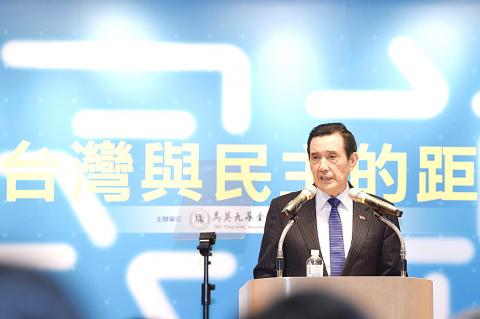
Photo: George Tsorng, Taipei Times
As a result, the KMT was forced to lay off many of its staff and cannot even access its assets unless approved by the committee, he said.
“That an opposition party’s assets would be controlled by the ruling party is rarely seen anywhere in the world,” he said.
The Act Governing the Settlement of Ill-gotten Properties by Political Parties and Their Affiliate Organizations (政黨及其附隨組織不當取得財產處理條例) and the Act on Promoting Transitional Justice (促進轉型正義條例), passed by the DPP-controlled legislature, seem to target the KMT, he said.
Both laws allowed the DPP administration to establish supposedly independent committees that are not actually independent and are likely unconstitutional, Ma said.
More than 400 of the people the Transitional Justice Commission exonerated at the end of last year were the Chinese Communist Party’s undercover agents, he said.
Their names can still be found at monuments in Beijing, he said, adding that exonerating them was inconsiderate for the families of those they allegedly killed.
Tsai’s “so-called” transitional justice does not bring reconciliation, but instead revives authoritarianism, he added.
While the extradition bill proposed by the Hong Kong government would undermine people’s freedom and democracy, “Tsai is worse” for making the DPP pass amendments to the Referendum Act (公民投票法) last month to restrict people’s freedom and political rights, he said.
Tsai has no right to criticize the Hong Kong government, yet she used the issue to manipulate people into supporting her, he said.
As suggested in the book How Democracies Die by Steven Levitsky and Daniel Ziblatt, a democracy dies when an authoritarian leader abuses their power to completely dominate an opposition party, Ma said.
“Is it not what is happening in Taiwan?” he asked.

The Centers for Disease Control (CDC) yesterday reported the first case of a new COVID-19 subvariant — BA.3.2 — in a 10-year-old Singaporean girl who had a fever upon arrival in Taiwan and tested positive for the disease. The girl left Taiwan on March 20 and the case did not have a direct impact on the local community, it said. The WHO added the BA.3.2 strain to its list of Variants Under Monitoring in December last year, but this was the first imported case of the COVID-19 variant in Taiwan, CDC Deputy Director-General Lin Ming-cheng (林明誠) said. The girl arrived in Taiwan on

South Korea is planning to revise its controversial electronic arrival card, a step Taiwanese officials said prompted them to hold off on planned retaliatory measures, a South Korean media report said yesterday. A Yonhap News Agency report said that the South Korean Ministry of Foreign Affairs is planning to remove the “previous departure place” and “next destination” fields from its e-arrival card system. The plan, reached after interagency consultations, is under review and aims to simplify entry procedures and align the electronic form with the paper version, a South Korean ministry official said. The fields — which appeared only on the electronic form

The Ministry of Foreign Affairs (MOFA) is suspending retaliation measures against South Korea that were set to take effect tomorrow, after Seoul said it is updating its e-arrival system, MOFA said today. The measures were to be a new round of retaliation after Taiwan on March 1 changed South Korea's designation on government-issued alien resident certificates held by South Korean nationals to "South Korea” from the "Republic of Korea," the country’s official name. The move came after months of protests to Seoul over its listing of Taiwan as "China (Taiwan)" in dropdown menus on its new online immigration entry system. MOFA last week

A bipartisan group of US senators has introduced a bill to enhance cooperation with Taiwan on drone development and to reduce reliance on supply chains linked to China. The proposed Blue Skies for Taiwan Act of 2026 was introduced by Republican US senators Ted Cruz and John Curtis, and Democratic US senators Jeff Merkley and Andy Kim. The legislation seeks to ease constraints on Taiwan-US cooperation in uncrewed aerial systems (UAS), including dependence on China-sourced components, limited access to capital and regulatory barriers under US export controls, a news release issued by Cruz on Wednesday said. The bill would establish a "Blue UAS


 RSS
RSS