


Taichung Metro Corp has filed a patent for a new company logo after its current logo, which is shaped like the front of a Taichung Mass Rapid Transit (MRT) system train, was met with criticism.
A public opinion poll showed that the new, simpler design was much more popular with people, the company said on Tuesday, adding that some respondents said the new logo was more easily discernible.
Others said the new logo was reminiscent of one used by Taichung Municipal First Senior High School, which has a history dating to the Japanese colonial era.
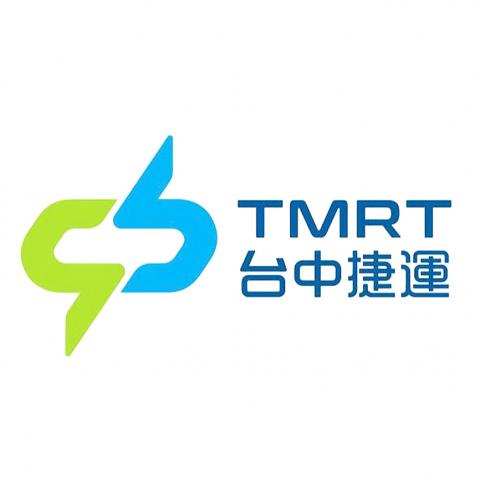
Image copied from the Intellectual Property Office Web site
The company’s logo has undergone several changes, with the first iteration chosen through a public vote held by the company in 2012.
However, the company later opted not to use that version and held another vote in 2017, registering the logo chosen in that vote in April last year.
However, public criticism has been rampant since the registration was announced, it said.

Image copied from the Intellectual Property Office Web site
Some people joked that it resembled a dog’s head or a motorcycle helmet; others said it looked like a Chinese opera mask or even buttocks, it said.
The new design is much simpler, featuring green and blue lines that come together to create the Chinese character for chung (中) from the city’s name, Taichung, it said.
Green and blue are the colors representing the MRT system’s first and second lines respectively.
“Those who have seen the new logo said it looks nicer and that it better represents Taichung MRT,” the company said.
However, some said the new logo was “ugly” and hoped it could be refined, it said.
“Some even questioned whether the use of blue and green meant the system would only have two lines, and that the planned third line would be canceled,” it said.
The logos put to vote last time had been chosen by the city’s Rapid Transit System Office and proved divisive, Taichung Metro Corp chairman Lin Chih-ying (林志盈) said.
This time the city hired a design consultancy company to create a logo that is neutral and more representative of the city, he said.
The MRT system is to have more than two lines, he added, hoping to clear up confusion caused by the use of two colors.
If the new logo passes a review, it could be used on station signage, as well as on Taichung MRT products, he said.

Considering that most countries issue more than five denominations of banknotes, the central bank has decided to redesign all five denominations, the bank said as it prepares for the first major overhaul of the banknotes in more than 24 years. Central bank Governor Yang Chin-lung (楊金龍) is expected to report to the Legislative Yuan today on the bank’s operations and the redesign’s progress. The bank in a report sent to the legislature ahead of today’s meeting said it had commissioned a survey on the public’s preferences. Survey results showed that NT$100 and NT$1,000 banknotes are the most commonly used, while NT$200 and NT$2,000

The Centers for Disease Control (CDC) yesterday reported the first case of a new COVID-19 subvariant — BA.3.2 — in a 10-year-old Singaporean girl who had a fever upon arrival in Taiwan and tested positive for the disease. The girl left Taiwan on March 20 and the case did not have a direct impact on the local community, it said. The WHO added the BA.3.2 strain to its list of Variants Under Monitoring in December last year, but this was the first imported case of the COVID-19 variant in Taiwan, CDC Deputy Director-General Lin Ming-cheng (林明誠) said. The girl arrived in Taiwan on

South Korea is planning to revise its controversial electronic arrival card, a step Taiwanese officials said prompted them to hold off on planned retaliatory measures, a South Korean media report said yesterday. A Yonhap News Agency report said that the South Korean Ministry of Foreign Affairs is planning to remove the “previous departure place” and “next destination” fields from its e-arrival card system. The plan, reached after interagency consultations, is under review and aims to simplify entry procedures and align the electronic form with the paper version, a South Korean ministry official said. The fields — which appeared only on the electronic form

The Ministry of Foreign Affairs (MOFA) is suspending retaliation measures against South Korea that were set to take effect tomorrow, after Seoul said it is updating its e-arrival system, MOFA said today. The measures were to be a new round of retaliation after Taiwan on March 1 changed South Korea's designation on government-issued alien resident certificates held by South Korean nationals to "South Korea” from the "Republic of Korea," the country’s official name. The move came after months of protests to Seoul over its listing of Taiwan as "China (Taiwan)" in dropdown menus on its new online immigration entry system. MOFA last week


 RSS
RSS