


President Tsai Ing-wen (蔡英文) yesterday awarded Chief of General Staff Admiral Lee Hsi-ming (李喜明), who plans to retire after nearly 50 years of service, the Order of Resplendent Banner with Special Grand Cordon at the Presidential Office in Taipei.
Tsai thanked Lee on behalf of all Taiwanese for dedicating himself to safeguarding the nation since joining the military in 1970.
Tsai said she believes that Taiwanese agree that a strong national defense is the only way to guarantee national sovereignty and the values of democracy and freedom.
As Beijing continues to expand its military capabilities, Taiwan must develop its ability to wage asymmetric warfare to deter the threat posed by China’s military, she said.
In doing so, the nation would not only ensure safety in the Taiwan Strait, but also contribute peace in the region, she added.
In April 2017, Lee became chief of general staff and worked with others to carry out an overall defense concept and improve military exercises and the preparedness of joint operations, she said.
Lee was given the military order in recognition of his efforts to enhance the military’s overall capabilities, Tsai added.
In a few days, Lee is to retire, she said, adding that she would remember the contributions made to the nation and society by each senior military officer who has retired.
Tsai also thanked Lee’s wife, saying that because of her support, Lee has been able to protect the nation and Taiwanese without reservation.
Calling it a mission that Lee “must fulfill,” Tsai said that he should exchange leading military personnel to various locations with taking care of his family and traveling with them.
Tsai concluded her speech by wishing the distinguished officer success in his retirement.
Yesterday, the Ministry of National Defense announced that six officers, including Major General Lu Kun-hsiu (呂坤修), would be promoted to the rank of lieutenant general, and 13 officers, including Colonel Wang Kuo-liang (王國樑), would be promoted to the rank of major general.
The appointments — routine promotions of general officers approved by the president — are to take effect on Monday, the ministry said.
With only 19 promotions, this is the smallest batch in the past few years, the ministry said, adding that a promotion ceremony would be held at 9am today at the Armed Forces Officers’ Club in Taipei.
Minister of National Defense Yen De-fa (嚴德發) is to preside over the promotion ceremony, which is to be attended by the president, high-ranking military officers and family members of the promoted officers, the ministry added.
Additional reporting by Aaron Tu

NATIONAL SECURITY: Authorities are working to confirm the identities of the military personnel involved and investigating possible illegal conduct and regulatory violations Authorities are probing possible national security implications after Kinmen police and immigration officers on Sunday found a Chinese woman allegedly posing as a tourist while engaging in prostitution involving more than 10 military personnel. The woman, surnamed Chen (陳), has since been deported, authorities said, adding that investigators are still working to confirm the identities of those implicated, as the records only listed code names and aliases. The case stemmed from a report received by the Kinmen District Prosecutors’ Office on Friday last week from the Jinhu Precinct of the Kinmen County Police Bureau. On Sunday, police, along with the National Immigration

GLOBALGIVING: ‘ Caving to external pressure is not acceptable for an organization that has cultivated justice reform and human rights for 30 years,’ one NGO said A slew of non-government organizations (NGOs) have withdrawn from the GlobalGiving fundraising platform after it announced it would use “Chinese Taipei” instead of “Taiwan” from next month. The Taiwan Good Rice Association wrote on Facebook on Friday that it was informed on April 28 via a teleconference call of the change, which was made because the platform wanted to operate in China. Taiwan Good Rice is to terminate all cooperative relationships with GlobalGiving in response to the platform’s “unilateral and non-negotiable” decision to remove references to Taiwan, the NGO said. “Taiwan is in the official name of Taiwan Good Rice Association and the

HEAVY WEATHER: Typhoon Jangmi is due to crash straight into the Ryukyus as airlines look to shift flights to larger aircraft or cancel flights to Okinawa entirely Taiwan’s international air carriers announced flight adjustments over the weekend as Typhoon Jangmi is forecast to hit the Ryukyu Islands today and tomorrow. The Central Weather Administration (CWA) upgraded Jangmi from a tropical storm to a typhoon at 8am yesterday, with the eye located 580km south of Naha city. It was moving north at 19kph. Today, China Airlines’ CI-120, CI-121, CI-122 and CI-123 flights between Taoyuan and Naha, Okinawa, have been canceled as well as CI-132 and CI-133 between Kaohsiung and Naha. EVA Air’s BR-112, BR-113, BR-186 and BR-185 flights between Taoyuan and Naha are also canceled. Low-cost carrier Tigerair Taiwan canceled IT-230,
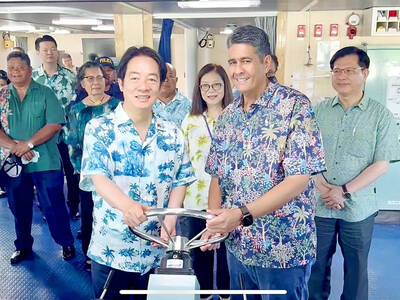
MULTIPRONGED APPROACH: China has sought to pressure Palau across a number of fronts, but the island nation has staunchly resisted overtures to ditch Taiwan Palau has been firm in backing Taiwan despite Chinese pressure that uses tourism economics, cyberattacks and criminal infiltration as tools to threaten the Pacific ally into renouncing its recognition of Taiwan as a sovereign state. The Presidential Office yesterday announced that Vice President Hsiao Bi-khim (蕭美琴) would visit Palau from Saturday to Wednesday next week at the invitation of Palauan President Surangel Whipps Jr. Whipps in April said in an interview that China had outspokenly asked Palau to “denounce Taiwan.” “And we have said: ‘We have no enemies, but nobody tells us who our friends are,’” he said. Whipps has told reporters multiple times


 RSS
RSS