


The Transitional Justice Commission yesterday said it has researched military prisons that the Ministry of National Defense used during the White Terror era.
The commission studied the history of seven facilities over the past six months and has begun making plans to establish memorials at each, commission spokeswoman Yeh Hung-ling (葉虹靈) said.
The research would provide a template for the commission’s future dealings regarding “sites of injustice,” she said.
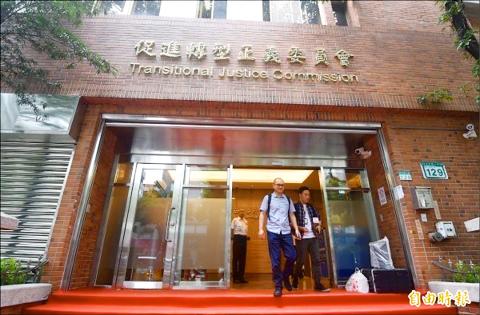
Photo: Chen Yu-fu, Taipei Times
The former Counterintelligence Bureau’s Taoyuan Correction and Training Facility, a “black site” located in Taoyuan’s Lujhu District (蘆竹), has survived intact, the commission said.
Before being commandeered by the bureau to be used as a secret prison, the traditional Minnan (閩南) compound was the ancestral home of former Taoyuan County commissioner Hsu Chung-te (徐崇德), it said.
Hsu’s family was allowed to live in half of the compound, while prisoners were kept in the other half, the commission said.
The bureau used the prison for alleged traitors from its own ranks and senior military officers who had incurred Chiang Kai-shek’s (蔣介石) wrath, such as Lee Hung (李鴻), a decorated commander who Chiang expelled from the army for befriending his rival, general Sun Li-jen (孫立人), it said.
The prison apparently remained in use until 1958, when the bureau relocated the program to the so-called “Wolung Mansion” (臥龍山莊) in the city’s Longtan District (龍潭), it said.
The Lujhu property is owned by a private citizen and the remains of sentry posts can still be seen, while the Wolung Mansion was demolished to build the Taoyuan Armed Forces General Hospital, it said.
The euphemistically named “Fongshan Guesthouse” (鳳山招待所) in Kaoshiung’s Fongshan District (鳳山) is one of three intact prison facilities used in the city during the White Terror era, it said.
The facility was a detention and interrogation center for sailors and other political prisoners in the navy’s custody, the commission said.
Built by Japan as a wireless communication hub, the facility is now a national historical heritage site, it said.
Kaohsiung’s two other military prisons can be found at Shoushan Military Base (壽山營區), and were operated by the Taiwan Garrison Command and the Southern Region Reserve Command, the commission said.
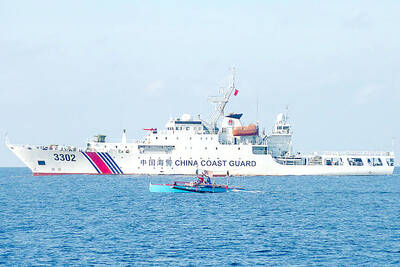
EXPANSIONIST: China deploys an average of 40 to 50 warships and coast guard vessels daily in the South China Sea, despite pledges not to militarize the region, an official said China is attempting to expand its influence across the First Island Chain and increase pressure on Japan by sending coast guard vessels into waters off of Taiwan under the pretext of maritime negotiations with Japan and the Philippines, a national security official said yesterday. China’s recent actions in the waters east of Taiwan and Japan and the Philippines’ exclusive economic zones (EEZ) are attempts to establish dominance in First Island Chain waters, said the official who declined to be named, adding that this is “expansion disguised as law enforcement.” Framing China’s actions solely as a cross-strait issue is a serious misjudgment that
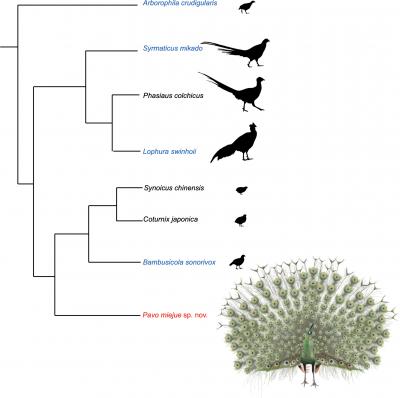
Through analyzing fossil evidence, a research team at National Taiwan University (NTU) discovered the largest endemic bird to have lived in Taiwan, naming it Pavo miejue, or extinct peafowl (滅絕孔雀). The Mikado pheasant, which is printed on the back of the NT$1,000 bank note, was previously believed to be the biggest endemic bird to Taiwan. The research team’s findings suggest that Pavo miejue lived during the Pleistocene epoch tens of thousands of years ago. It is the first endemic extinct bird species discovered and formally named in Taiwan. The study was coauthored by NTU Institute of Ecology and Evolutionary Biology professor Tsai Cheng-hsiu (蔡政修),
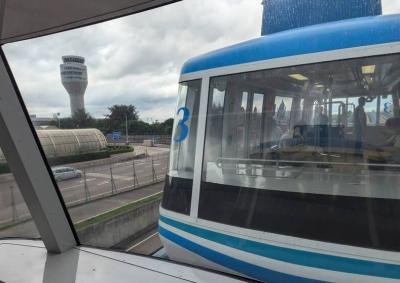
Taiwan Taoyuan International Airport is to suspend its automated Skytrain service connecting Terminal 1 and Terminal 2 starting on July 1 to facilitate connection works for the upcoming Terminal 3, the airport operator said today. Passengers and staff who need to travel between the two terminals after the suspension can instead use the Taoyuan MRT or the airport's 24-hour shuttle bus service, Taoyuan International Airport Corp said. The Taoyuan MRT Airport Line directly links the two terminals, while the shuttle buses are to operate around the clock, the company added. The Skytrain provides free transportation between the airport’s two terminals for travelers and
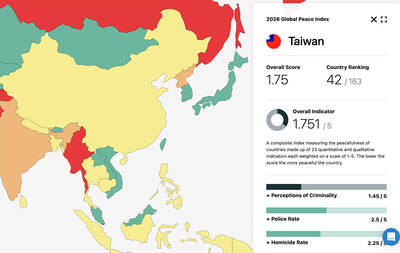
Taiwan ranked 42nd in terms of peacefulness among 163 countries, down five places from last year, according to this year’s Global Peace Index. With an overall score of 1.751, Taiwan dropped from 37th last year, the report published by the global Institute for Economics and Peace showed. The overall score measures a country’s level of peacefulness using 23 quantitative and qualitative indicators across three domains — ongoing domestic and international conflict, societal safety and security, and militarization. While Taiwan ranked 42nd worldwide, it was listed in ninth place among the 19 Asian-Pacific countries in the report, after New Zealand, Singapore, Japan, Malaysia,


 RSS
RSS