


The Taichung District Court yesterday found a businessman guilty of stealing proprietary technology and selling it to China, handing him an 18-month prison sentence and a NT$2 million (US$63,436) fine.
Chen Shih-yu (陳世彧) was convicted on two counts of contravening the Trade Secrets Act (營業秘密法) for the theft of proprietary technology from local firms, which he sold to Chengdu Trailblazer Technology Co (成都領航科技), based in China’s Sichuan Province.
The court said that investigators had uncovered evidence of Chen’s illegal activities, which began when he was general manager and then special assistant to the president of Taichung-based A-Lumen Machine Co from 2010 to 2012.
He reportedly held the top jobs because he is a relative of A-Lumen owner Lu Chun-lin (呂俊麟).
Chen handled the firm’s contracts for optical film and coating equipment with Chengdu Trailblazer and in 2012 began doing business with its owner, a man surnamed Liang (梁), the court said.
In 2013, Chen left A-Lumen and established his own company, Wellsun International Co (昱盛國際企業), it said.
Investigators found that Liang enlisted Chen to help him get into the production of smart glass, for which they set their sights on technology from BenQ Materials Corp, the court said, adding that Chen conducted secret negotiations with a key BenQ engineer surnamed Huang (黃).
Liang and Chen persuaded Huang to travel to China on weekends and holidays to teach Chengdu Trailblazer staff how to make smart glass, which Huang was not authorized to do, as it was restricted proprietary technology, it said.
Chen also secretly obtained data on A-Lumen’s UV optical film forming machine, which his and Liang’s companies were interested in, the court said.
Liang in 2012 started purchasing the machine from A-Lumen, with Chen handling the contracts as general manager, it said.
Investigators found that Chen, without authorization from A-Lumen, later gave the schematics to local contract manufacturer Ding Teng Machinery Co to produce the machines, which he planned to sell through Wellsun in cooperation with Liang in China, the court said.

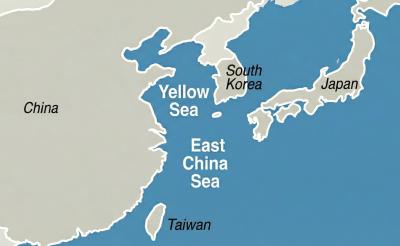
China has reserved offshore airspace in the Yellow Sea and East China Sea from March 27 to May 6, issuing alerts usually used to warn of military exercises, although no such exercises have been announced, the Wall Street Journal (WSJ) reported yesterday. Reserving such a large area for 40 days without explanation is an “unusual step,” as military exercises normally only last a few days, the paper said. These alerts, known as Notice to Air Missions (Notams), “are intended to inform pilots and aviation authorities of temporary airspace hazards or restrictions,” the article said. The airspace reserved in the alert is

South Korea is planning to revise its controversial electronic arrival card, a step Taiwanese officials said prompted them to hold off on planned retaliatory measures, a South Korean media report said yesterday. A Yonhap News Agency report said that the South Korean Ministry of Foreign Affairs is planning to remove the “previous departure place” and “next destination” fields from its e-arrival card system. The plan, reached after interagency consultations, is under review and aims to simplify entry procedures and align the electronic form with the paper version, a South Korean ministry official said. The fields — which appeared only on the electronic form
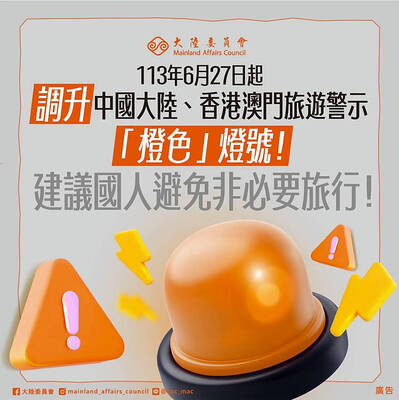
More than 6,000 Taiwanese students have participated in exchange programs in China over the past two years, despite the Mainland Affairs Council’s (MAC) “orange light” travel advisory, government records showed. The MAC’s publicly available registry showed that Taiwanese college and university students who went on exchange programs across the Strait numbered 3,592 and 2,966 people respectively. The National Immigration Agency data revealed that 2,296 and 2,551 Chinese students visited Taiwan for study in the same two years. A review of the Web sites of publicly-run universities and colleges showed that Taiwanese higher education institutions continued to recruit students for Chinese educational programs without

A bipartisan group of US senators has introduced a bill to enhance cooperation with Taiwan on drone development and to reduce reliance on supply chains linked to China. The proposed Blue Skies for Taiwan Act of 2026 was introduced by Republican US senators Ted Cruz and John Curtis, and Democratic US senators Jeff Merkley and Andy Kim. The legislation seeks to ease constraints on Taiwan-US cooperation in uncrewed aerial systems (UAS), including dependence on China-sourced components, limited access to capital and regulatory barriers under US export controls, a news release issued by Cruz on Wednesday said. The bill would establish a "Blue UAS


 RSS
RSS