


Kaohsiung Mayor Han Kuo-yu (韓國瑜) showed up unexpectedly yesterday morning at the Legislative Yuan to appeal for more funds to deal with dengue fever, spurring accusations of grandstanding as a prelude to his presidential bid.
The Centers for Disease Control (CDC) earlier this month said that eight indigenous cases of dengue fever had been confirmed so far this year, all in Kaohsiung.
Han made the visit as lawmakers were holding a special legislative session.

Photo: Liao Chen-huei, Taipei Times
He said that the city’s nine legislators have failed to speak up for Kaohsiung about the spread of dengue fever, so he decided to visit the nine, as well as the Chinese Nationalist Party (KMT) caucus, to call for more subsidies from the central government to help the city combat the disease.
Democratic Progressive Party Legislator Chao Tien-lin (趙天麟), one of the nine, said that all lawmakers representing the city have been fighting for more funding from the central government to help the city fight the disease.
“The issue is whether Mayor Han’s heart is in Kaohsiung,” Chao said. “Is the safety of the city’s residents truly the priority in your heart when your attention is divided, traveling across the nation for [your] presidential bid?”
Han, one of five competing to represent the KMT in next year’s presidential election, has been holding rallies nationwide in the past few weeks for his presidential campaign.
New Power Party Kaohsiung City Councilor Huang Jie (黃捷) accused Han of using the disease as an excuse to travel to Taipei again.
In a news release on Sunday, the CDC said that it has granted a total subsidy of NT$15.239 million (US$483,471) to Kaohsiung for communicable disease prevention this year, including NT$8.61 million for dengue fever — the highest among all cities and counties.
The Communicable Disease Control Act (傳染病防治法) stipulates that the dengue fever prevention budget should be allocated by local governments and the Executive Yuan can provide a subsidy for assistance, but the Kaohsiung City Government had mistakenly thought it could receive the subsidy by merely making a proposal at regular meetings, the CDC said.
“The central government did not reject the Kaohsiung City Government’s application in two meetings, and the subsidy approved was not lower nor did it come later than in previous years,” it said.
Local governments must follow a standard procedure in applying for the subsidy, including proposing a prevention plan for review, the CDC said.
Kaohsiung proposed a subsidy of NT$5.3 million at the Feb. 19 meeting and NT$4.6 million on May 21, it said.
The CDC said it has told Kaohsiung to submit the required documents for review during the two meetings, and informed it that if the budget for disease prevention runs out, the CDC would apply for the Executive Yuan’s secondary reserve fund.
While Minister of Health and Welfare Chen Shih-chung (陳時中) had proposed using the secondary reserve fund to grant additional subsidies, the CDC only received Kaohsiung’s official proposal on Friday, and Chen and CDC officials worked during the weekend to review the documents.
As soon as the Executive Yuan approves use of the secondary reserve fund, the CDC will immediately extend its support to Kaohsiung, it said.
The CDC is fully committed to assisting Kaohsiung in disease prevention and there is no difference in its efforts to assist any local government, it added.
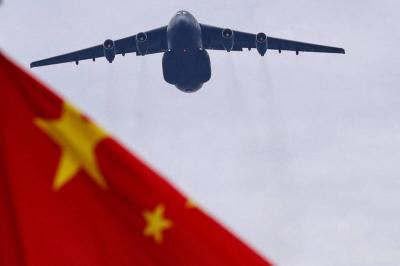
Beijing could eventually see a full amphibious invasion of Taiwan as the only "prudent" way to bring about unification, the US Department of Defense said in a newly released annual report to Congress. The Pentagon's "Annual Report to Congress: Military and Security Developments Involving the People's Republic of China 2025," was in many ways similar to last year’s report but reorganized the analysis of the options China has to take over Taiwan. Generally, according to the report, Chinese leaders view the People's Liberation Army's (PLA) capabilities for a Taiwan campaign as improving, but they remain uncertain about its readiness to successfully seize

Taiwan is getting a day off on Christmas for the first time in 25 years. The change comes after opposition parties passed a law earlier this year to add or restore five public holidays, including Constitution Day, which falls on today, Dec. 25. The day marks the 1947 adoption of the constitution of the Republic of China, as the government in Taipei is formally known. Back then the Chinese Nationalist Party (KMT) governed China from Nanjing. When the KMT, now an opposition party in Taiwan, passed the legislation on holidays, it said that they would help “commemorate the history of national development.” That

Taiwan has overtaken South Korea this year in per capita income for the first time in 23 years, IMF data showed. Per capita income is a nation’s GDP divided by the total population, used to compare average wealth levels across countries. Taiwan also beat Japan this year on per capita income, after surpassing it for the first time last year, US magazine Newsweek reported yesterday. Across Asia, Taiwan ranked fourth for per capita income at US$37,827 this year due to sustained economic growth, the report said. In the top three spots were Singapore, Macau and Hong Kong, it said. South
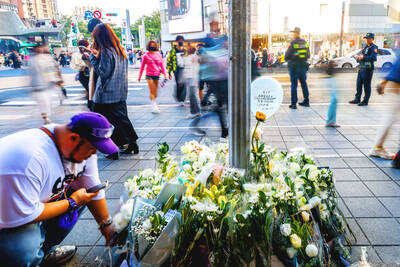
HORROR STORIES: One victim recounted not realizing they had been stabbed and seeing people bleeding, while another recalled breaking down in tears after fleeing A man on Friday died after he tried to fight the knife-wielding suspect who went on a stabbing spree near two of Taipei’s busiest metro stations, Taipei Mayor Chiang Wan-an (蔣萬安) said. The 57-year-old man, identified by his family name, Yu (余), encountered the suspect at Exit M7 of Taipei Main Station and immediately tried to stop him, but was fatally wounded and later died, Chiang said, calling the incident “heartbreaking.” Yu’s family would receive at least NT$5 million (US$158,584) in compensation through the Taipei Rapid Transit Corp’s (TRTC) insurance coverage, he said after convening an emergency security response meeting yesterday morning. National


 RSS
RSS