


The National Women’s League on Monday last week approved transitioning into a political party to prevent being dissolved under provisions of the Political Parties Act (政黨法), people familiar with the matter said yesterday.
According to amendments passed in 2017, politically oriented civil groups established in compliance with the Civil Associations Act (人民團體法) prior to the changes must revise their charters and transition into a political party by Dec. 17 or be dissolved.
To meet the requirements, the group’s standing committee held a meeting at which a lawyer explained that transitioning would be the only way to keep the organization alive, a branch member said.
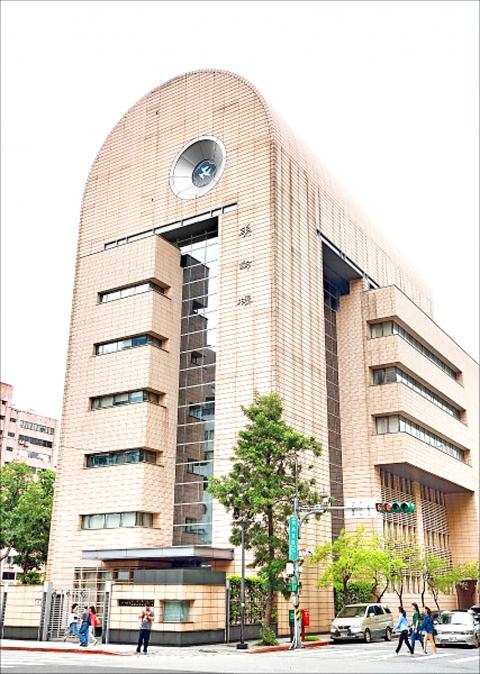
Photo: Chen Yu-fu, Taipei Times
While the committee voted in favor of the transition, the group still has to revise its charter and approve the changes at a national convention before submitting an application to the Ministry of the Interior, the sources said.
If the group is to transition into a political party, National Women’s League chairwoman Joanna Lei (雷倩) is expected to become the new party’s chairwoman, the sources said.
To prevent opposition from branch organizations, headquarters has offered extensive subsidies, including a Dragon Boat Festival payment of up to NT$500,000 (US$15,863), the sources said.
Under former National Women’s League chairwoman Cecilia Koo (辜嚴倬雲), headquarters did not have close ties with its branches, a branch member said, adding that it provided minimal financial support, but had great power over them.
Branches often had to fund their own events, despite having to share the credit with headquarters, the members said.
For example, Kaohsiung branch real estate was jointly purchased by Chinese Nationalist Party (KMT) Chairman Wu Den-yih’s (吳敦義) wife, Tsai Ling-yi (蔡令怡), and branch members, the member said.
Although headquarters did not contribute any money, the real estate was frozen and confiscated by the Executive Yuan’s Ill-gotten Party Assets Settlement Committee along with other assets, they said.
This was why some branch members opposed signing an administrative contract with the ministry, which forces drastic structural reforms, the member said.
Headquarters’ decision to distribute subsidies was clearly an attempt to lobby support for the transition into a political party, but even with subsidies for rice dumplings and Dragon Boat Festival events, branches might not vote for Lei as party chairwoman at the national convention, the member said.
The assets committee in February last year declared the National Women’s League to be a KMT-affiliated organization, froze its assets and began investigating its financial records.
Following investigations spanning a year, the assets committee in March ordered that holdings totaling NT$38.8 billion be confiscated, leaving the group with about NT$246 million.
The group appealed the decision and the Supreme Administrative Court on May 15 ordered that the assets should not be confiscated until it reaches a decision.
However, as the assets committee’s order remains in place, the funds are still frozen.

LOUD AND PROUD Taiwan might have taken a drubbing against Australia and Japan, but you might not know it from the enthusiasm and numbers of the fans Taiwan might not be expected to win the World Baseball Classic (WBC) but their fans are making their presence felt in Tokyo, with tens of thousands decked out in the team’s blue, blowing horns and singing songs. Taiwanese fans have packed out the Tokyo Dome for all three of their games so far and even threatened to drown out home team supporters when their team played Japan on Friday. They blew trumpets, chanted for their favorite players and had their own cheerleading squad who dance on a stage during the game. The team struggled to match that exuberance on the field, with
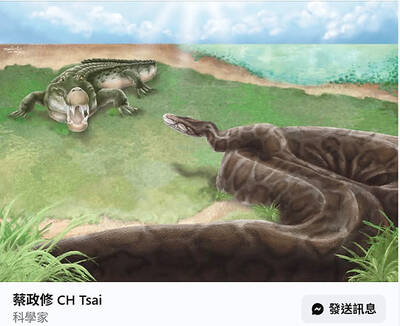
Taiwanese paleontologists have discovered fossil evidence that pythons up to 4m long inhabited Taiwan during the Pleistocene epoch, reporting their findings in the international scientific journal Historical Biology. National Taiwan University (NTU) Institute of Ecology and Evolutionary Biology associate professor Tsai Cheng-hsiu (蔡政修) led the team that discovered the largest snake fossil ever found in Taiwan. The single trunk vertebra was discovered in Tainan at the Chiting Formation, dated to between 400,000 and 800,000 years ago in the Middle Pleistocene, the paper said. The area also produced Taiwan’s first avian fossil, as well as crocodile, mammoth, saber-toothed cat and rhinoceros fossils, it said. Discoveries

Taiwanese paleontologists have discovered fossil evidence that pythons up to 4m long inhabited Taiwan during the Pleistocene epoch, reporting their findings in the international scientific journal Historical Biology. National Taiwan University (NTU) Institute of Ecology and Evolutionary Biology associate professor Tsai Cheng-hsiu (蔡政修) led the team that discovered the largest snake fossil ever found in Taiwan. A single trunk vertebra was discovered in Tainan at the Chiting Formation, dated to between 800,000 to 400,000 years ago in the Middle Pleistocene, the paper said. The area also produced Taiwan’s first avian fossil, as well as crocodile, mammoth, sabre-toothed cat and rhinoceros fossils, it said. Discoveries

Whether Japan would help defend Taiwan in case of a cross-strait conflict would depend on the US and the extent to which Japan would be allowed to act under the US-Japan Security Treaty, former Japanese minister of defense Satoshi Morimoto said. As China has not given up on the idea of invading Taiwan by force, to what extent Japan could support US military action would hinge on Washington’s intention and its negotiation with Tokyo, Morimoto said in an interview with the Liberty Times (sister paper of the Taipei Times) yesterday. There has to be sufficient mutual recognition of how Japan could provide


 RSS
RSS