


At a cake shop they run in Taipei, Shane Lin and Marc Yuan are planning their wedding as they await Asia’s first gay marriage law, but a last-minute push could scupper their dreams.
The pair, who met at college, are among hundreds of same-sex couples who have made reservations to register with government agencies on Friday next week for what they hope will be a marriage.
That is the deadline set by the Council of Grand Justices to allow same-sex couples to legally wed.
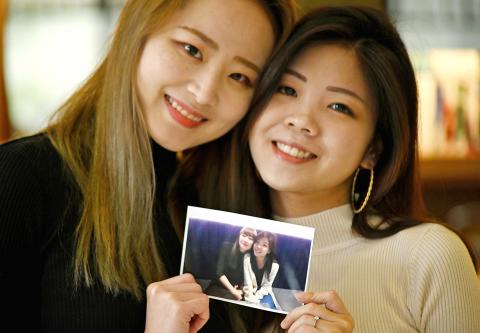
Photo: SAM YEH, AFP
In a 2017 ruling, judges said that denying gay couples the right to marry violated the Constitution. The court gave lawmakers two years to make marriage equality happen or see it enacted automatically if they failed — a move that promises a new milestone for Asia.
For gay couples like Lin, 31, and Yuan, 30 — who decided to tie the knot as they celebrated their 10th anniversary — the ruling allowed them to start planning for their big day.
“Taiwan may often be overlooked internationally, but the things we have done are visionary and with purpose, which we can be proud of,” said Lin, referring to the ruling.
Yet with a week to go, Taiwan’s LGBT community still does not know what marriage equality would look like, because the legislation has yet to be conclusively decided.
Gay rights groups hoped that the government would simply amend the Civil Code’s marriage clauses to include homosexual couples, a move they said would grant the truest form of equality.
However, President Tsai Ing-wen’s (蔡英文) Democratic Progressive Party (DPP) dithered for months after the ruling, tabling no proposed law or changes.
Opponents of the ruling organized a series of referendums in November last year, in which people comprehensively rejected defining marriage as anything other than a union between a man and a woman, weakening the government’s legislative hand.
The fight for same-sex marriage has finally landed in the legislature where three rival bills are to be voted on today, just a week before the deadline.
The most progressive bill — which most gay rights groups have begrudgingly backed — is the government’s. It is the only one to use the word “marriage” and offer some limited adoption rights.
Opponents have tabled two other versions that avoid the word marriage and offer something closer to same-sex unions with no adoption rights. One version even enabled close relatives to legally challenge a union, although that clause was withdrawn earlier this week following an outcry.
“When it comes to equality and human rights, everyone should be the same. Why should our marriage be given a different name?” Lin asked.
The DPP holds a comfortable majority, but no one knows which way the voting will go, especially given elections are just eight months away.
On Tuesday, Tsai urged people to back her government’s bill, saying it respected both the court’s judgement and the results of the referendums.
Lesbian couple Huang Ting-yu and Hsueh Ya-chieh, from New Taipei City, fear that the fight for equal rights will stumble if the Cabinet’s bill fails.
“You will have more problems in life when you don’t have your basic rights. That’s why in same-sex marriage, we are striving for equality and the same rights as everyone else,” Huang said.
The couple, both engineers aged 28, got together shortly after the 2017 ruling. They agreed to marry six months later.
They plan to register on Friday next week and host a banquet in September.
For Lin and Yuan, adoption and surrogacy are also pressing issues. They hope to have one biological child and one adopted child.
“We hope that Taiwan can quickly enact a law to allow surrogacy. Another thing which is most important is that we can have the same rights and privileges as heterosexual couples in adoption,” Lin said.
The government’s bill only allows gay couples to adopt the biological children of their partner. The other bills only grant limited guardianship rights for existing children.

LOUD AND PROUD Taiwan might have taken a drubbing against Australia and Japan, but you might not know it from the enthusiasm and numbers of the fans Taiwan might not be expected to win the World Baseball Classic (WBC) but their fans are making their presence felt in Tokyo, with tens of thousands decked out in the team’s blue, blowing horns and singing songs. Taiwanese fans have packed out the Tokyo Dome for all three of their games so far and even threatened to drown out home team supporters when their team played Japan on Friday. They blew trumpets, chanted for their favorite players and had their own cheerleading squad who dance on a stage during the game. The team struggled to match that exuberance on the field, with

Taiwanese paleontologists have discovered fossil evidence that pythons up to 4m long inhabited Taiwan during the Pleistocene epoch, reporting their findings in the international scientific journal Historical Biology. National Taiwan University (NTU) Institute of Ecology and Evolutionary Biology associate professor Tsai Cheng-hsiu (蔡政修) led the team that discovered the largest snake fossil ever found in Taiwan. The single trunk vertebra was discovered in Tainan at the Chiting Formation, dated to between 400,000 and 800,000 years ago in the Middle Pleistocene, the paper said. The area also produced Taiwan’s first avian fossil, as well as crocodile, mammoth, saber-toothed cat and rhinoceros fossils, it said. Discoveries

Taiwanese paleontologists have discovered fossil evidence that pythons up to 4m long inhabited Taiwan during the Pleistocene epoch, reporting their findings in the international scientific journal Historical Biology. National Taiwan University (NTU) Institute of Ecology and Evolutionary Biology associate professor Tsai Cheng-hsiu (蔡政修) led the team that discovered the largest snake fossil ever found in Taiwan. A single trunk vertebra was discovered in Tainan at the Chiting Formation, dated to between 800,000 to 400,000 years ago in the Middle Pleistocene, the paper said. The area also produced Taiwan’s first avian fossil, as well as crocodile, mammoth, sabre-toothed cat and rhinoceros fossils, it said. Discoveries

Whether Japan would help defend Taiwan in case of a cross-strait conflict would depend on the US and the extent to which Japan would be allowed to act under the US-Japan Security Treaty, former Japanese minister of defense Satoshi Morimoto said. As China has not given up on the idea of invading Taiwan by force, to what extent Japan could support US military action would hinge on Washington’s intention and its negotiation with Tokyo, Morimoto said in an interview with the Liberty Times (sister paper of the Taipei Times) yesterday. There has to be sufficient mutual recognition of how Japan could provide


 RSS
RSS