


Eighteen Aldabra giant tortoises are doing well and have grown from 40g to 1kg since they hatched in captivity last year, Taipei Zoo said.
Adult Aldabra giant tortoises can live for more than 150 years, the zoo said in a statement last week.
The tortoises were born to Shuei Ke (帥哥) and Chung Chung (中中), a male and female that the Forestry Bureau handed to the zoo in 2000 and 2001 respectively.
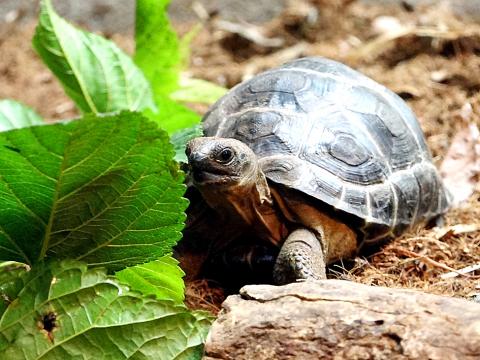
Photo courtesy of Taipei Zoo
They had been seized after being discovered in illegal captivity, it said.
The zoo tried to get the tortoises to mate for five years and it finally succeeded in 2017, resulting in 20 inseminated eggs, 18 of which survived being artificially incubated.
They hatched in March and April last year, it said.
Zoo workers feed the tortoises a diet of vegetables that is rich in fiber, as well as calcium supplements, while monitoring their growth by weighing and measuring them monthly, it said.
The tortoises are growing at a rate comparable to specimens in the wild, it added.
The tortoises are allowed to bask in the sun so that ultraviolet rays stimulate healthy bone and shell growth, the zoo said.
Normally placid and social, Aldabra giant tortoises are known to be single-minded in the presence of food and trample or shoulder aside all obstacles, including other tortoises in the vacinity, the zoo said.
The giant tortoises reside at the zoo’s amphibian and reptilian area and visitors can take part in special tortoise activities by scanning a QR code, it said.

Considering that most countries issue more than five denominations of banknotes, the central bank has decided to redesign all five denominations, the bank said as it prepares for the first major overhaul of the banknotes in more than 24 years. Central bank Governor Yang Chin-lung (楊金龍) is expected to report to the Legislative Yuan today on the bank’s operations and the redesign’s progress. The bank in a report sent to the legislature ahead of today’s meeting said it had commissioned a survey on the public’s preferences. Survey results showed that NT$100 and NT$1,000 banknotes are the most commonly used, while NT$200 and NT$2,000

The Centers for Disease Control (CDC) yesterday reported the first case of a new COVID-19 subvariant — BA.3.2 — in a 10-year-old Singaporean girl who had a fever upon arrival in Taiwan and tested positive for the disease. The girl left Taiwan on March 20 and the case did not have a direct impact on the local community, it said. The WHO added the BA.3.2 strain to its list of Variants Under Monitoring in December last year, but this was the first imported case of the COVID-19 variant in Taiwan, CDC Deputy Director-General Lin Ming-cheng (林明誠) said. The girl arrived in Taiwan on

South Korea is planning to revise its controversial electronic arrival card, a step Taiwanese officials said prompted them to hold off on planned retaliatory measures, a South Korean media report said yesterday. A Yonhap News Agency report said that the South Korean Ministry of Foreign Affairs is planning to remove the “previous departure place” and “next destination” fields from its e-arrival card system. The plan, reached after interagency consultations, is under review and aims to simplify entry procedures and align the electronic form with the paper version, a South Korean ministry official said. The fields — which appeared only on the electronic form

The Ministry of Foreign Affairs (MOFA) is suspending retaliation measures against South Korea that were set to take effect tomorrow, after Seoul said it is updating its e-arrival system, MOFA said today. The measures were to be a new round of retaliation after Taiwan on March 1 changed South Korea's designation on government-issued alien resident certificates held by South Korean nationals to "South Korea” from the "Republic of Korea," the country’s official name. The move came after months of protests to Seoul over its listing of Taiwan as "China (Taiwan)" in dropdown menus on its new online immigration entry system. MOFA last week


 RSS
RSS