


EVA Air flight attendants yesterday accused the Taoyuan City Government of releasing a “heavily biased” report that makes “unfair comparisons” between their salaries and those of China Airlines (CAL) flight attendants’ ahead of a union vote on launching a strike.
EVA Air on April 27 released a report compiled by the Taoyuan Department of Labor, which it said confirms that the company offers a competitive per diem.
Although CAL appears to offer more per diem, EVA Air’s flight attendants are given higher year-end bonuses, more rest time, free breakfast and are paid for longer periods for every flight, the report said.
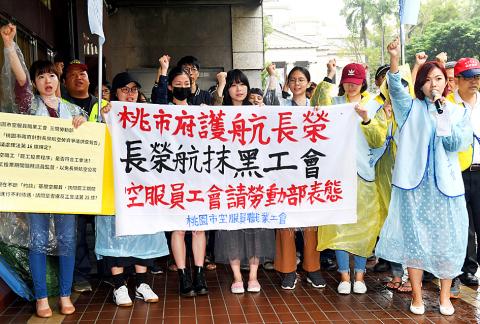
Photo: CNA
The report was full of one-sided information provided by the company, Taoyuan Flight Attendants’ Union secretary-general Cheng Ya-ling (鄭雅菱) told a news conference outside the Ministry of Labor in Taipei.
It not only calculated payments inaccurately, but completely left out the hourly flight pay, which makes up an important portion of flight attendants’ income, she said.
“China Airlines offers an hourly flight pay that is two to three times the amount paid by EVA Air,” she said, adding that the difference could be as high as NT$10,000 to NT$15,000.
It also offers more per hour, after it raised the allowance by US$3 following a strike by CAL flight attendants in 2016, Cheng said.
“What we are demanding now is what CAL flight attendants demanded three years ago,” she said.
The union has been urging the company to raise payments from NT$90 per hour to NT$150 per hour, which is similar to CAL’s per diem of US$5, she said.
In addition to providing inaccurate information, the report was not presented to the union’s representatives until four days after they requested a copy, she said.
“Since the previous round of negotiations failed [on April 17], the union has remained open to resuming talks with the company, but so far it has not shown any interest in renegotiating; only multiple attempts to damage the union’s reputation,” Cheng added.
Ministry official Chin Shih-ping (金士平) said the report is “not worthy of dwelling on,” as it provides “limited information” and has not been signed off by union representatives.
He urged the company to avoid interfering with the union’s activities and to resume the negotiations.
“If EVA Air considers its employees as its family, it should do its best to respond to the union’s requests in a sincere manner and engage in dialogue with them,” he said.
The airline also defended the legitimacy of the results of an investigation launched by the labor department on April 16, which was meant for the members of an arbitration committee to scrutinize how the airline distributed daily allowances.
The union on Tuesday last week said that EVA Air flight attendants would launch a strike if 80 percent of them in the union and half of total union members vote in favor.
The union consists of more than 5,600 flight attendants from various airlines, including more than 3,000 from EVA Air.
Voting is to take place in Taipei, Taoyuan and Kaohsiung from May 13 to June 6.
Separately yesterday, EVA Air denied breaching Article 35 of the Labor Union Act (工會法) by disrupting the operations of the union by holding direct conversations with the flight attendants, accusing the union of spreading false allegations.
“As per the Civil Aeronautics Administration’s request, we need to stipulate an emergency response plan in view of the imminent labor strike, including maintaining transport capacity during the strike. As such, we are conducting a survey among flight attendants to inquire if any of them would be able to work during the strike, with the purpose of protecting our consumers,” the airline said.
“It is regrettable that the union chose to twist the laws and apply a broad and unrestricted interpretation of them, which has severely interfered in the management and administration of a private firm,” the company said.
Additional reporting by Shelley Shan
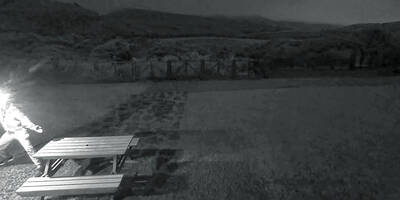
Yangmingshan National Park authorities yesterday urged visitors to respect public spaces and obey the law after a couple was caught on a camera livestream having sex at the park’s Qingtiangang (擎天崗) earlier in the day. The Shilin Police Precinct in Taipei said it has identified a suspect and his vehicle registration number, and would summon him for questioning. The case would be handled in accordance with public indecency charges, it added. The couple entered the park at about 11pm on Thursday and began fooling around by 1am yesterday, the police said, adding that the two were unaware of the park’s all-day live
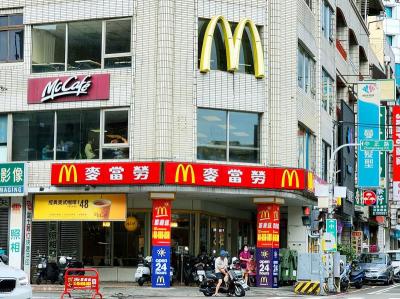
Fast food chain McDonald's is to raise prices by up to NT$5 on some products at its restaurants across Taiwan, starting on Wednesday next week, the company announced today. The prices of all extra value meals and sharing boxes are to increase by NT$5, while breakfast combos and creamy corn soup would go up by NT$3, the company said in a statement. The price of the main items of those meals, if ordered individually, would remain the same. Meanwhile, the price of a medium-sized lemon iced tea and hot cappuccino would rise by NT$3, extra dipping sauces for chicken nuggets would go up
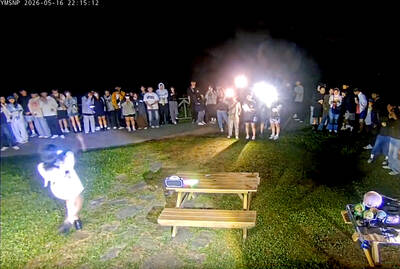
Yangmingshan National Park’s Qingtiangang (擎天崗) nature area has gone viral after a park livestream camera observed a couple in the throes of intimate congress, which was broadcast live on YouTube, drawing large late-night crowds and sparking a backlash over noise, bright lights and disruption to wildlife habitat. The area’s livestream footage appeared to show a couple engaging in sexual activity on a picnic table in the park on Friday last week, with the uncensored footage streamed publicly online. The footage quickly spread across social media, prompting a tide of visitors to travel to the site to “check in” and recreate the

Minister of Digital Affairs Lin Yi-ching (林宜敬) yesterday cited regulatory issues and national security concerns as an expert said that Taiwan is among the few Asian regions without Starlink. Lin made the remarks on Facebook after funP Innovation Group chief executive officer Nathan Chiu (邱繼弘) on Friday said Taiwan and four other countries in Asia — China, North Korea, Afghanistan and Syria — have no access to Starlink. Starlink has become available in 166 countries worldwide, including Ukraine, Malaysia, the Philippines and Vietnam, in the six years since it became commercial, he said. While China and North Korea block Starlink, Syria is not


 RSS
RSS