


Lawmakers yesterday urged the Tourism Bureau to step up its crackdown on operators of illegal daily room rentals, including those posted on the popular online platform Airbnb.
The legislature’s Transportation Committee yesterday reviewed amendments to the Act for the Development of Tourism (發展觀光條例) proposed by the bureau and lawmakers.
Democratic Progressive Party (DPP) legislators Lin Chun-hsien (林俊憲) and Chen Su-yueh (陳素月) focused their questions on the bureau’s proposed amendments to Article 55 to Article 55-1 of the act, which would impose harsher penalties on illegal hotel and bed and breakfast operators.
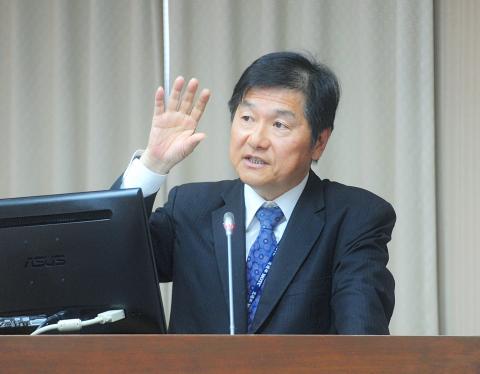
Photo: Wang Yi-sung, Taipei Times
These include a fine of up to NT$2 million (US$64,714) and repeated fines if the illegal act persists.
Operators of online platforms such as Airbnb or Booking.com would also face up to NT$2 million in fines for posting information about illegal accommodation and would be asked to remove the content.
Airbnb was founded on the concept of a sharing economy, where people put extra rooms in their houses up for rent, Lin said.
However, the New York and Florida state governments have launched a large-scale crackdown on illegal operators posting ads on the platform, as it has severely disrupted the rental housing market and affected the businesses of legal hotel and bed and breakfast operators, he said.
Airbnb has 35,000 daily room rentals on its list for Taiwan, including about 10,000 in Taipei, he said.
“The Web site shows that four people each have more than 50 rooms available to rent and six other people each have more than 40 rooms to rent. Do you know anyone who has 50 rooms to ‘share’ with other people? Is this how a ‘sharing economy’ works?” Lin asked.
“This shows that some group are abusing online platforms to run illegal hotel businesses,” he added.
The bureau should also ask Airbnb to establish a subsidiary in Taiwan, Lin said, adding that it should let the platform operator know the nation is ruled by law.
The government should crack down on illegal daily room rentals, or many young people would not be able to find affordable rooms to rent, he said.
Deputy Minister of Transportation and Communications Chi Wen-chung (祁文中) said that the proposed amendments are designed to raise the penalties against illegal operators and the bureau is collecting public opinions about the proposal.
“We have told platform operators that we hope the information posted on the platforms belongs to legal hoteliers and bed and breakfast operators,” Chi said. “This way consumers need not worry that they might end up with an illegal rental that is not regulated by the law.”

NATIONAL SECURITY: Authorities are working to confirm the identities of the military personnel involved and investigating possible illegal conduct and regulatory violations Authorities are probing possible national security implications after Kinmen police and immigration officers on Sunday found a Chinese woman allegedly posing as a tourist while engaging in prostitution involving more than 10 military personnel. The woman, surnamed Chen (陳), has since been deported, authorities said, adding that investigators are still working to confirm the identities of those implicated, as the records only listed code names and aliases. The case stemmed from a report received by the Kinmen District Prosecutors’ Office on Friday last week from the Jinhu Precinct of the Kinmen County Police Bureau. On Sunday, police, along with the National Immigration

GLOBALGIVING: ‘ Caving to external pressure is not acceptable for an organization that has cultivated justice reform and human rights for 30 years,’ one NGO said A slew of non-government organizations (NGOs) have withdrawn from the GlobalGiving fundraising platform after it announced it would use “Chinese Taipei” instead of “Taiwan” from next month. The Taiwan Good Rice Association wrote on Facebook on Friday that it was informed on April 28 via a teleconference call of the change, which was made because the platform wanted to operate in China. Taiwan Good Rice is to terminate all cooperative relationships with GlobalGiving in response to the platform’s “unilateral and non-negotiable” decision to remove references to Taiwan, the NGO said. “Taiwan is in the official name of Taiwan Good Rice Association and the

HEAVY WEATHER: Typhoon Jangmi is due to crash straight into the Ryukyus as airlines look to shift flights to larger aircraft or cancel flights to Okinawa entirely Taiwan’s international air carriers announced flight adjustments over the weekend as Typhoon Jangmi is forecast to hit the Ryukyu Islands today and tomorrow. The Central Weather Administration (CWA) upgraded Jangmi from a tropical storm to a typhoon at 8am yesterday, with the eye located 580km south of Naha city. It was moving north at 19kph. Today, China Airlines’ CI-120, CI-121, CI-122 and CI-123 flights between Taoyuan and Naha, Okinawa, have been canceled as well as CI-132 and CI-133 between Kaohsiung and Naha. EVA Air’s BR-112, BR-113, BR-186 and BR-185 flights between Taoyuan and Naha are also canceled. Low-cost carrier Tigerair Taiwan canceled IT-230,

REASONS FOR TRAVEL: An assistant professor said that proposed amendments to penalize drivers if they used drugs overseas would not deter people from traveling People who operate a motor vehicle under the influence of marijuana would have their driver’s license revoked, even if they used the substance while overseas, the Ministry of Transportation and Communications said yesterday, citing proposed amendments to the Road Traffic Management and Penalty Act (道路交通管理處罰條例). The amendments would also authorize the government to revoke the licenses of people determined to have used Category 1 or Category 2 narcotics, even if they were not operating a vehicle while under the influence of drugs, as well as ban them from taking the license test for three years, the ministry said. People aged 18 or


 RSS
RSS