


The Legislative Yuan yesterday postponed a review of draft amendments to the Teachers’ Act (教師法) aimed at eliminating unqualified teachers after more than 100 teachers rallied outside the legislative compound in Taipei to protest the proposed changes.
The draft amendments, submitted by the Executive Yuan on March 7, propose lowering the number of teachers who do not hold administrative positions or board seats to no more than 50 percent of the Teachers’ Review Committee, while increasing its number of non-teacher experts to help prevent partiality when considering cases of teacher misconduct.
Also included is a provision that would prevent a teacher from being rehired after contravening the law.
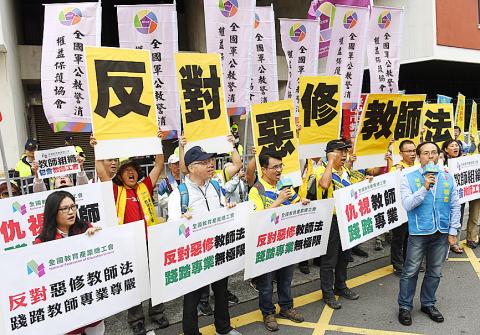
Photo: CNA
The proposed changes sparked heated debate among teachers and parents, who also protested outside the Legislative Yuan yesterday.
Under the proposed amendments, “if you get fined for accidentally hitting someone’s car while driving, you could get fired,” Taipei School Education Union president Lee Hui-lan (李惠蘭) said during a demonstration organized by a coalition of teachers’ groups on Jinan Road.
“That would make a terrible law,” Lee said.
Despite the grave punishments they entail, the amendments would not solve any problems, she said.
If the government is concerned about review committees being biased, it should create a system where experienced teachers from other schools can be recommended, instead of recruiting third-party people with no teaching experience, she said.
More reasons for firing teachers and increased outside members on the committee would only grant schools greater power over the committee and teachers, as principals would likely be selecting those members, National Federation of Teachers’ Unions president Chang Hsu-cheng (張旭政) said.
“We are outraged by the draft amendments, because they amount to persecution of teachers,” Chang said.
“It is as if we were back in the authoritarian era, when administrative officials had absolute power over teachers,” he said.
National Federation of Teachers’ Unions director-general Huang Yao-nan (黃耀南) described the proposed amendments as a “criminal code for teachers, because half of the proposals are about when a teacher should get fired.”
The Legislative Yuan did not properly discuss the proposed changes with teachers before scheduling a meeting to carry out an article-by-article review, Huang said, adding that it should hold a public hearing before the review.
About 30 people from a coalition of parents’ groups rallied on Zhongshan S Road, calling on legislators to further lower the threshold for firing teachers over misconduct from two-thirds to half of committee members’ votes.
“We respect teachers and hope they have self-discipline, but child abuse continues to happen at schools,” National Alliance of Parents Organization president Maggie Peng (彭淑燕) said.
A petition the group launched last week to call for an increased percentage of outside members on teachers’ review committees and more oversight over their operations has garnered 100,000 signatures from parents nationwide, Peng said.
Due to the demonstrations, the Education and Culture Committee yesterday passed a motion by Chinese Nationalist Party (KMT) Legislator Apollo Chen (陳學聖) to hold a meeting with teachers and parents tomorrow morning and postpone the article-by-article review of the amendments to the afternoon.
While Chen proposed a public hearing, it was changed to a meeting to speed up the process, as public hearings require a five-day notice to be issued to participants.

LOUD AND PROUD Taiwan might have taken a drubbing against Australia and Japan, but you might not know it from the enthusiasm and numbers of the fans Taiwan might not be expected to win the World Baseball Classic (WBC) but their fans are making their presence felt in Tokyo, with tens of thousands decked out in the team’s blue, blowing horns and singing songs. Taiwanese fans have packed out the Tokyo Dome for all three of their games so far and even threatened to drown out home team supporters when their team played Japan on Friday. They blew trumpets, chanted for their favorite players and had their own cheerleading squad who dance on a stage during the game. The team struggled to match that exuberance on the field, with

Taiwanese paleontologists have discovered fossil evidence that pythons up to 4m long inhabited Taiwan during the Pleistocene epoch, reporting their findings in the international scientific journal Historical Biology. National Taiwan University (NTU) Institute of Ecology and Evolutionary Biology associate professor Tsai Cheng-hsiu (蔡政修) led the team that discovered the largest snake fossil ever found in Taiwan. The single trunk vertebra was discovered in Tainan at the Chiting Formation, dated to between 400,000 and 800,000 years ago in the Middle Pleistocene, the paper said. The area also produced Taiwan’s first avian fossil, as well as crocodile, mammoth, saber-toothed cat and rhinoceros fossils, it said. Discoveries

Taiwanese paleontologists have discovered fossil evidence that pythons up to 4m long inhabited Taiwan during the Pleistocene epoch, reporting their findings in the international scientific journal Historical Biology. National Taiwan University (NTU) Institute of Ecology and Evolutionary Biology associate professor Tsai Cheng-hsiu (蔡政修) led the team that discovered the largest snake fossil ever found in Taiwan. A single trunk vertebra was discovered in Tainan at the Chiting Formation, dated to between 800,000 to 400,000 years ago in the Middle Pleistocene, the paper said. The area also produced Taiwan’s first avian fossil, as well as crocodile, mammoth, sabre-toothed cat and rhinoceros fossils, it said. Discoveries
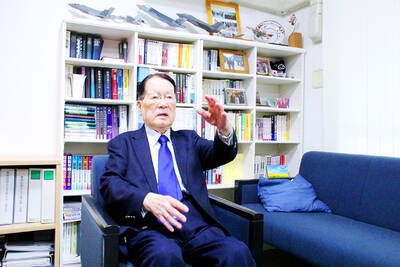
Whether Japan would help defend Taiwan in case of a cross-strait conflict would depend on the US and the extent to which Japan would be allowed to act under the US-Japan Security Treaty, former Japanese minister of defense Satoshi Morimoto said. As China has not given up on the idea of invading Taiwan by force, to what extent Japan could support US military action would hinge on Washington’s intention and its negotiation with Tokyo, Morimoto said in an interview with the Liberty Times (sister paper of the Taipei Times) yesterday. There has to be sufficient mutual recognition of how Japan could provide


 RSS
RSS