


The Legislative Yuan yesterday passed amendments to the Renewable Energy Development Act (再生能源發展條例), which set a goal for the nation’s renewable energy sources to reach a total of capacity of 27 gigawatts by 2025.
The Ministry of Economic Affairs is to review renewable energy development goals for next year and 2021, set development plans and publish the proportion that each source of renewable energy should contribute, according to the amended act.
To realize the goal by 2025, local governments should evaluate the potential for developing renewable energy sources in their jurisdiction, and may establish power generation facilities with an installed capacity of up to 2,000 kilowatts, the act says.
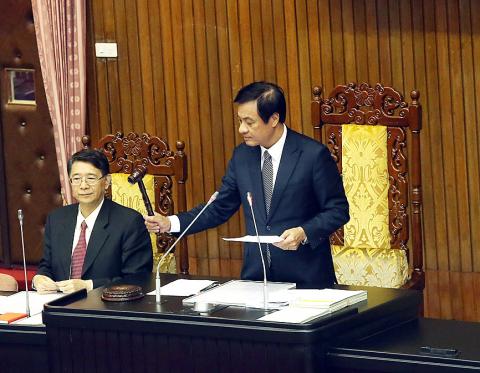
Photo: CNA
Power generation facilities with an installed capacity of greater than 2,000 kilowatts should be established by the ministry, it says.
The ministry should set up a renewable energy fund that draws from fees levied on non-renewable energy retailers, as well as on entities with self-use non-renewable power generation facilities, the act stipulates.
The ministry should establish a committee comprising representatives from relevant agencies, experts, academics and civic groups to review feed-in tariffs for the purchase of renewable energy and design a formula to calculate prices, it says.
The ministry may set out a period during which it can provide incentives for renewable energy generation facilities that it deems to have potential or for demonstration, the act says.
The amendments stipulate that renewable energy generation facilities can be established in Aboriginal territories in accordance with the Indigenous Peoples Basic Act (原住民族基本法).
If the premises of the government agencies, public schools or state-run enterprises undergo expansion or renovation, or if new structures are erected, they should be equipped with renewable energy generation facilities as long as sites meet the requirements, the act says.
The ministry said that the government’s “nuclear-free homeland by 2025” initiative aims to boost the proportion of renewable energy to 20 percent of the nation’s energy makeup, and the passage of the amendments would help to provide a legal basis for that goal.
Cities or counties that are home to state-run renewable energy generation facilities would receive some of the profits generated from clean energy sales as a reward, it said.
The amended act includes wording stating the government’s resolve to cut greenhouse gas emissions and improve the nation’s energy makeup.
Democratic Progressive Party Legislator Chen Man-li (陳曼麗), a sponsor of the amendments, said that the world invests more than twice as much in renewables as it does in fossil fuels.
At a time when industry leaders such as Apple, Sony and Google have joined the RE100 renewable power movement, the amendments would hopefully bring Taiwan clean energy, boost its economy and improve its global competitiveness, she said.


UPGRADE: The Kang Ding-class frigate is replacing its Chaparall missiles with Tien Chien II and Hua Yang VLS, which would provide it with long-range, 360° air defense Taiwan plans to produce 1,200 to 1,376 Hai Chien II missiles (海劍二, Sea Sword II) — also known as TC-2N — to serve as the standard air defense system of the navy’s surface combatant fleet, a source said yesterday. Last week, the Hai Chien II, the naval version of the Tien Kung II missile (天劍二, Sky Sword II), completed a live-fire test in waters off the National Chungshan Institute of Science and Technology’s Jiupeng facility (九鵬) in Pingtung County’s Manjhou Township (滿州). The MIM72 Chaparral and other dated air defense missiles that currently arm Taiwanese ships have inadequate range to combat Chinese

REASONS FOR TRAVEL: An assistant professor said that proposed amendments to penalize drivers if they used drugs overseas would not deter people from traveling People who operate a motor vehicle under the influence of marijuana would have their driver’s license revoked, even if they used the substance while overseas, the Ministry of Transportation and Communications said yesterday, citing proposed amendments to the Road Traffic Management and Penalty Act (道路交通管理處罰條例). The amendments would also authorize the government to revoke the licenses of people determined to have used Category 1 or Category 2 narcotics, even if they were not operating a vehicle while under the influence of drugs, as well as ban them from taking the license test for three years, the ministry said. People aged 18 or
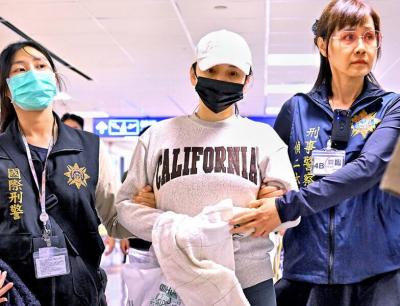
Johanne Liou (劉喬安), a Taiwanese woman who shot to unwanted fame during the Sunflower movement protests in 2014, returned to Taiwan last night after being deported from the US. She is to stand trial in Taiwan for charges involving embezzlement, fraud and drug crimes. The Criminal Investigation Bureau (CIB) said it took her into custody at Taiwan Taoyuan International Airport and would first question her before transferring her to the New Taipei District Prosecutors’ Office. She was arrested upon disembarking a flight from San Francisco that landed shortly before 7pm. Liou absconded to the US in 2019 after jumping bail
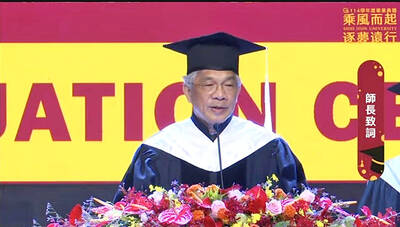
Shih Hsin University President Chen Ching-he (陳清河) yesterday issued a public apology for comments made in his commencement speech last week, stating that he has asked the school to suspend his duties and halt his wages for two months as a show of contrition. At the commencement ceremony on May 30, Chen said, “If you don’t manage your time well, or your own emotions, or your health, then I am telling every one of you — put a quick end to ‘you,’ because the world has no need for ‘you.’” The comments have sparked significant controversy online, and Chen through an open


 RSS
RSS