


Demonstrations against nuclear power are to take place simultaneously in Taipei and Kaohsiung on April 27, environmental groups said yesterday, urging people to support phasing out nuclear power as its advocates are regaining momentum.
The demonstrations would be the first large movement after a referendum abolishing the legal basis for the government’s “nuclear-free homeland by 2025” policy was passed on Nov. 24 last year, National Anti-nuclear Action Platform spokesperson Tsuei Su-hsin (崔愫欣) said.
The referendum, initiated by Nuclear Myth Busters group founder Huang Shih-hsiu (黃士修) and endorsed by former president Ma Ying-jeou (馬英九), was passed after garnering more than 5.8 million votes in favor and 4 million against.

Photo: Liu Le-jen, Taipei Times
This year’s rallies are scheduled to mark the Chernobyl nuclear disaster on April 26, 1986, Tsuei said, adding that nuclear power is not as safe as its proponents have claimed.
Nearly 4.9 percent of the nation’s electricity was generated from renewable power sources last year, 11.4 percent from nuclear power, 38.6 percent from gas-fired units, 38.8 percent from coal-fired units, and the rest from other means, data from the state-run Taiwan Power Co’s Web site shows.
Given the relatively low ratio of nuclear power, decommissioning nuclear power facilities before 2025 as scheduled would not be that difficult, Citizen of the Earth, Taiwan deputy executive Tsai Chung-yueh (蔡中岳) said.
The Taipei march is to start at 1pm from the main stage on Ketagalan Boulevard, while participants in Kaohsiung are to gather at 2pm at Aozihdi Forest Park (凹子底森林公園), he said.
More than 220,000 people took to the streets in 2013 to oppose nuclear power, while the number of participants dropped to 2,000 in last year’s parade.
Seeing that their discourse on phasing out nuclear power did not reach many of its targets on Facebook — the main social media platform in Taiwan — they are switching to more interesting ways of promoting ideas, Tsai said.
Opponents against nuclear power are also gathering petitions for two new referendum proposals, including one that proposes not extending the permits of nuclear power generation facilities nor building new ones before the government finds ways to dispose of highly radioactive nuclear waste, the action platform said.
The other proposes turning the compound of the mothballed Fourth Nuclear Power Plant in New Taipei City’s Gongliao District (貢寮) into a site for renewable power research and development, it said.

The military has spotted two Chinese warships operating in waters near Penghu County in the Taiwan Strait and sent its own naval and air forces to monitor the vessels, the Ministry of National Defense (MND) said. Beijing sends warships and warplanes into the waters and skies around Taiwan on an almost daily basis, drawing condemnation from Taipei. While the ministry offers daily updates on the locations of Chinese military aircraft, it only rarely gives details of where Chinese warships are operating, generally only when it detects aircraft carriers, as happened last week. A Chinese destroyer and a frigate entered waters to the southwest
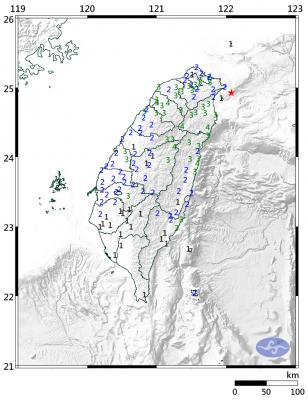
A magnitude 6.1 earthquake struck off the coast of Yilan County at 8:39pm tonight, the Central Weather Administration (CWA) said, with no immediate reports of damage or injuries. The epicenter was 38.7km east-northeast of Yilan County Hall at a focal depth of 98.3km, the CWA’s Seismological Center said. The quake’s maximum intensity, which gauges the actual physical effect of a seismic event, was a level 4 on Taiwan’s 7-tier intensity scale, the center said. That intensity level was recorded in Yilan County’s Nanao Township (南澳), Hsinchu County’s Guansi Township (關西), Nantou County’s Hehuanshan (合歡山) and Hualien County’s Yanliao (鹽寮). An intensity of 3 was

Japanese Prime Minister Sanae Takaichi’s comment last year on Tokyo’s potential reaction to a Taiwan-China conflict has forced Beijing to rewrite its invasion plans, a retired Japanese general said. Takaichi told the Diet on Nov. 7 last year that a Chinese naval blockade or military attack on Taiwan could constitute a “survival-threatening situation” for Japan, potentially allowing Tokyo to exercise its right to collective self-defense. Former Japan Ground Self-Defense Force general Kiyofumi Ogawa said in a recent speech that the remark has been interpreted as meaning Japan could intervene in the early stages of a Taiwan Strait conflict, undermining China’s previous assumptions
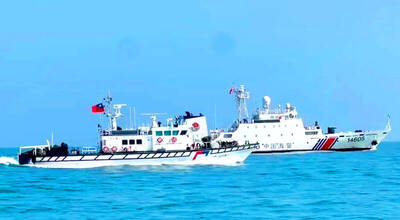
Instead of focusing solely on the threat of a full-scale military invasion, the US and its allies must prepare for a potential Chinese “quarantine” of Taiwan enforced through customs inspections, Stanford University Hoover fellow Eyck Freymann said in a Foreign Affairs article published on Wednesday. China could use various “gray zone” tactics in “reconfiguring the regional and ultimately the global economic order without a war,” said Freymann, who is also a nonresident research fellow at the US Naval War College. China might seize control of Taiwan’s links to the outside world by requiring all flights and ships entering or leaving Taiwan


 RSS
RSS