


The government needs to have an understanding of Kaohsiung Mayor Han Kuo-yu’s (韓國瑜) meetings with Chinese officials before deciding whether to take action against him, Mainland Affairs Council Minister Chen Ming-tong (陳明通) said yesterday.
Han’s meetings have drawn criticism at home and abroad, but the Ministry of the Interior and the council need to know whether the visits were political in nature before deciding whether he should be reprimanded, Chen told reporters at the Legislative Yuan in Taipei.
The ministry has established an ad hoc committee to look into the visits, and it hopes that Han would cooperate with the committee by clarifying the nature of his talks with Chinese officials, he added.
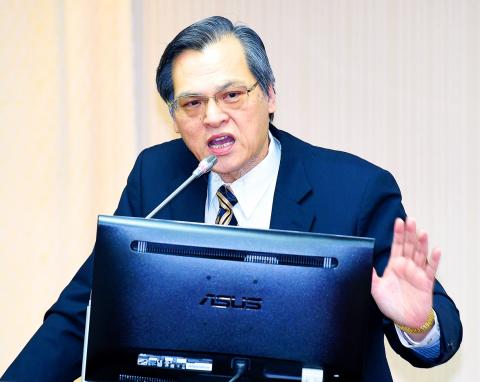
Photo: Liao Chen-huei, Taipei Times
Han’s visits to Hong Kong, Macau and Shenzhen and Xiamen over the past five days were orchestrated by Beijing to convince him that China’s “one country, two systems” framework is successful, Chen said.
Commenting on draft legislation proposed by the council to limit visits to Hong Kong and Macau by commissioners and mayors, Chinese Nationalist Party (KMT) Legislator Chiang Wan-an (蔣萬安) said that it appeared to be aimed specifically at Han, adding that it would not conform with the nation’s style of enacting legislation.
Chen denied that Han was the sole motivation for proposing the draft legislation, saying that it was also intended as a response to Chinese President Xi Jinping’s (習近平) call in a speech on Jan. 2 for Taiwan to be united with China under the “one country, two systems” framework.
Legislative proposals are responses to long-term and short-term issues, and Han was merely a short-term concern, he added.
The government is mulling a Hong Kong and Macau version of the Act Governing Relations Between the People of the Taiwan Area and the Mainland Area (臺灣地區與大陸地區人民關係條例), Chen said.
He also rejected a rumor that Kaohsiung Deputy Mayor Yeh Kuang-shih (葉匡時) had informed him ahead of time about Han’s plan to visit China’s liaison office in Hong Kong.
When he and Yeh met prior to Han’s trip, they only discussed the need for supplemental documentation if Han planned to meet with China’s Taiwan Affairs Office Minister Liu Jieyi (劉結一), Chen said.
Han’s visit to the liaison office was a serious breach of protocol that sparked controversy at home and abroad, he said, adding that none of the nation’s mayors or commissioners, past or present, had visited the office before.
Asked about hosting Xing Kuishan (邢魁山), head of the Taiwan affairs department under the Chinese State Council’s Hong Kong office, at a dinner in Taipei’s Maokong (貓空) area after Xing assumed his post, Chen said that his intention at the time was to assert Taiwan’s sovereignty.
Chen shrugged off criticism by the KMT that he is a “Ming Dynasty-era secret police officer.”
“We are very honest and reasonable at the Republic of China Mainland Affairs Council. There is no such dynastic-era nomenclature that applies to us,” he said.
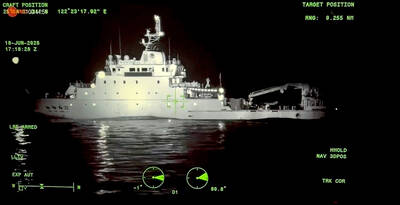
EXCUSES: Beijing is using government and research vessels as a pretext to harass the nation and enter its EEZ, and engage in ‘hegemonic expansion,’ the coast guard said The Coast Guard Administration yesterday said it drove away Chinese oceanographic research vessel Xiang Yang Hong 22 (向陽紅33) from restricted waters after warning it that it was in Taiwan’s exclusive economic zone (EEZ). The Chinese vessel entered restricted waters off the coast of Yilan County’s Suao (蘇澳) at 11:35pm on Thursday, the coast guard said, adding that it dispatched the Lanyu patrol vessel and the boat PP-10077 to shadow the Chinese ship and issue radio warnings ordering it to leave. China has no sovereignty over waters off Taiwan’s east coast, Lanyu’s crew told Xiang Yang Hong 22 over the radio, and demanded
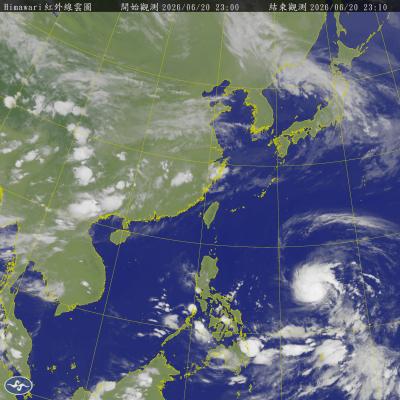
Tropical Storm Mekkhala is forecast to strengthen into a typhoon tomorrow and could come close enough to Taiwan later in the week to prompt a sea warning, the Central Weather Administration (CWA) said yesterday. As of 2 pm, the storm was located 1,870 kilometers southeast of Taiwan's southern tip and moving west- northwest at 23 km per hour. CWA forecaster Cheng Chieh-jen (鄭傑仁) said Mekkhala is expected to continue moving west-northwest through Tuesday under the influence of the Pacific high- pressure system before gradually turning north toward waters east of Taiwan or south of the Ryukyu Islands. The timing and angle of the
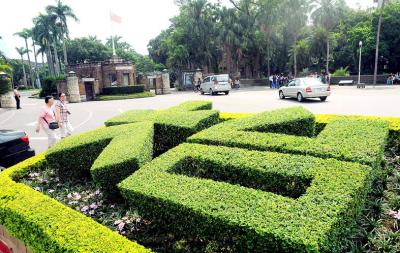
Four Taiwanese universities have been ranked among the world's top 200 institutions in the Quacquarelli Symonds (QS) World University Rankings for next year, the highest Taiwan has ever placed in the category, with National Taiwan University (NTU) achieving its best performance at 54th globally and 17th in Asia. The four Taiwanese institutions in the global top 200 are NTU (54th), National Tsing Hua University (142nd), National Yang Ming Chiao Tung University (177th) and National Cheng Kung University (191st), the rankings showed. All four universities achieved their highest-ever global rankings this year, QS data showed. National Cheng Kung University entered the top 200 for

RISING POPULARITY: Enhanced flight connectivity and a visa waiver trial program are among the motivations that have boosted travel to Taiwan by Filipinos, the agency said The Tourism Administration said yesterday that it is stepping up efforts to attract tourists from the Philippines following strong growth during the first quarter. The agency’s data showed the nation welcomed 210,000 Filipino visitors from January to March, marking a 43 percent increase compared with the same period last year. The Philippines is Taiwan’s top source of inbound tourists among the Southeast Asian nations, data showed. With a population of 116 million and national median age of 26, the Philippines boasts a young demographic with strong travel potential, the Tourism Administration said. Outbound travel demand in the Philippines continues to rise amid robust


 RSS
RSS