


People should be aware of the symptoms of addiction if they find themselves spending a lot of money on claw machines, Tainan Municipal An-Nan Hospital psychiatrist Chang Chun-hung (張俊鴻) warned.
Most people can enjoy claw machines as an occasional activity, but those with tendencies toward addiction might find that they are unable to pull themselves away, even if they win prizes, Chang said.
Chang, who is also director of the hospital’s psychiatry department, cited the case of a 35-year-old man surnamed Lin (林), who he treated for severe addiction to claw machines.
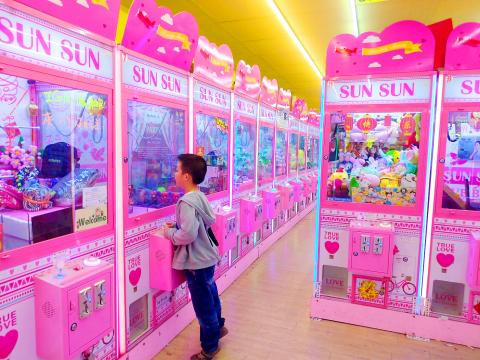
Photo: Tsai Ya-hua, Taipei Times
Lin, who worked as an elevator repairman, spent all his money on the machines and even took out a loan to continue using them, Chang said.
Lin turned to theft to fuel his habit — for which he was arrested and charged, costing him his job, Chang said.
In a separate case, a 40-year-old construction worker surnamed Chang (張) spent all of his salary of about NT$20,000 on claw machines, Chang Chun-hung said.
However, after his money was gone and he still did not have the Bluetooth speaker he was after, the construction worker used a strong magnet to maneuver the gadget out of the machine, Chang Chun-hung said, adding that the owner of the arcade reported the incident to the police.
An explanation for the popularity of claw machines could be the psychological effects of the “cute” figurines they often contain, the psychiatrist said.
People are also drawn to bright and colorful objects, he said, citing research involving newborns.
The upbeat music that claw machine parlors usually play also motivates people to spend, he said.
Research has uncovered new triggers for pleasure centers in the brain, and there is speculation that claw machines trigger these, releasing dopamine, he said.
As with other addictions, those who become hooked on claw machines might find that they are drawn to more expensive or challenging machines, he said.
Furthermore, people might experience withdrawal symptoms or a sense of helplessness over their perceived irrationality, Chang Chun-hung said.
It is common for people with an addiction to have other conditions, he said. More than half of young people with addictions also show signs of depression or attention deficit hyperactivity disorder.
Both conditions must be addressed at the same time for treatment to be effective, he said, adding that it did not necessarily require medication.
Those who find themselves unable to stop using claw machines — or stop other behaviors — should consult a psychiatrist, such as those at his hospital, he said.

Considering that most countries issue more than five denominations of banknotes, the central bank has decided to redesign all five denominations, the bank said as it prepares for the first major overhaul of the banknotes in more than 24 years. Central bank Governor Yang Chin-lung (楊金龍) is expected to report to the Legislative Yuan today on the bank’s operations and the redesign’s progress. The bank in a report sent to the legislature ahead of today’s meeting said it had commissioned a survey on the public’s preferences. Survey results showed that NT$100 and NT$1,000 banknotes are the most commonly used, while NT$200 and NT$2,000

The Centers for Disease Control (CDC) yesterday reported the first case of a new COVID-19 subvariant — BA.3.2 — in a 10-year-old Singaporean girl who had a fever upon arrival in Taiwan and tested positive for the disease. The girl left Taiwan on March 20 and the case did not have a direct impact on the local community, it said. The WHO added the BA.3.2 strain to its list of Variants Under Monitoring in December last year, but this was the first imported case of the COVID-19 variant in Taiwan, CDC Deputy Director-General Lin Ming-cheng (林明誠) said. The girl arrived in Taiwan on

South Korea is planning to revise its controversial electronic arrival card, a step Taiwanese officials said prompted them to hold off on planned retaliatory measures, a South Korean media report said yesterday. A Yonhap News Agency report said that the South Korean Ministry of Foreign Affairs is planning to remove the “previous departure place” and “next destination” fields from its e-arrival card system. The plan, reached after interagency consultations, is under review and aims to simplify entry procedures and align the electronic form with the paper version, a South Korean ministry official said. The fields — which appeared only on the electronic form

The Ministry of Foreign Affairs (MOFA) is suspending retaliation measures against South Korea that were set to take effect tomorrow, after Seoul said it is updating its e-arrival system, MOFA said today. The measures were to be a new round of retaliation after Taiwan on March 1 changed South Korea's designation on government-issued alien resident certificates held by South Korean nationals to "South Korea” from the "Republic of Korea," the country’s official name. The move came after months of protests to Seoul over its listing of Taiwan as "China (Taiwan)" in dropdown menus on its new online immigration entry system. MOFA last week


 RSS
RSS