


“Buckyballs” — magnetic balls sold as toys — are to be subject to mandatory inspections starting on Oct. 1, the Ministry of Economic Affairs said, after the introduction of warning labels in 2012 failed to prevent cases of children swallowing the magnets.
Often marketed as educational toys, Buckyballs are said to stimulate creativity and improve logical reasoning, the Consumer Protection Committee said.
However, the potential risks should not be underestimated, it said.
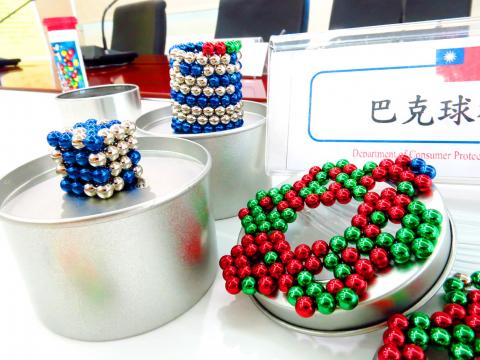
Photo: Yang Chiu-ying, Taipei Times
Buckyballs have a magnetic strength of more than 4,000 gauss, or 80 times the international standard, and as they are small, children could accidentally swallow them, it said.
Swallowing Buckyballs could result in gastrointestinal perforation, blood poisoning or even death, the US Consumer Product Safety Commission has said.
From December 2010 to March last year, there were 124 known cases of children being taken to hospital after swallowing the magnetic toys, the Japan Times reported, citing the National Consumer Affairs Center of Japan.
In 2017, the US reported 109 cases of Buckyballs being swallowed, the committee said.
About 80 percent of children who swallowed Buckyballs in Japan were under the age of three, compared with about 53 percent in the US, it said.
In both countries, children under the age of one were involved in most of the incidents, it added.
From 2017 to last year, there were three cases of children swallowing Buckyballs in Taiwan, the committee said.
The incidents occurred even after the committee, in collaboration with the ministry, required that sellers comply with the Commodity Labeling Act (商品標示法) by including warnings on the dangers of swallowing the toy.
To safeguard children’s health and safety, the committee hosted several meetings requesting the ministry to step up measures to control the situation, the committee said.
As a result, the ministry decided to include Buckyballs on a list of toys subject to mandatory inspection, it said.
From October, Buckyballs must pass inspections before they can be sold in the market, it said, adding that the ministry would carry out stricter sampling inspections of the product.
Consumers should pay attention to the warning labels when purchasing Buckyballs, and parents should prevent children under the age of 14 from putting the small, higher-powered magnets into their mouths or noses, it said.
If a child accidentally ingests magnetic parts, they should be sent to the hospital immediately to avoid delays in treatment from causing further damage, the committee added.

LOUD AND PROUD Taiwan might have taken a drubbing against Australia and Japan, but you might not know it from the enthusiasm and numbers of the fans Taiwan might not be expected to win the World Baseball Classic (WBC) but their fans are making their presence felt in Tokyo, with tens of thousands decked out in the team’s blue, blowing horns and singing songs. Taiwanese fans have packed out the Tokyo Dome for all three of their games so far and even threatened to drown out home team supporters when their team played Japan on Friday. They blew trumpets, chanted for their favorite players and had their own cheerleading squad who dance on a stage during the game. The team struggled to match that exuberance on the field, with
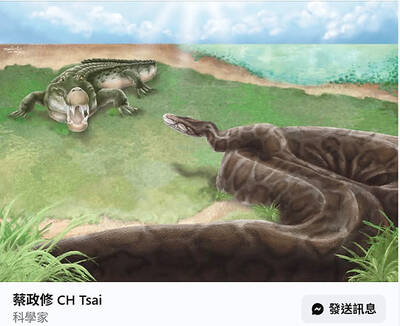
Taiwanese paleontologists have discovered fossil evidence that pythons up to 4m long inhabited Taiwan during the Pleistocene epoch, reporting their findings in the international scientific journal Historical Biology. National Taiwan University (NTU) Institute of Ecology and Evolutionary Biology associate professor Tsai Cheng-hsiu (蔡政修) led the team that discovered the largest snake fossil ever found in Taiwan. The single trunk vertebra was discovered in Tainan at the Chiting Formation, dated to between 400,000 and 800,000 years ago in the Middle Pleistocene, the paper said. The area also produced Taiwan’s first avian fossil, as well as crocodile, mammoth, saber-toothed cat and rhinoceros fossils, it said. Discoveries

Taiwanese paleontologists have discovered fossil evidence that pythons up to 4m long inhabited Taiwan during the Pleistocene epoch, reporting their findings in the international scientific journal Historical Biology. National Taiwan University (NTU) Institute of Ecology and Evolutionary Biology associate professor Tsai Cheng-hsiu (蔡政修) led the team that discovered the largest snake fossil ever found in Taiwan. A single trunk vertebra was discovered in Tainan at the Chiting Formation, dated to between 800,000 to 400,000 years ago in the Middle Pleistocene, the paper said. The area also produced Taiwan’s first avian fossil, as well as crocodile, mammoth, sabre-toothed cat and rhinoceros fossils, it said. Discoveries

Whether Japan would help defend Taiwan in case of a cross-strait conflict would depend on the US and the extent to which Japan would be allowed to act under the US-Japan Security Treaty, former Japanese minister of defense Satoshi Morimoto said. As China has not given up on the idea of invading Taiwan by force, to what extent Japan could support US military action would hinge on Washington’s intention and its negotiation with Tokyo, Morimoto said in an interview with the Liberty Times (sister paper of the Taipei Times) yesterday. There has to be sufficient mutual recognition of how Japan could provide


 RSS
RSS