


An exhibition of photograps by Liu Xia (劉霞), the widow of Chinese democracy advocate and Nobel Peace Prize laureate Liu Xiaobo (劉曉波), is to be held at Taipei’s Museum of Contemporary Art in March, the museum’s director said on Friday.
The poet and photographer is unlikely to open the exhibition in person, because of concerns that the Chinese authorities might be upset if she visited Taiwan, risking the safety of her brother, who lives in Beijing, director Yuki Pan (潘小雪) said.
“To avoid the consequence [she is] unwilling to see,” Liu Xia is unable to meet the media freely for the time being, Pan said.

Photo: Liu Xia
The joint exhibition by Liu Xia and Tsai Hai-ru (蔡海如), titled “A Swing of Breath” (呼吸鞦韆), is to take place from March 30 to May 26, with 26 photographs and poems by Liu featured alongside Tsai’s installation art.
Tsai is a Taiwanese artist who, like Liu, has also seen a family member — her father — suffer from political persecition.
Tsai’s father was jailed for more than two decades as a political dissident during the White Terror era.
Liu’s photographs were taken during the three-year period that her husband was jailed at a re-education through labor camp on charges of “disturbing the social order,” the museum said.
Liu Xiaobo was awarded the Nobel Peace Prize in 2010 for “his long and non-violent struggle for fundamental human rights in China.”
He died of cancer in July 2017 in Shenyang, in China’s Liaoning Province, while serving an 11-year jail sentence for “inciting subversion of state power.”
After her husband’s plight gained international attention, Liu Xia’s photographic works were banned from being exhibited in China and were only shown in private settings or online, Pan said.
Liu Xia was freed and left Beijing, arriving in Berlin on July 10 last year.
Altogether, she spent eight years under house arrest.

Yangmingshan National Park authorities yesterday urged visitors to respect public spaces and obey the law after a couple was caught on a camera livestream having sex at the park’s Qingtiangang (擎天崗) earlier in the day. The Shilin Police Precinct in Taipei said it has identified a suspect and his vehicle registration number, and would summon him for questioning. The case would be handled in accordance with public indecency charges, it added. The couple entered the park at about 11pm on Thursday and began fooling around by 1am yesterday, the police said, adding that the two were unaware of the park’s all-day live

Fast food chain McDonald's is to raise prices by up to NT$5 on some products at its restaurants across Taiwan, starting on Wednesday next week, the company announced today. The prices of all extra value meals and sharing boxes are to increase by NT$5, while breakfast combos and creamy corn soup would go up by NT$3, the company said in a statement. The price of the main items of those meals, if ordered individually, would remain the same. Meanwhile, the price of a medium-sized lemon iced tea and hot cappuccino would rise by NT$3, extra dipping sauces for chicken nuggets would go up
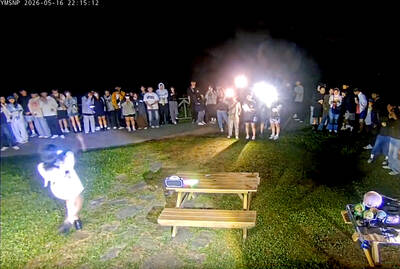
Yangmingshan National Park’s Qingtiangang (擎天崗) nature area has gone viral after a park livestream camera observed a couple in the throes of intimate congress, which was broadcast live on YouTube, drawing large late-night crowds and sparking a backlash over noise, bright lights and disruption to wildlife habitat. The area’s livestream footage appeared to show a couple engaging in sexual activity on a picnic table in the park on Friday last week, with the uncensored footage streamed publicly online. The footage quickly spread across social media, prompting a tide of visitors to travel to the site to “check in” and recreate the

Minister of Digital Affairs Lin Yi-ching (林宜敬) yesterday cited regulatory issues and national security concerns as an expert said that Taiwan is among the few Asian regions without Starlink. Lin made the remarks on Facebook after funP Innovation Group chief executive officer Nathan Chiu (邱繼弘) on Friday said Taiwan and four other countries in Asia — China, North Korea, Afghanistan and Syria — have no access to Starlink. Starlink has become available in 166 countries worldwide, including Ukraine, Malaysia, the Philippines and Vietnam, in the six years since it became commercial, he said. While China and North Korea block Starlink, Syria is not


 RSS
RSS