


A Formosan rock macaque on Sunday last week broke into a home in a village in Pingtung County and attacked the homeowner, who was sleeping inside.
The man, surnamed Chang (張), who lives in Haikou Village (海口) in Checheng Township (車城), yesterday said that he was napping in the living room when the macaque bit him on the head, leaving a 3cm laceration.
The Pingtung Department of Agriculture urged residents of the Hengchun Peninsula (恆春半島) to keep their windows closed to keep macaques out.
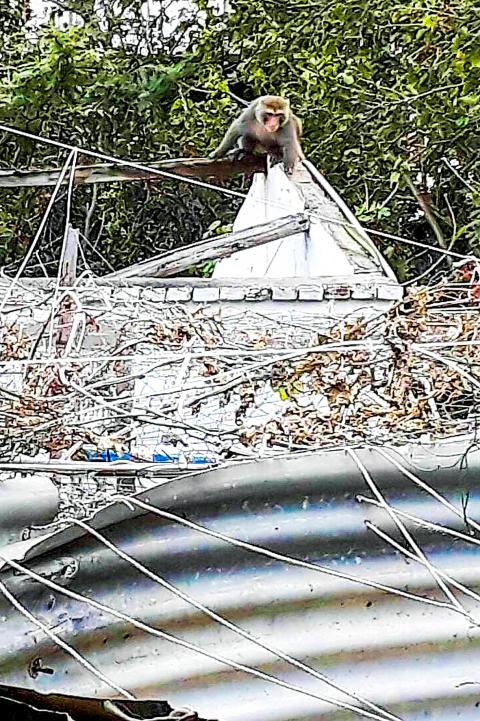
Photo retaken by Tsai Tsung-hsien, Taipei Times
Chang, 67, said he had left the windows open to let fresh air in, adding that the animal had already escaped by the time he realized he had been attacked.
His family rushed him to a hospital, where he received 10 stitches, he said.
Chang said he believes the macaque that attacked him was the same one that was spotted near the village several months ago.
The animal had been stealing fruits from homes and had broken into his home before, Chang said, adding that he had chased the macaque out at the time.
Other village residents believe that a local might have cared for the animal in the past, so it is not afraid of people, he said.
Macaques in the area have been moving into settlements from the mountains, Township Office Deputy Chairperson Pai Teng-ko (白登科) said, adding that as many as 30 macaques could be seen gathering along mountain roads at certain times.
The macaques have been stealing fruit from homes for a while, Pai said, raising concerns among residents.
Pai urged county authorities to come up with measures to protect residents from the animals.
County animal protection officials said that as macaques are no longer classified as a protected species as of last year, people could deal with the animal in accordance with Article 21 of the Wildlife Conservation Act (野生動物保育法).
The article says that “wildlife may be hunted or killed [if it poses] a danger to public safety or human life.”
It is possible that the macaque that bit Chang was a lone “misbehaving” animal, but county authorities should still survey other macaques in the area to make sure there are not others like it, Tunghai University Department of Life Science professor Lin Liang-kung (林良恭) said.
As long as there is no policy in place to keep the macaques’ movements in check, the animals would not fear people and would be more likely to break into homes, he said.
Misbehaving macaques should be trapped to prevent them from influencing the behavior of other macaques in their barrel, he said.
Additional reporting by Chien Hui-ju

Actor Darren Wang (王大陸) was sentenced to six months in prison, commutable to a fine, by the New Taipei District Court today for contravening the Personal Data Protection Act (個人資料保護法) in a case linked to an alleged draft-dodging scheme. Wang allegedly paid NT$3.6 million (US$114,380) to an illegal group to help him evade mandatory military service through falsified medical documents, prosecutors said. He transferred the funds to Chen Chih-ming (陳志明), the alleged mastermind of a draft-evasion ring, although he lost contact with him as he was already in detention on fraud charges, they said. Chen is accused of helping a

UNREASONABLE SURVEILLANCE: A camera targeted on an road by a neighbor captured a man’s habitual unsignaled turn into home, netting him dozens of tickets The Taichung High Administrative Court has canceled all 45 tickets given to a man for failing to use a turn signal while driving, as it considered long-term surveillance of his privacy more problematic than the traffic violations. The man, surnamed Tseng (曾), lives in Changhua County and was reported 45 times within a month for failing to signal while driving when he turned into the alley where his residence is. The reports were filed by his neighbor, who set up security cameras that constantly monitored not only the alley but also the door and yard of Tseng’s house. The surveillance occurred from July

SECURITY: Starlink owner Elon Musk has taken pro-Beijing positions, and allowing pro-China companies to control Taiwan’s critical infrastructure is risky, a legislator said Starlink was reluctant to offer services in Taiwan because of the nation’s extremely high penetration rates in 4G and 5G services, the Ministry of Digital Affairs said yesterday. The ministry made the comments at a meeting of the legislature’s Transportation Committee, which reviewed amendments to Article 36 of the Telecommunications Management Act (電信管理法). Article 36 bans foreigners from holding more than 49 percent of shares in public telecommunications networks, while shares foreigners directly and indirectly hold are also capped at 60 percent of the total, unless specified otherwise by law. The amendments, sponsored by Chinese Nationalist Party (KMT) Legislator Ko

‘SAME OLD TRICK’: Even if Beijing resumes individual travel to Taiwan, it would only benefit Chinese tourism companies, the Economic Democracy Union convener said China’s 10 new “incentives” are “sugar-coated poison,” an official said yesterday, adding that Taiwanese businesses see them clearly for what they are, but that Beijing would inevitably find some local collaborators to try to drums up support. The official, speaking on condition of anonymity, made the remark ahead of a news conference the General Chamber of Commerce is to hold today. The event, titled “Industry Perspectives on China’s Recent Pro-Taiwan Policies,” is expected to include representatives from industry associations — such as those in travel, hotels, food and agriculture — to request the government cooperate with China’s new measures, people familiar with


 RSS
RSS