


Abolishing military conscription while wishing for Taiwanese independence shows how politics is overriding professional decisionmaking, Taipei Mayor Ko Wen-je (柯文哲) said yesterday.
Ko made the remark in a speech at the Taichung Architecture Development Association on the second day of a Taichung trip that included visits to the Dajia Jenn Lann Temple (大甲鎮瀾宮) and Fengchia Night Market (逢甲夜市) on Friday night, as well as a fan event and a meeting with Taichung Mayor Lu Shiow-yen (盧秀燕) at the Taichung World Flora Exposition yesterday.
An association member asked Ko after his speech whether his statement — that people on both sides of the Taiwan Strait are “one family” — would be a better starting point for discourse with Beijing than a statement by Kaohsiung Mayor Han Kuo-yu (韓國瑜) — that Taiwanese and Chinese “deeply love each other” (你儂我儂).
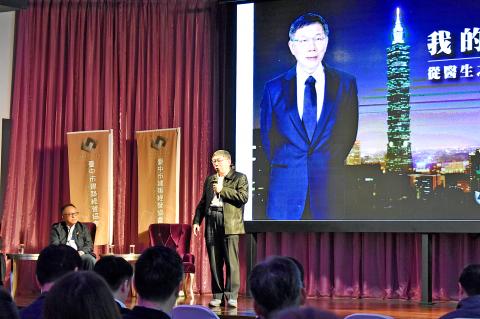
Photo: Chang Jui-chen, Taipei Times
Protecting the well-being of Taiwanese is paramount, Ko said.
“In international politics, we still have to honestly face the problem of how to be strong enough [to assert our interests],” he said.
China can choose to be relentless and bully Taiwan, but Taiwan must be wise and not overexpress certain ideologies, Ko said.
Taiwan would have difficulty negotiating with China if it lacked an undivided leadership, a robust economy and a strong national defense, he said, adding that the government must be practical and count on its strengths.
Ko said he heard a US Department of Defense official ask whether Taiwan had the capability to withstand the first two days of a Chinese attack.
“Taiwan has abolished military conscription and young people are not willing to join the military, so how can we withstand two days of an attack?” Ko said. “We need help from the US, but we need to stop provoking China and build up our nation’s strengths.”
“What is the sense of calling for Taiwanese independence when we abolished compulsory military service?” he said.
Additional reporting by Chang Rui-chen
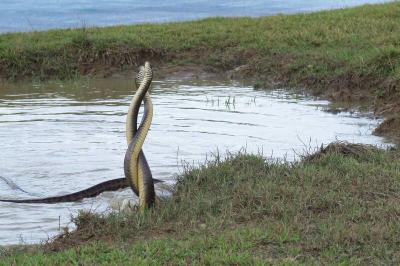
Kenting National Park service technician Yang Jien-fon (楊政峰) won a silver award in World Grand Prix Photography Awards Spring Season for his photograph of two male rat snakes intertwined in combat. Yang’s colleagues at Kenting National Park said he is a master of nature photography who has been held back by his job in civil service. The awards accept entries in all four seasons across six categories: architectural and urban photography, black-and-white and fine art photography, commercial and fashion photography, documentary and people photography, nature and experimental photography, and mobile photography. Awards are ranked according to scores and divided into platinum, gold and

The Chinese Nationalist Party (KMT) caucus yesterday said it opposes the introduction of migrant workers from India until a mechanism is in place to prevent workers from absconding. Minister of Labor Hung Sun-han (洪申翰) on Thursday told the Legislative Yuan that the first group of migrant workers from India could be introduced as early as this year, as part of a government program. The caucus’ opposition to the policy is based on the assessment that “the risk is too high,” KMT caucus secretary-general Lin Pei-hsiang (林沛祥) said. Taiwan has a serious and long-standing problem of migrant workers absconding from their contracts, indicating that

SPACE VETERAN: Kjell N. Lindgren, who helps lead NASA’s human spaceflight missions, has been on two expeditions on the ISS and has spent 311 days in space Taiwan-born US astronaut Kjell N. Lindgren is to visit Taiwan to promote technological partnerships through one of the programs organized by the US for its 250th national anniversary. Lindgren would be in Taiwan from Tuesday to Saturday next week as part of the US Bureau of Educational and Cultural Affairs’ US Speaker Program, organized to celebrate the 250th anniversary of the signing of the Declaration of Independence, the American Institute in Taiwan (AIT) said in a statement yesterday. Lindgren plans to engage with key leaders across the nation “to advance cutting-edge technological partnerships and inspire the next generation of scientists and engineers,”
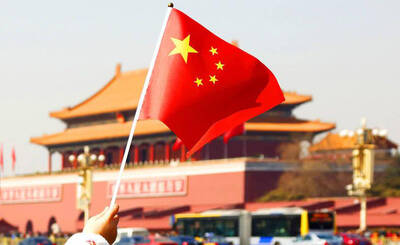
TRADE-OFF: Beijing seeks to trade a bowl of tempura for a Chinese delicacy, an official said, while another said its promises were attempts to interfere in the polls The government must carefully consider the national security implications of building a bridge connecting Kinmen County and Xiamen, China, the Public Construction Commission (PCC) said yesterday. PCC Commissioner Derek Chen (陳金德), who is also a minister without portfolio, made the remarks in a meeting of the legislature’s Transportation Committee, after Democratic Progressive Party Legislator Hsu Fu-kuei (徐富癸) asked about China’s proposal of new infrastructure projects to further connect Kinmen and Lienchiang (Matsu) counties with Xiamen. China unveiled the bridge plan, along with nine other policies for Taiwan, on Sunday, the last day of Chinese Nationalist Party (KMT) Chairwoman Cheng Li-wun’s (鄭麗文) visit


 RSS
RSS