


The executive committee of the US-based Association of State Democratic Committees on Wednesday passed a resolution reaffirming Washington’s commitment to Taiwan on the 40th anniversary of the enactment of the Taiwan Relations Act.
The resolution was passed on the first day of the association’s four-day winter meeting in Washington. The group is comprised of state chairs and vice chairs of Democratic US states.
The Taiwan Relations Act, which was signed into law on April 10, 1979, and the “six assurances” issued by then-US president Ronald Reagan in 1982 have been the cornerstones of US policy toward Taiwan, the committee said.
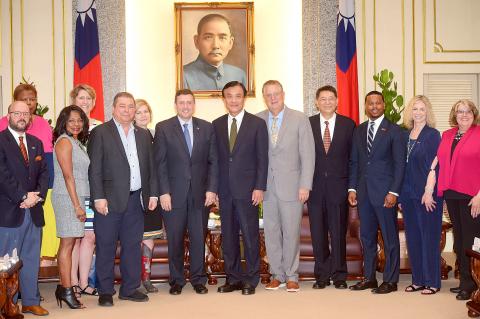
Photo: Huang Yao-cheng, Taipei Times
“The US and Taiwan have forged ever-closer economic and security relations over the last four decades based on their shared commitment to democracy, freedom, the rule of law and free-market principles,” the committee said.
The Taiwan-US partnership is critical for the promotion of prosperity, democratic values and security throughout the Asia-Pacific region, it said.
In the resolution, the committee reaffirmed that the “six assurances” and the Taiwan Relations Act “are and will remain cornerstones of US relations with Taiwan,” adding that it also supports Taiwan’s democracy and freedom, and a robust Taiwan-US partnership through economic, security and cultural ties.
The “six assurances” stipulate that the US would not set a date for ending arms sales to Taiwan; would not alter the Taiwan Relations Act; would not hold consultations with China over arms sales to Taiwan; would not mediate between Taiwan and China; would not pressure Taiwan to negotiate with China; and would not formally recognize Chinese sovereignty over Taiwan.
The Ministry of Foreign Affairs yesterday issued a press release thanking the association for the resolution’s passage, saying that it demonstrates the Democratic Party’s firm support of US-Taiwan relations.
The association has long maintained friendly ties with Taiwan, the ministry said, citing as examples its passage of resolutions supporting Taiwan’s participation at the International Civil Aviation Organization Assembly in 2013 and the World Health Assembly in 2017.
It is the first time the association has passed a resolution regarding the Taiwan Relations Act and the “six assurances,” the ministry said, adding that it carries particular significance given that Taipei and Washington are celebrating the 40th anniversary of the act’s enactment.
Meanwhile, the ministry yesterday also thanked US Indo-Pacific Commander Admiral Philip Davidson for on Tuesday reiterating in a written statement to the US Senate Committee on Armed Services the US’ commitment to Taiwan in accordance with the Taiwan Relations Act.
Davidson also expressed in the statement the US’ concerns about China’s military buildup across the Taiwan Strait, as well as its opaqueness about its military capabilities and capacity, and its unwillingness to preclude the use of force to resolve the cross-strait issue.
He also said that Chinese President Xi Jinping’s (習近平) proposed solution of a “one country, two systems” approach to unification does not reflect the wishes of both nations.
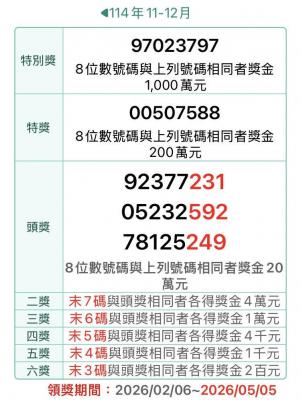
Seven of the 17 NT$10 million (US$311,604) winning receipts from the November-December uniform invoice lottery remain unclaimed as of today, the Ministry of Finance said, urging winners to redeem their prizes by May 5. The reminder comes ahead of the release of the winning numbers for the January-February lottery tomorrow. Among the unclaimed receipts was one for a NT$173 phone bill in Keelung, while others were for a NT$5,913 purchase at Costco in Taipei's Neihu District (內湖), a NT$49 purchase at a FamilyMart in New Taipei City's Tamsui District (淡水), and a NT$500 purchase at a tea shop in New Taipei City's

Taiwanese officials were shown the first of 66 F-16V fighter jets purchased by Taiwan from the United States, the Ministry of National Defense said yesterday, adding the aircraft has completed an initial flight test and is expected to be delivered later this year. A delegation led by Deputy Minister of National Defense Hsu Szu-chien (徐斯儉) visited Lockheed Martin’s F-16 C/D Block 70 (also known as F-16V) assembly line in South Carolina on March 16 to view the aircraft. The jet will undergo a final acceptance flight in the US before being delivered to Taiwan, the
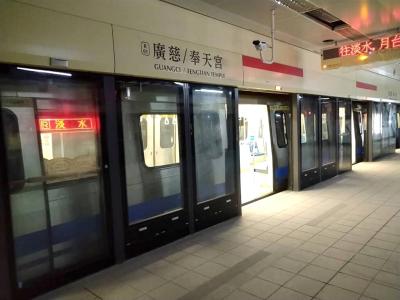
The New Taipei Metro's Sanyin Line and the eastern extension of the Taipei Metro's Tamsui-Xinyi Line (Red Line) are scheduled to begin operations in June, the National Development Council said today. The Red Line, which terminates at Xiangshan Station, would be connected by the 1.4km extension to a new eastern terminal, Guangci/Fengtian Temple Station, while the Sanyin Line would link New Taipei City's Tucheng and Yingge stations via Sanxia District (三峽). The council gave the updates at a council meeting reviewing progress on public construction projects for this year. Taiwan's annual public infrastructure budget would remain at NT$800 billion (US$25.08 billion), with NT$97.3
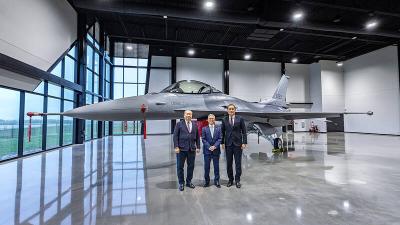
Deliveries of delayed F-16V jets are expected to begin in September, Minister of National Defense Wellington Koo (顧立雄) said today, after senior defense officials visited the US last week. The US in 2019 approved a US$8 billion sale of Lockheed Martin F-16 jets to Taiwan, a deal that would take the nation’s F-16 fleet to more than 200 jets, but the project has been hit by issues including software problems. Koo appeared today before a meeting of the legislature’s Foreign Affairs and National Defense Committee, which is discussing different versions of the special defense budget this week. The committee is questioning officials today,


 RSS
RSS