


National Taiwan University (NTU) president Kuan Chun-ming (管中閔) received about NT$16 million (US$518,925) for illegally working part-time while serving as an Academia Sinica research fellow, NTU professor and minister without portfolio between 2002 and 2015, the Control Yuan said yesterday.
According to NTU regulations, teachers who accept outside jobs without the school’s approval could be fired, suspended, denied a contract renewal or deprived of certain benefits as a punishment, Control Yuan member Wang Yu-ling (王幼玲) told a news conference in Taipei.
The Control Yuan on Jan. 15 voted seven to four to impeach Kuan after an investigation found that he had received NT$50,000 per month for seven years for writing for a column in the Chinese-
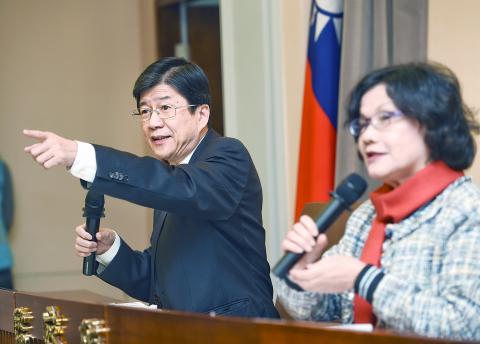
Photo: Fang Pin-chao, Taipei Times
language Next Magazine while serving as a minister.
Under the Public Functionary Service Act (公務員服務法) and Act Governing the Appointment of Educators (教育人員任用條例), civil servants and public-school teachers are banned from accepting other jobs unless approved by their agency or school to prevent distractions from their public duties.
While the Judicial Yuan’s Public Functionary Disciplinary Sanction Commission has yet to decide whether to impeach Kuan, the Control Yuan yesterday announced more findings from its investigation.
While working as a professor at NTU’s Department of Finance from 2009 to 2017, Kuan took on unapproved part-time work at National Chengchi University (NCCU), National Central University (NCU), National Chi Nan University, the Chen-Yung Foundation, Hong Kong-based Next Digital Ltd’s Taiwan subsidiary, the Chung-Hua Institution for Economic Research, the Taiwan Institute of Economic Research, the Taiwan Econometric Research Society, the Cross-strait CEO Summit and Cathay Financial Holding Co, Wang said.
Some of the part-time work, such as that for Next Digital and Cathay Financial Holding, continued during his term as minister without portfolio from 2011 to 2015, but remained unreported, she said.
Kuan received an aggregate NT$7 million from Cathay Financial Holding alone, she said.
Although he worked for the company from 2009 to 2012 and from 2015 to 2017, he had only applied for and been granted permission to work there between 2009 and 2010, she said.
“That he did apply for permission on some occasions, but not others showed that he clearly understood it was required by law,” Control Yuan member Tsai Chung-yi (蔡崇義) said.
During his time at Academia Sinica from 2002 to 2008, Kuan also served as a part-time chair professor at NCCU and NCU, and did paid work for the Chen-Yung Foundation without the institute’s approval, Wang said.
In addition, Kuan in 2007 applied for US$357 from Academia Sinica to cover his three-day trip to China’s Xi’an Jiaotong University, even though the university stated in its invitation letter that it would cover all expenses for food and accommodation during that period, she said.
The Control Yuan has asked Academia Sinica to investigate the matter, she said, adding that it would ask the Ministry of Education to ensure that NTU handles Kuan’s illegal part-time work during his time as professor according to its regulations.
“As university president, Mr Kuan must handle the problems he caused when he was a professor,” she added.
“We are not targeting any individuals,” Tsai said. “Perhaps other people have done the same thing, but high-ranking government officials in particular are expected to obey the law. There would have been no problems if he had followed the law.”
NTU yesterday issued a brief statement saying it would handle the matter according to its regulations.
It added that it is in the process of setting down regulations governing the percentage of income its teachers should share with the university from their approved outside work.
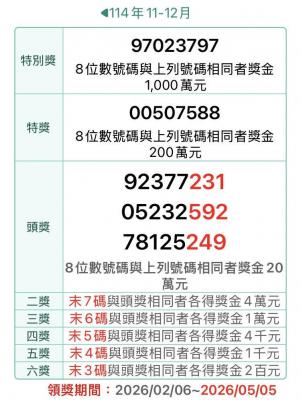
Seven of the 17 NT$10 million (US$311,604) winning receipts from the November-December uniform invoice lottery remain unclaimed as of today, the Ministry of Finance said, urging winners to redeem their prizes by May 5. The reminder comes ahead of the release of the winning numbers for the January-February lottery tomorrow. Among the unclaimed receipts was one for a NT$173 phone bill in Keelung, while others were for a NT$5,913 purchase at Costco in Taipei's Neihu District (內湖), a NT$49 purchase at a FamilyMart in New Taipei City's Tamsui District (淡水), and a NT$500 purchase at a tea shop in New Taipei City's

Taiwanese officials were shown the first of 66 F-16V fighter jets purchased by Taiwan from the United States, the Ministry of National Defense said yesterday, adding the aircraft has completed an initial flight test and is expected to be delivered later this year. A delegation led by Deputy Minister of National Defense Hsu Szu-chien (徐斯儉) visited Lockheed Martin’s F-16 C/D Block 70 (also known as F-16V) assembly line in South Carolina on March 16 to view the aircraft. The jet will undergo a final acceptance flight in the US before being delivered to Taiwan, the
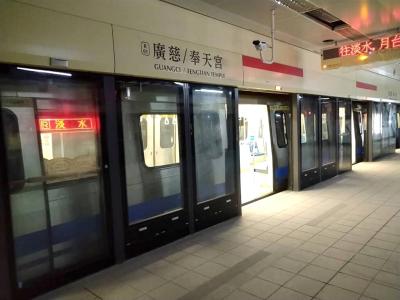
The New Taipei Metro's Sanyin Line and the eastern extension of the Taipei Metro's Tamsui-Xinyi Line (Red Line) are scheduled to begin operations in June, the National Development Council said today. The Red Line, which terminates at Xiangshan Station, would be connected by the 1.4km extension to a new eastern terminal, Guangci/Fengtian Temple Station, while the Sanyin Line would link New Taipei City's Tucheng and Yingge stations via Sanxia District (三峽). The council gave the updates at a council meeting reviewing progress on public construction projects for this year. Taiwan's annual public infrastructure budget would remain at NT$800 billion (US$25.08 billion), with NT$97.3
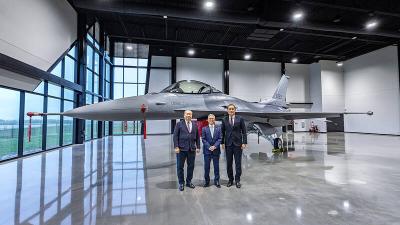
Deliveries of delayed F-16V jets are expected to begin in September, Minister of National Defense Wellington Koo (顧立雄) said today, after senior defense officials visited the US last week. The US in 2019 approved a US$8 billion sale of Lockheed Martin F-16 jets to Taiwan, a deal that would take the nation’s F-16 fleet to more than 200 jets, but the project has been hit by issues including software problems. Koo appeared today before a meeting of the legislature’s Foreign Affairs and National Defense Committee, which is discussing different versions of the special defense budget this week. The committee is questioning officials today,


 RSS
RSS